How to Use the Speed Converter
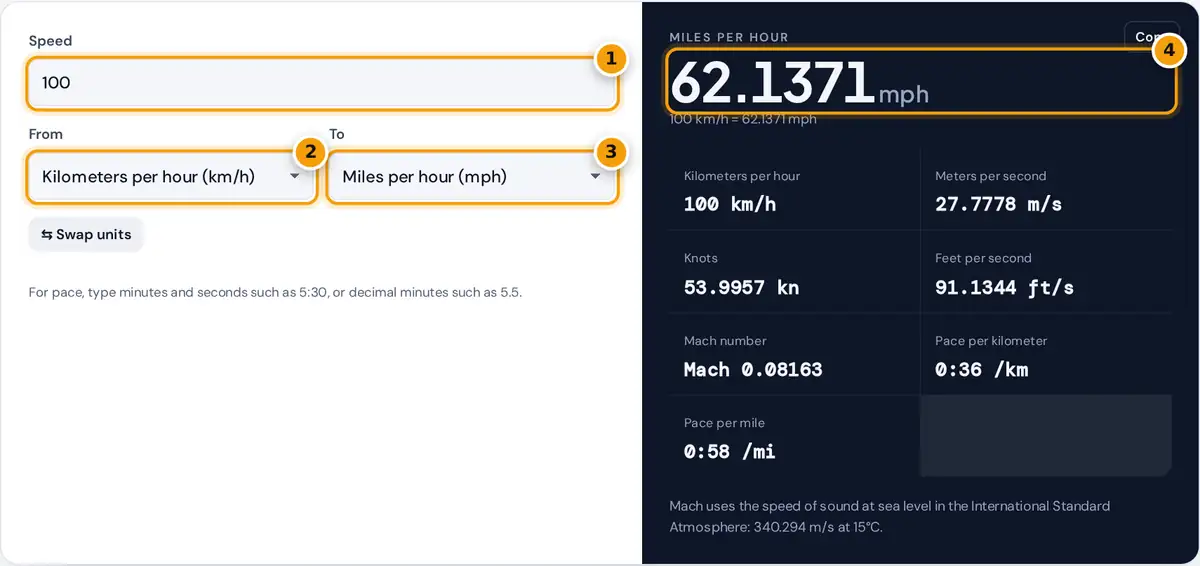
- Type a speed, or a pace such as 5:30 when converting from pace.
- Choose the unit you have.
- Choose the unit you want.
- Read the result, with all other speed and pace units listed below.
Type a speed, pick the unit it is in under From and the unit you want under To. The answer appears in large type and every other unit is listed below it, so one entry gives you km/h, mph, m/s, knots, ft/s, Mach and pace together. Swap units reverses the conversion and carries the result across.
Runners and walkers can choose a pace unit instead. Type the pace as minutes and seconds, such as 5:30 for five and a half minutes per kilometer, and the converter shows the matching speed and the pace per mile.
Speed Conversion Factors
Every factor comes from an exact definition. The international mile is 1,609.344 m, the nautical mile is 1,852 m and the foot is 0.3048 m, so conversions between these units have no rounding apart from the displayed digits.
1 mph = 1,609.344 m ÷ 3,600 s = 0.44704 m/s = 1.609344 km/h
1 knot = 1,852 m ÷ 3,600 s = 0.514444 m/s
1 ft/s = 0.3048 m/s
pace (min/km) = 60 ÷ speed (km/h)
Worked Example
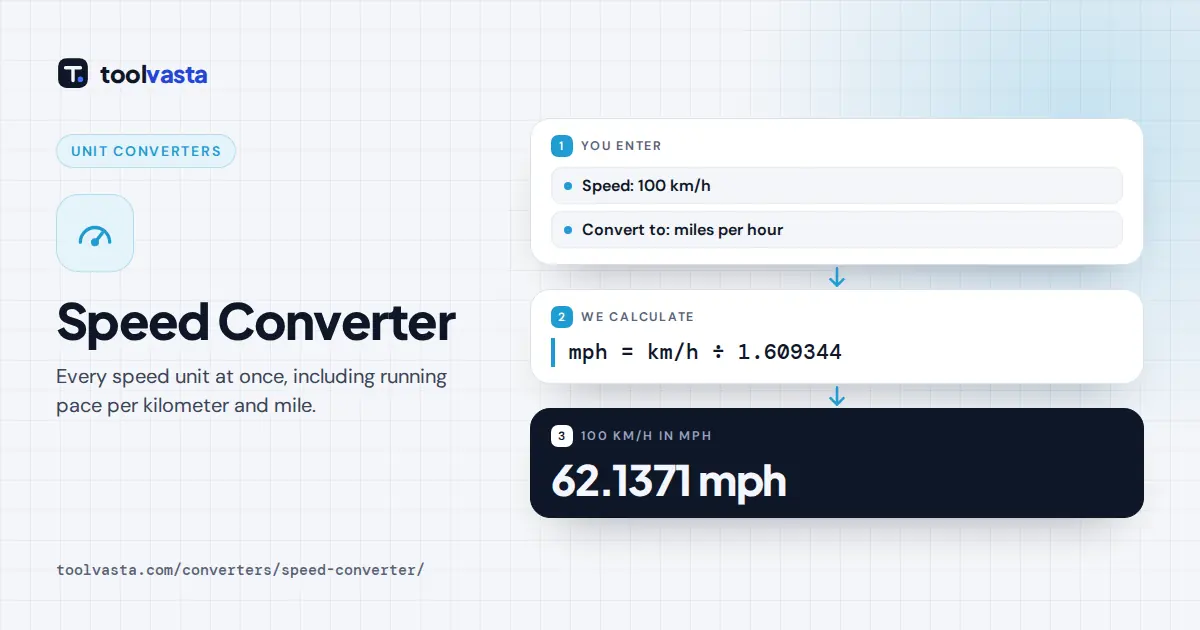
A highway limit of 100 km/h is 100 ÷ 1.609344 = 62.137 mph, or 27.778 m/s. The US speed of 65 mph is 104.607 km/h. A runner holding 5:30 per kilometer is moving at 60 ÷ 5.5 = 10.909 km/h, which is 6.779 mph or a pace of 8:51 per mile.
Speed Conversion Table
| km/h | mph | m/s | knots | Pace /km |
|---|---|---|---|---|
| 5 | 3.107 | 1.389 | 2.700 | 12:00 |
| 10 | 6.214 | 2.778 | 5.400 | 6:00 |
| 12 | 7.456 | 3.333 | 6.479 | 5:00 |
| 20 | 12.427 | 5.556 | 10.799 | 3:00 |
| 30 | 18.641 | 8.333 | 16.199 | 2:00 |
| 50 | 31.069 | 13.889 | 26.998 | 1:12 |
| 80 | 49.710 | 22.222 | 43.197 | 0:45 |
| 100 | 62.137 | 27.778 | 53.996 | 0:36 |
| 120 | 74.565 | 33.333 | 64.795 | 0:30 |
| 1,000 | 621.371 | 277.778 | 539.957 | 0:04 |
Where Each Unit Is Used
- km/h: road signs and car speedometers in Canada and most of the world.
- mph: roads in the United States and the United Kingdom.
- m/s: physics, engineering and wind speed in scientific data.
- Knots: aviation and marine navigation, where distances are in nautical miles.
- ft/s: ballistics and some engineering fields in North America.
- Mach: aircraft speed relative to the speed of sound.
- Pace: running, walking and rowing, where time per distance is easier to plan with.
About Mach Numbers
Mach 1 is the local speed of sound, which falls as air gets colder. This converter uses the standard sea-level value of 340.294 m/s at 15°C, so Mach 1 shows as 1,225.06 km/h or 761.21 mph. At the cruising altitude of airliners, around 11,000 m, the air is about −56.5°C and Mach 1 is only about 295 m/s, so treat Mach results as a sea-level reference.
Quick Mental Math
To estimate mph from km/h, multiply by 0.6 and add a little. To go from m/s to km/h, multiply by 3.6 exactly. Knots are about 15% faster than mph, and a pace of 6:00 per kilometer is exactly 10 km/h.
Speed Limits Across the Border
Drivers crossing between Canada and the US switch between km/h and mph. Common Canadian limits of 50, 80, 100 and 110 km/h are 31.1, 49.7, 62.1 and 68.4 mph. Common US limits of 25, 55, 65 and 70 mph are 40.2, 88.5, 104.6 and 112.7 km/h. Many speedometers show both scales, but the converter is handy when planning a trip or reading signs in a rental car set to the other unit.
Pace and Race Times
Pace makes race planning simple: multiply the pace by the distance. At 5:30 per kilometer, a 10 km race takes 55 minutes and a half marathon of 21.0975 km takes 1 hour 56 minutes. To compare with a treadmill set in mph, convert the pace here: 5:30 per kilometer is about 6.8 mph.
Cyclists can use the same pace units, although speed in km/h or mph is more common on bike computers.
Frequently asked questions
How do I convert km/h to mph?
Divide kilometers per hour by 1.609344, or multiply by 0.621371. So 100 km/h is about 62.14 mph. The factor is exact because the international mile is defined as exactly 1,609.344 meters.
How do I convert m/s to km/h?
Multiply meters per second by 3.6, because one hour has 3,600 seconds and one kilometer has 1,000 meters. For example, 10 m/s is exactly 36 km/h, and 27.78 m/s is about 100 km/h.
What speed is a 5 minute per km pace?
A pace of 5:00 per kilometer is 12 km/h, because 60 minutes divided by 5 equals 12. That is about 7.46 mph, or a pace of about 8:03 per mile.
How fast is Mach 1?
At sea level in the standard atmosphere, Mach 1 is 340.294 meters per second, which is about 1,225 km/h or 761 mph. The speed of sound drops in colder air, so it is lower at high altitude.
How many mph is a knot?
One knot is about 1.15078 mph, or exactly 1.852 km/h. Knots measure nautical miles per hour and are used in aviation and marine navigation. So 20 knots is about 23.02 mph.
Is ft/s the same as fps?
Yes. Feet per second is often abbreviated fps or ft/s, for example in projectile speeds. One foot per second is exactly 0.3048 meters per second, or about 0.6818 mph.