How to Use the Pressure Altitude Calculator
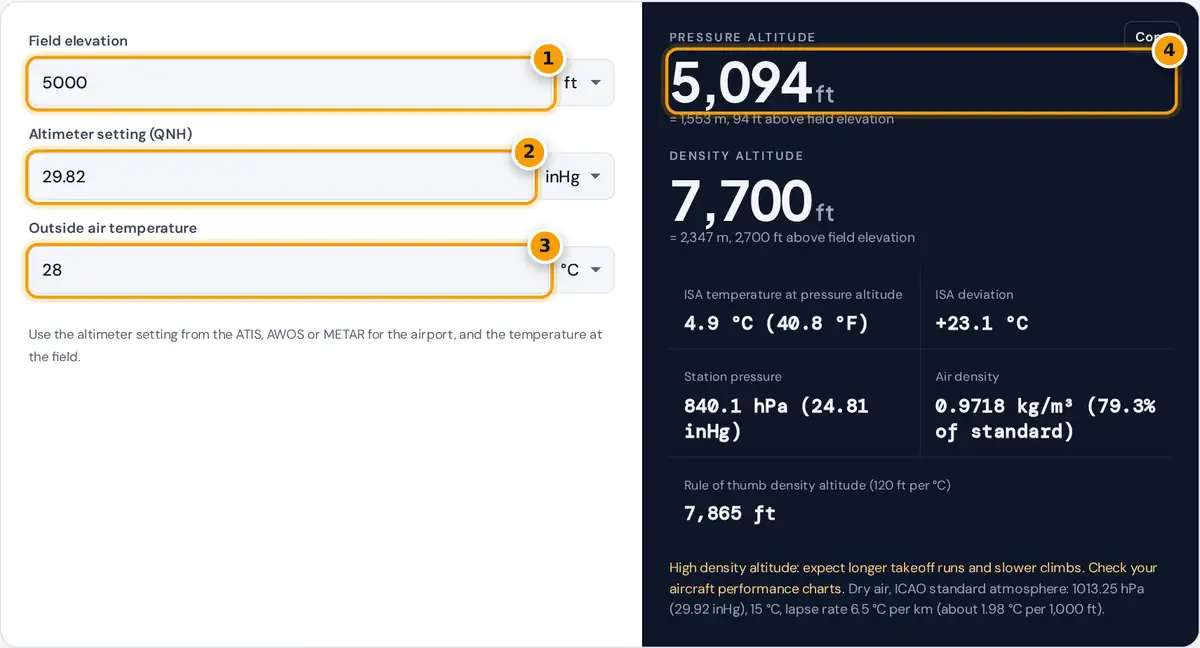
- Enter the field elevation in feet or meters.
- Enter the altimeter setting from the ATIS, AWOS or METAR, in inHg or hPa.
- Enter the outside air temperature in °C or °F.
- Read the pressure altitude, then the density altitude and ISA details below.
Enter the field elevation, the current altimeter setting and the outside air temperature. Each input has a unit menu: feet or meters for elevation, inches of mercury or hectopascals for the altimeter setting, and Celsius or Fahrenheit for temperature. Changing a unit converts the value you typed. The result shows pressure altitude and density altitude, plus the ISA temperature, the deviation from standard, the station pressure, the air density and the common rule of thumb estimate for comparison.
Pressure Altitude and Density Altitude
Pressure altitude is the height in the International Standard Atmosphere (ISA) at which the standard pressure equals the pressure at your location. It is what an altimeter reads when set to 29.92 inHg or 1013.25 hPa, and flight levels are pressure altitudes. When the altimeter setting is lower than standard, pressure altitude is higher than field elevation.
Density altitude is pressure altitude corrected for temperature. It is the ISA height at which the air has the same density as the air around you. Engines, propellers and wings respond to air density, so aircraft performance charts depend on density altitude. Hot days at high airports can push density altitude thousands of feet above the field.
The Formulas
Station pressure = 1013.25 × (1 − PA ÷ 44,330.77 m)5.25588 hPa
ISA temperature = 15 − 0.0065 × PA (m) °C
Air density ρ = P ÷ (287.05 × TK)
Density altitude = 44,330.77 m × (1 − (ρ ÷ 1.225)0.234969)
The constants come from the ICAO standard atmosphere: sea level pressure 1013.25 hPa, temperature 288.15 K, lapse rate 0.0065 K per meter, and a sea level density of 1.225 kg/m³. 44,330.77 m is 288.15 ÷ 0.0065, and the exponent 0.190263 is the gas constant times the lapse rate divided by gravity. Common pilot shortcuts are 1,000 ft per inch of mercury (about 27 ft per hPa) for pressure altitude, and 120 ft per degree Celsius above ISA for density altitude.
Worked Example
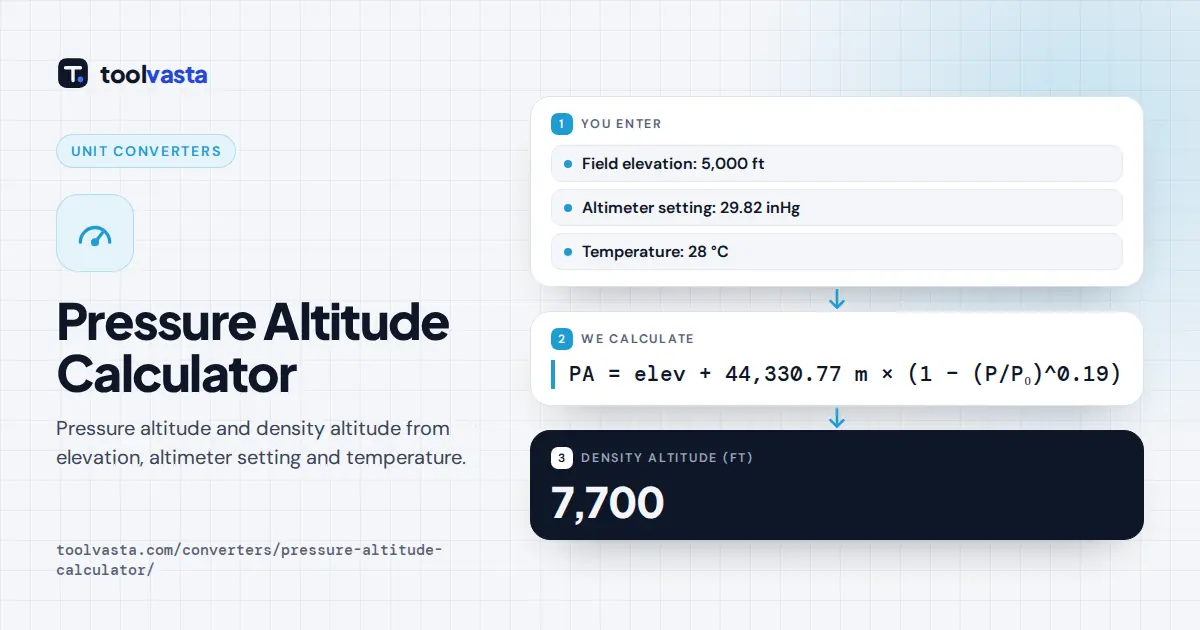
An airport sits at 5,000 ft with an altimeter setting of 29.82 inHg and a temperature of 28 °C. The shortcut gives 5,000 + (29.92 − 29.82) × 1,000 = 5,100 ft; the exact ISA formula gives a pressure altitude of 5,094 ft. The standard temperature at that altitude is 15 − 1.98 × 5.094 = 4.9 °C, so the day is 23.1 °C warmer than standard.
The station pressure is 840.1 hPa and the air density is 0.9718 kg/m³, about 79% of the sea level standard. That density matches the ISA at a density altitude of 7,700 ft. The 120 ft per degree rule of thumb gives 5,094 + 120 × 23.1 = 7,865 ft, close but a little high.
ISA Reference Values
| Pressure altitude | ISA temperature | Pressure |
|---|---|---|
| 0 ft | 15.0 °C | 1013.25 hPa (29.92 inHg) |
| 2,000 ft | 11.0 °C | 942.1 hPa (27.82 inHg) |
| 4,000 ft | 7.1 °C | 875.1 hPa (25.84 inHg) |
| 6,000 ft | 3.1 °C | 812.0 hPa (23.98 inHg) |
| 8,000 ft | −0.8 °C | 752.6 hPa (22.22 inHg) |
| 10,000 ft | −4.8 °C | 696.8 hPa (20.58 inHg) |
A quick way to read the table: pressure falls by about 1 inch of mercury, or roughly 34 hPa, for each 1,000 ft in the lower atmosphere, and the standard temperature falls by about 2 °C. When the outside temperature is well above the ISA value for your pressure altitude, density altitude will be noticeably higher.
Limits
- The calculation assumes dry air. Humid air is slightly less dense, which raises density altitude a little further, often by a few hundred feet on hot, humid days.
- Use the aircraft flight manual or pilot operating handbook for takeoff, climb and landing performance. This tool helps you check the inputs to those charts; it does not replace them.
- Altimeter settings are reduced to sea level by the reporting station. Very cold or very hot conditions make true altitude differ from indicated altitude, which is a separate correction.
The Federal Aviation Administration and Transport Canada both publish guidance on density altitude and its effect on aircraft performance.
Frequently asked questions
How do I calculate pressure altitude?
Subtract the altimeter setting from 29.92 inHg, multiply by 1,000 and add the result to field elevation. At 5,000 ft with 29.82 inHg that gives about 5,100 ft. The exact ISA formula used here gives 5,094 ft.
What is density altitude?
Density altitude is the altitude in the standard atmosphere where air density equals the density at your location. It rises on hot days and at high elevations, and aircraft take off and climb as if they were at that higher altitude.
What is the rule of thumb for density altitude?
Add about 120 ft to pressure altitude for every degree Celsius the temperature is above the ISA standard. The ISA standard is 15 °C at sea level, falling about 2 °C per 1,000 ft.
What is the standard temperature at altitude?
In the International Standard Atmosphere it is 15 °C at sea level and decreases by 6.5 °C per kilometer, about 1.98 °C per 1,000 ft. At 5,000 ft the standard temperature is about 5.1 °C.
Why does high density altitude matter?
Thinner air reduces engine power, propeller thrust and wing lift at the same indicated airspeed. Takeoff runs get longer and climb rates fall, which is why pilots check density altitude before departing from hot or high airports.
How do I convert hPa to inHg?
Divide hectopascals by 33.8639 to get inches of mercury, or multiply inHg by 33.8639 to get hPa. Standard pressure is 1013.25 hPa, which equals 29.92 inHg.