How to Use the Humidex Calculator
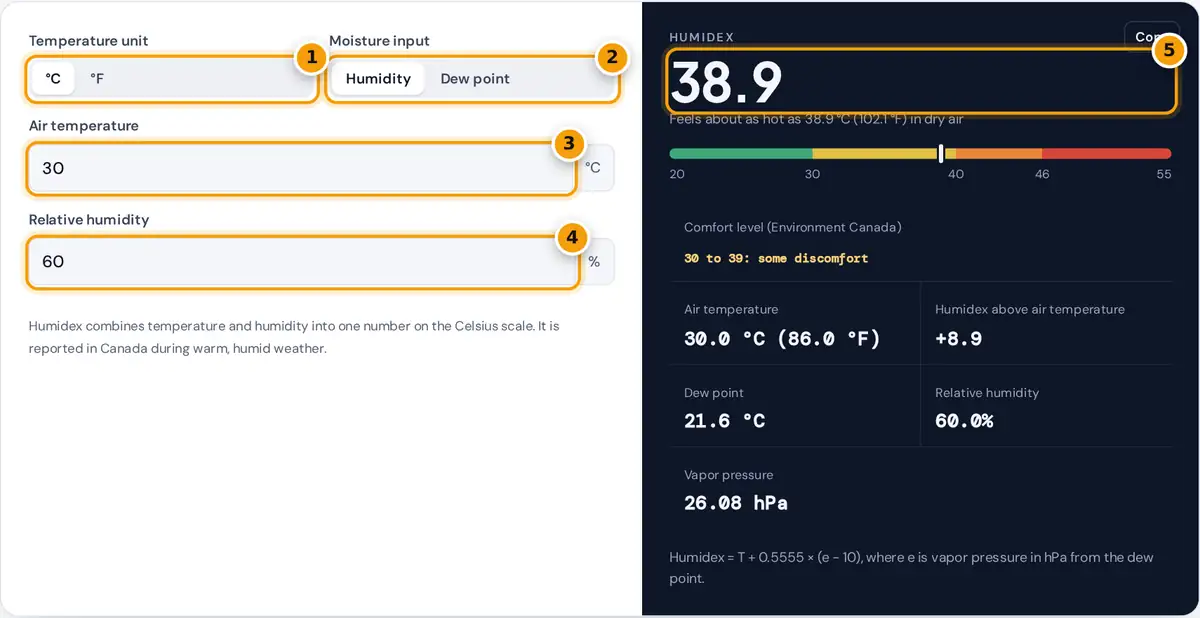
- Choose Celsius or Fahrenheit.
- Choose whether to enter relative humidity or the dew point.
- Enter the air temperature.
- Enter the relative humidity in percent.
- Read the humidex and its Environment Canada comfort level on the scale.
Choose Celsius or Fahrenheit, then enter the air temperature. For moisture you can use either the relative humidity, which most home weather stations show, or the dew point, which Environment and Climate Change Canada reports in its hourly observations. The result shows the humidex, a marker on the comfort scale, the Environment Canada comfort level and the dew point, humidity and vapor pressure behind the number.
What Humidex Means
Humidex is a Canadian index that describes how hot and humid weather feels to the average person. It was developed by Canadian meteorologists in the 1960s and is still used in Environment Canada forecasts and heat warnings. Humid air slows the evaporation of sweat, which is how the body cools itself, so a humid 30 °C day feels hotter than a dry one. Humidex expresses that as a single number on the Celsius scale. It has no unit of its own, but you can read it as a rough “feels like” temperature.
The Humidex Formula
e = 6.11 × exp(5417.7530 × (1 ÷ 273.16 − 1 ÷ Td,K)) hPa
with relative humidity: e = RH ÷ 100 × 6.11 × exp(5417.7530 × (1 ÷ 273.16 − 1 ÷ TK))
T is the air temperature in degrees Celsius, Td,K is the dew point in kelvin and e is the water vapor pressure in hectopascals. When you enter relative humidity, the calculator finds the vapor pressure from the same saturation curve at the air temperature and multiplies it by the humidity fraction, then reports the matching dew point.
Worked Example
Take 30 °C air with a dew point of 15 °C. The dew point is 288.15 K, so e = 6.11 × exp(5417.7530 × (1/273.16 − 1/288.15)) = 17.14 hPa. Humidex = 30 + 0.5555 × (17.14 − 10) = 34.0, which falls in the “some discomfort” band.
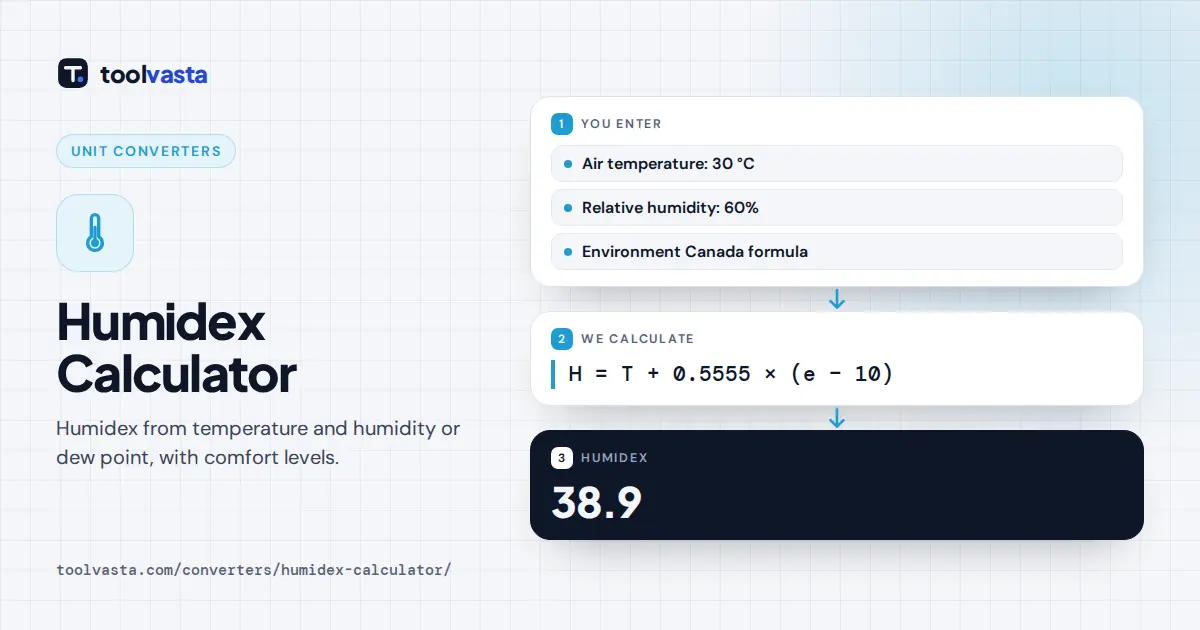
With 30 °C and 60% relative humidity, the vapor pressure is 26.08 hPa, the dew point is 21.6 °C and the humidex is 38.9, just below the “great discomfort” range. At 35 °C with a dew point of 25 °C the humidex reaches 47.3, which Environment Canada classes as dangerous.
Humidex Comfort Levels
| Humidex | Degree of comfort |
|---|---|
| 20 to 29 | Little or no discomfort |
| 30 to 39 | Some discomfort |
| 40 to 45 | Great discomfort; avoid exertion |
| Above 45 | Dangerous; heat stroke possible |
These ranges follow the comfort scale published by Environment and Climate Change Canada. Local heat warning criteria differ by region and also consider overnight temperatures, so check current alerts on the official Government of Canada weather site.
Reading Humidex in Forecasts
Canadian forecasts give the expected daytime high and, when it is relevant, the humidex value for the afternoon. Observations at weather stations are updated hourly, so the humidex can rise through the day as the temperature climbs even when the dew point stays steady. Use the dew point option with an official observation to reproduce the published figure. Evenings matter too: if the dew point stays high, the night stays muggy and the body has less chance to recover, which is why heat warnings also look at overnight conditions.
Humidex and the Heat Index
The heat index used in the United States answers the same question with a different method and reports the result in Fahrenheit. The two numbers are not interchangeable: for the same conditions the humidex is usually a few degrees higher when both are expressed in Celsius. If you compare readings from Canadian and American sources, compare like with like.
Tips and Limits
- Humidex assumes shade and light wind. Direct sun can make conditions feel several degrees hotter.
- Children, older adults, outdoor workers and people with some health conditions are more sensitive to heat. Drink water, take breaks in the shade and follow public health advice during heat events.
- In cool or very dry air, the formula can return a humidex at or below the air temperature. Humidex is only meaningful in warm weather.
Frequently asked questions
How is humidex calculated?
Humidex equals the air temperature in Celsius plus 0.5555 times the vapor pressure minus 10, where vapor pressure in hectopascals comes from the dew point. At 30 °C with a 15 °C dew point the humidex is 34.
What humidex is dangerous?
Environment Canada describes a humidex above 45 as dangerous, with heat stroke possible. From 40 to 45 there is great discomfort and people should avoid exertion. From 30 to 39 most people feel some discomfort.
Is humidex the same as the heat index?
No. Both describe how hot humid air feels, but humidex is the Canadian index on the Celsius scale while the US heat index uses a different formula and Fahrenheit. For the same weather the numbers usually differ.
Do I need dew point or humidity for humidex?
Either works. The official formula uses the dew point, but you can enter relative humidity instead. The calculator turns humidity into vapor pressure and dew point using the same equation, so both routes agree.
Does humidex have a unit?
Officially humidex is a dimensionless number, but it is designed to be read like a Celsius temperature. A humidex of 38 means the weather feels roughly like 38 °C in dry air.
Why is humidex lower than the temperature?
When the air is dry, the vapor pressure is below 10 hectopascals, so the formula subtracts a little from the temperature. Humidex is only reported in warm, humid conditions, where it is higher than the temperature.