How to Use the Kg to Lbs Converter
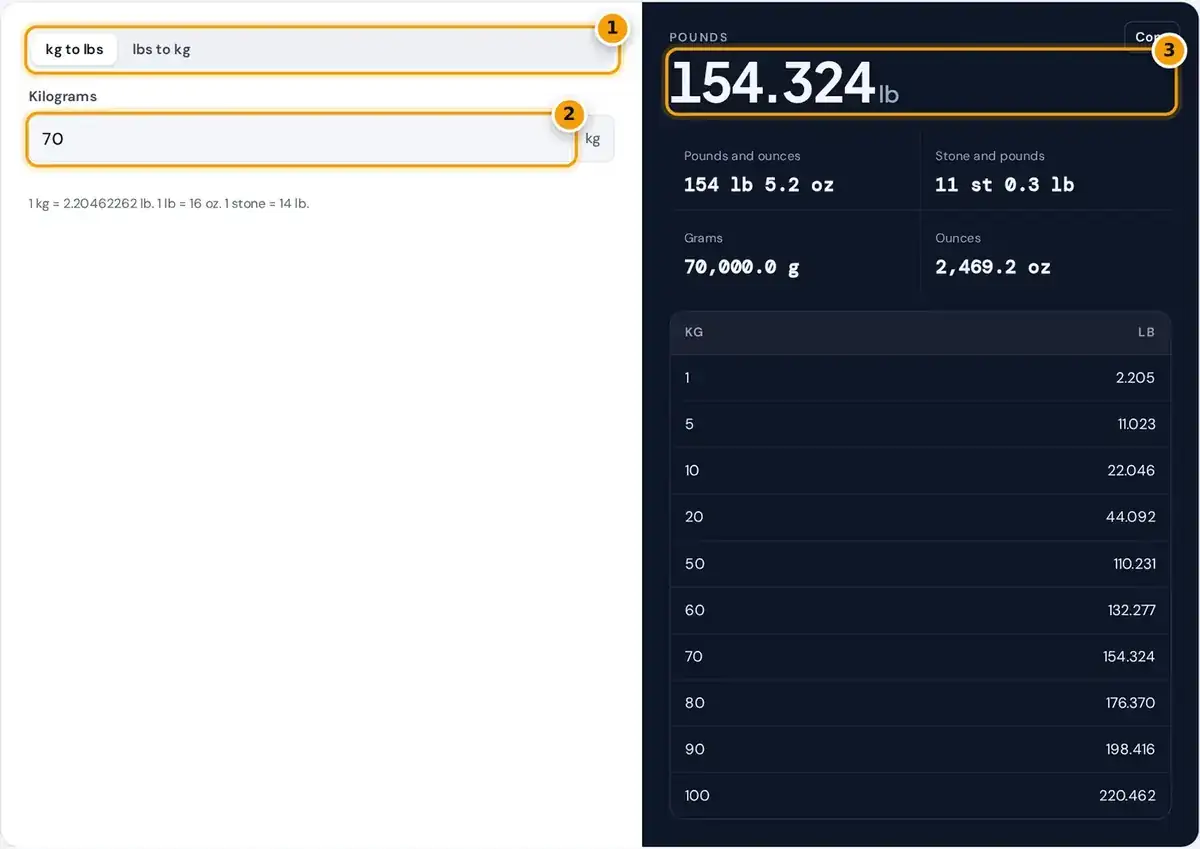
- Choose kg to lbs, or lbs to kg.
- Enter the weight in kilograms.
- Read pounds, then pounds and ounces, stone and grams underneath.
Leave the direction on kg to lbs and type a weight in kilograms. The result shows decimal pounds, plus pounds and ounces, stone and pounds, grams and total ounces, all updated live as you type.
To go the other way, switch to lbs to kg and enter pounds, ounces or both. This makes it easy to convert a baby's weight or a shipping parcel label written as pounds and ounces.
A reference table under the result lists common values in the direction you picked. Press Copy to grab a one line summary, such as 70 kg equals 154.324 lb, ready to paste into any document.
Kg to Lbs Formula
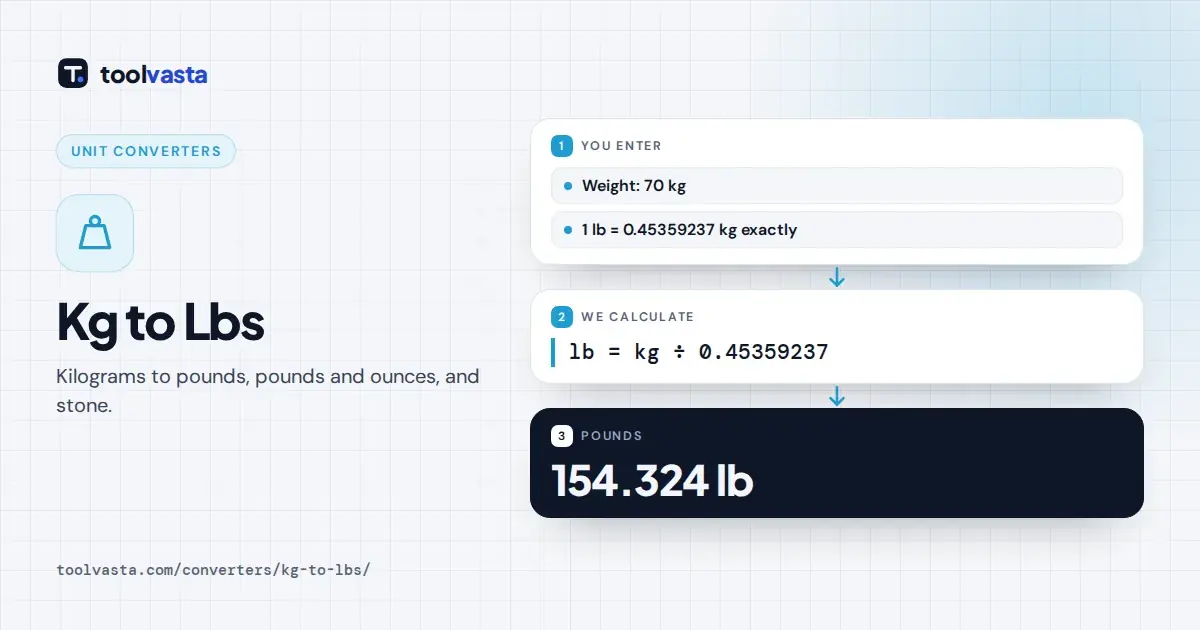
The conversion factor is fixed by international definition: one pound is exactly 0.45359237 kilograms. To turn kilograms into pounds, divide by that number, or multiply by its inverse, which is about 2.20462262 pounds per kilogram.
kg = lb × 0.45359237
ounces = decimal part of lb × 16
For a worked example, 70 kg divided by 0.45359237 is 154.324 lb. The decimal part, 0.324 lb, times 16 gives 5.2 oz, so 70 kg is 154 lb 5.2 oz, or 11 stone 0.3 lb.
Going the other way round, 150 lb times 0.45359237 is 68.039 kg. Because the factor is exact, as listed in the NIST conversion factors, any rounding comes only from the number of decimal places displayed.
Kilogram and Pound Definitions
The kilogram is the SI unit of mass and the base of the metric system. Since 2019 it has been defined by fixing the Planck constant, as described in the official SI base units guide.
The international pound, also called the avoirdupois pound, was agreed by the United States, Canada, the United Kingdom and other countries in 1959. It was then defined as exactly 0.45359237 kilograms from that point on.
The symbol lb comes from the Latin libra, an ancient Roman unit of weight. The pound is still used in US customary and British imperial measures, and Canadians often use both units in daily life.
Kg to Lbs Conversion Table
This conversion table covers the most common values. Pounds are rounded to three decimals, and the lb and oz column rounds ounces to one decimal, the same way the result panel of the converter does.
| kg | lb | lb and oz |
|---|---|---|
| 1 | 2.205 | 2 lb 3.3 oz |
| 5 | 11.023 | 11 lb 0.4 oz |
| 10 | 22.046 | 22 lb 0.7 oz |
| 25 | 55.116 | 55 lb 1.8 oz |
| 50 | 110.231 | 110 lb 3.7 oz |
| 75 | 165.347 | 165 lb 5.6 oz |
| 100 | 220.462 | 220 lb 7.4 oz |
To read a value not listed, scale a row. Since the conversion is linear, 200 kg is twice 100 kg, or 440.925 lb, and 2.5 kg is half of 5 kg, or about 5.51 lb.
The converter also shows its own table under the result, with rows for 1 to 100 kg or 1 to 250 lb. That table flips automatically when you change the conversion direction at the top.
Pounds and Ounces to Kilograms
One pound has 16 ounces, and one ounce is about 28.35 grams. A whole pound is 453.592 grams, so converting mixed pounds and ounces starts by turning ounces into a decimal fraction of a pound.
For example, 7 lb 8 oz is 7.5 lb, because 8 divided by 16 is 0.5. Then 7.5 times 0.45359237 gives 3.402 kg. The converter does this in one step when you enter both boxes.
A birth weight works the same way in reverse. A baby weighing 3,400 g is 3.4 kg, which is 7.496 lb, or 7 lb 7.9 oz, the format many families still use when sharing news.
Stone, Pounds and Ounces
In the UK and Ireland, body weight is still often given in stone and pounds, not kilograms. One stone equals 14 pounds, or exactly 6.35029318 kg, because it is defined through the same international pound.
To convert kilograms to stone, convert to pounds first, then divide by 14. The whole number is the stone and the remainder is pounds, so 154.3 lb becomes 11 stone and 0.3 lb left over.
The result panel shows stone and pounds for every entry, whichever direction you choose. That helps when a scale, a medical form or a fitness app uses a unit different from the one you know.
Common Uses
Kilograms and pounds meet in a great many everyday situations, especially in Canada, where official measures are metric but many people still think in pounds. The common examples below all use the exact conversion factor.
- Body weight: 70 kg is about 154.3 lb.
- Baggage allowance: a 23 kg checked bag limit is about 50.7 lb.
- Gym weights: a 20 kg Olympic bar is about 44.1 lb.
- Shopping: a price per kilogram times 0.4536 gives the price per pound.
Airlines usually state bag limits in both units, but the pound figure is often rounded. Converting the exact kilogram limit before you pack avoids a surprise fee at the counter for just a few ounces.
Parcel carriers also price shipments by weight bands. Knowing the kilogram weight of a parcel before you ship helps you stay under a weight break, especially for international mail that often uses metric units only.
Mass Versus Weight
Strictly, kilograms measure mass, the amount of matter in an object. Weight is the force gravity puts on that mass, so an astronaut has the same mass on the Moon but a much smaller weight.
The pound actually has two different versions. The pound of mass, sometimes written lbm, is the unit this converter uses. The pound-force, written lbf, is a unit of force used in engineering and physics calculations.
Everyday scales, food labels and shipping forms treat pounds as mass, so the kg to lbs conversion is identical anywhere on Earth. Local differences in gravity never change the numbers shown in this converter tool.
Quick Mental Math
For mental math, double the kilograms and add 10% of the result. For 70 kg, double to get 140, then add 14 for 154 lb. The exact answer is 154.32 lb, so this works well.
The approximation multiplies by 2.2 instead of 2.2046, so the result is about 0.2% too low. That is close enough for a quick sense of a weight, but not for medicine doses or shipping labels.
For pounds to kilograms, halve the pounds and then subtract 10% of that result. For 150 lb, half is 75, minus 7.5 is 67.5 kg, which is fairly close to the exact answer, 68.04 kg.
Frequently asked questions
How many pounds are in a kilogram?
One kilogram is about 2.20462 pounds. The exact relationship is that one pound equals 0.45359237 kilograms, so dividing any kilogram value by 0.45359237 gives pounds.
What is 70 kg in pounds?
70 kg is about 154.32 lb, which is 154 lb 5.2 oz. In stone and pounds, that is 11 stone 0.3 lb, the format common in the UK and Ireland.
How many kg is 150 lbs?
150 lb is 68.039 kg. Multiply the pounds by 0.45359237 to convert to kilograms, or use the lbs to kg direction in the converter above.
Is the conversion factor exact?
Yes. Since 1959 the international pound has been defined as exactly 0.45359237 kg, so the only rounding comes from how many decimal places are shown in the result.
How do I convert kg to stone?
Convert to pounds first, then divide by 14. The whole number is stone and the remainder is pounds. For example, 70 kg is 154.3 lb, which is 11 stone 0.3 lb.
Which countries use pounds?
The United States uses pounds for most everyday weights. The UK uses kilograms officially but stone and pounds for body weight, and many Canadians use both units depending on the setting.