How to Use the Crosswind Calculator
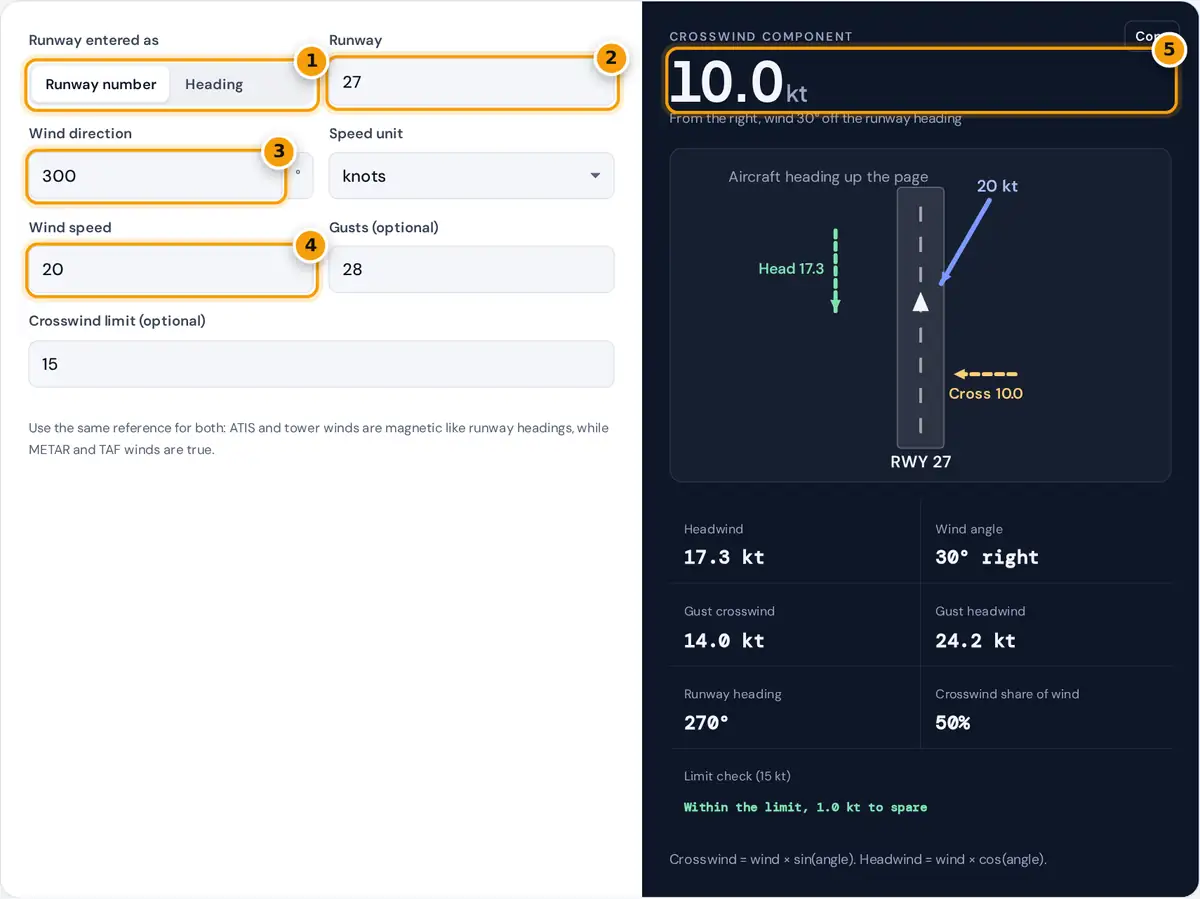
- Choose whether to enter a runway number or an exact heading.
- Enter the runway, such as 27 or 09L.
- Enter the wind direction in degrees.
- Enter the wind speed and any gusts, then an optional crosswind limit.
- Read the crosswind, then the headwind, gust values and limit check.
Enter the runway as a runway number, such as 27 or 09L, or switch to Heading and type the exact heading in degrees. Then enter the wind direction and speed from the ATIS, tower or weather report, and the gust value if one is reported. Choose knots, mph, km/h or m/s; the components come out in the same unit. Add your aircraft’s maximum demonstrated crosswind or your personal limit to see whether the gusts stay within it.
The diagram shows the runway with the aircraft heading up the page. The blue arrow is the wind, the dashed yellow arrow is the crosswind component and the dashed green arrow is the headwind or tailwind component.
The Crosswind Formula
Crosswind = wind speed × sin(wind angle)
Headwind = wind speed × cos(wind angle)
A negative headwind is a tailwind
The wind is split into two parts at right angles: one blowing straight down the runway and one blowing across it. Trigonometry gives each part from the angle between the wind and the runway. A wind 30° off the runway puts half its strength across the runway, because sin 30° = 0.5. At 60° it is about 87%, and at 90° all of the wind is crosswind.
Worked Example
You are landing on runway 27, heading 270°, and the wind is 300° at 20 knots gusting 28. The wind angle is 300 − 270 = 30° from the right. The crosswind is 20 × sin 30° = 10.0 knots and the headwind is 20 × cos 30° = 17.3 knots. In the gusts the crosswind reaches 28 × 0.5 = 14.0 knots, with a headwind of 24.2 knots. Against a 15 knot crosswind limit, that leaves 1.0 knot of margin.
Clock Method Quick Reference
Many pilots estimate crosswind in their head with the clock method: treat the wind angle as minutes on a clock face and take that fraction of an hour as the share of the wind that is crosswind. The exact sine values are below.
| Wind angle | Clock method | Exact crosswind share | Exact headwind share |
|---|---|---|---|
| 10° | 1/6 | 17% | 98% |
| 20° | 1/3 | 34% | 94% |
| 30° | 1/2 | 50% | 87% |
| 45° | 3/4 | 71% | 71% |
| 60° or more | All | 87% to 100% | 50% to 0% |
Why the Components Matter
The headwind component shortens takeoff and landing distances because the aircraft reaches flying speed at a lower groundspeed. A tailwind does the opposite and can lengthen the ground roll considerably. The crosswind component decides how much correction is needed to keep the aircraft aligned with the centerline, and it is the figure compared with the maximum demonstrated crosswind in the flight manual. When an airport has several runways, compute the components for each and choose the runway with the most headwind and the least crosswind that suits your aircraft and experience.
Magnetic and True Headings
Runway numbers are the magnetic heading rounded to the nearest 10° and divided by 10. Winds from ATIS, AWOS broadcasts and the tower are usually given relative to magnetic north so they can be compared directly with the runway. Winds in METAR and TAF reports are relative to true north. Where the magnetic variation is large, convert one of them before calculating, or use the exact runway heading from the airport diagram.
Tips and Limits
- The maximum demonstrated crosswind in an aircraft manual is the value tested during certification. It is not necessarily a structural limit, but many pilots and operators treat it as one.
- Plan with the gust value, not the steady wind. Gusts can change both speed and direction quickly near the ground.
- For a tailwind, check the runway in the opposite direction. Most aircraft performance charts allow only a small tailwind component on takeoff and landing.
Frequently asked questions
How do I calculate the crosswind component?
Find the angle between the wind direction and the runway heading, then multiply the wind speed by the sine of that angle. A 20 knot wind 30 degrees off the runway gives 20 times 0.5, which is a 10 knot crosswind.
How do I calculate the headwind component?
Multiply the wind speed by the cosine of the angle between the wind and the runway. A 20 knot wind at 30 degrees gives 20 times 0.866, about 17.3 knots of headwind. A negative result means a tailwind.
What is the clock method for crosswind?
Treat the wind angle as minutes on a clock. At 15 degrees, a quarter of the wind is crosswind; at 30 degrees, half; at 45 degrees, three quarters; at 60 degrees or more, all of it. It slightly overestimates small angles.
Should I use the gust speed for crosswind?
Yes. The calculator shows the crosswind in the gusts separately, and the limit check uses the gust value when one is entered. Gusts give the worst case you may meet during the landing flare or takeoff roll.
How do I turn a runway number into a heading?
Multiply the runway number by 10. Runway 27 points about 270 degrees magnetic and runway 09 about 090. For more precision, switch to heading and enter the exact runway heading from the airport diagram.
Are wind directions true or magnetic?
Winds broadcast by ATIS, AWOS and the control tower are normally magnetic, matching runway numbers. Winds in written METAR and TAF reports are true. Use the same reference for runway and wind.