How to Use the LED Resistor Calculator
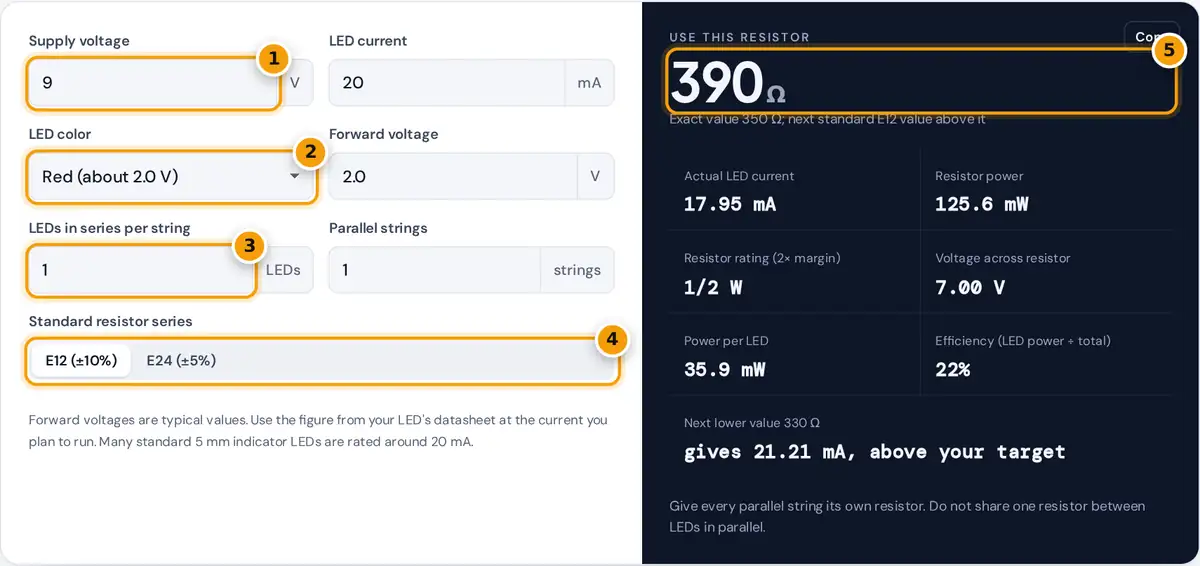
- Enter the supply voltage and the LED current in mA.
- Pick the LED color to fill a typical forward voltage, or type the datasheet value.
- Set LEDs in series per string and the number of parallel strings.
- Choose the E12 or E24 resistor series.
- Read the resistor to buy, with real current, power and the wattage rating.
Enter the supply voltage and the current you want through the LED, then choose the LED color to fill in a typical forward voltage, or type the exact forward voltage from the datasheet. If you are wiring several LEDs end to end, set the number of LEDs in series per string. If you are building several identical strings in parallel, set the number of strings; each string gets its own resistor.
The result shows the resistor to buy, chosen as the next standard value above the exact answer so the current never exceeds your target. It also shows the actual current with that resistor, the power the resistor turns into heat, a wattage rating with a two times safety margin and the next lower standard value for comparison.
The LED Resistor Formula
Actual current = (Vsupply − n × Vf) ÷ Rstandard
Resistor power P = I² × R
Rating: the next standard wattage at least 2 × P
An LED has a nearly fixed voltage drop, its forward voltage Vf, and very little resistance of its own, so without a resistor the current would rise until the LED fails. The resistor takes up the difference between the supply voltage and the LEDs’ total forward voltage and, by Ohm’s law, sets the current.
Worked Example
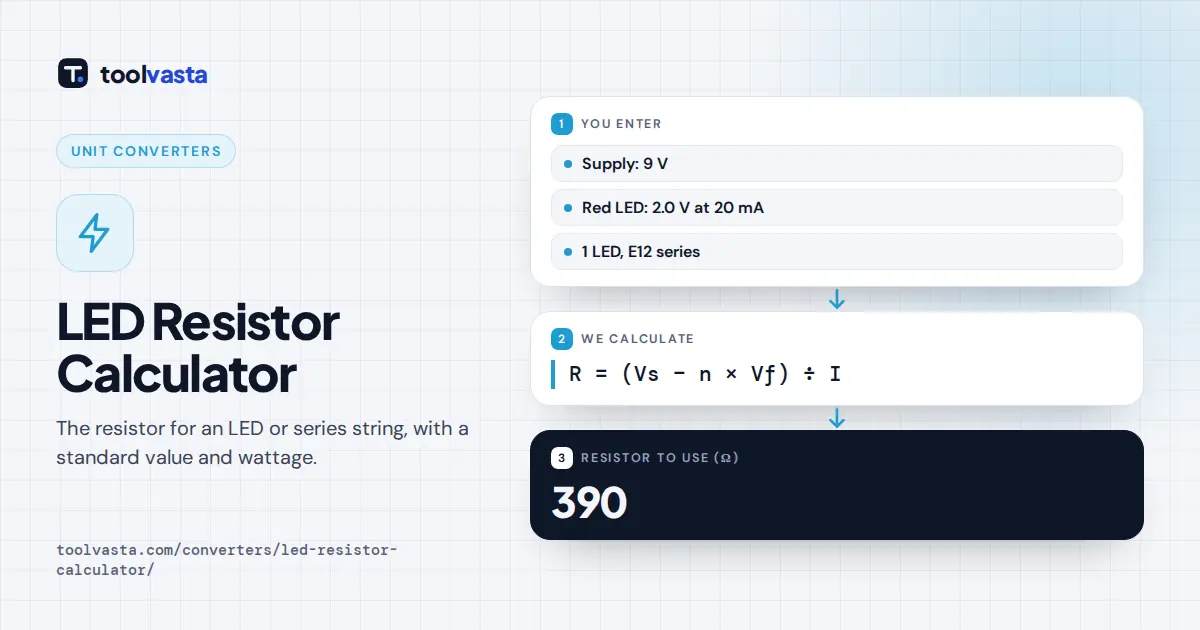
A red LED with a forward voltage of 2.0 V runs from a 9 V battery at 20 mA. The resistor drops 9 − 2 = 7 V, so R = 7 ÷ 0.020 = 350 Ω. That is not a standard value. In the E12 series the next value up is 390 Ω, which gives 7 ÷ 390 = 17.95 mA. The resistor dissipates 0.01795² × 390 = 0.126 W, so with a two times margin a 1/2 W resistor is the safe choice. In the E24 series, 360 Ω gives 19.44 mA and 0.136 W.
For three white LEDs in series on 12 V at 20 mA, the LEDs drop 3 × 3.2 = 9.6 V, leaving 2.4 V for the resistor: 2.4 ÷ 0.020 = 120 Ω, an exact E12 value, dissipating only 0.048 W, so a 1/8 W part is enough.
Typical LED Forward Voltages
| LED color | Typical forward voltage | Resistor on 5 V at 20 mA |
|---|---|---|
| Infrared | 1.2 to 1.5 V | about 185 Ω |
| Red | 1.8 to 2.2 V | 150 Ω (exact for 2.0 V) |
| Orange or yellow | 2.0 to 2.2 V | 145 Ω (use 150 Ω) |
| Green, standard | 2.0 to 2.4 V | 140 Ω (use 150 Ω) |
| Blue, white, true green | 2.8 to 3.4 V | 90 Ω (use 100 Ω) |
Forward voltage varies between manufacturers, batches and operating currents, so these are typical ranges only. The datasheet value at your chosen current is always the better figure.
Series Strings and Parallel Strings
Putting LEDs in series is efficient: they share one resistor and one current, and less power is wasted as heat. The limit is the supply voltage, which must be comfortably higher than the total forward voltage. When you need more LEDs than one string allows, build several identical strings and connect them in parallel, each with its own resistor. Sharing a single resistor between parallel LEDs is a common mistake: small differences in forward voltage make one LED take most of the current.
Tips and Limits
- Leave at least a volt or two across the resistor. With very little headroom, a small change in supply voltage or LED temperature changes the current a lot.
- Indicator LEDs are often bright enough at 5 to 10 mA, which also extends battery life.
- For high power LEDs above a few hundred milliamps, use a constant current driver instead of a resistor.
- Check the resistor’s power rating: a resistor running near its rating gets hot and can drift or fail.
Frequently asked questions
How do I calculate the resistor for an LED?
Subtract the LED forward voltage from the supply voltage and divide by the current in amps. A red LED at 2.0 V on 9 V at 20 mA needs 7 divided by 0.02, which is 350 ohms. Round up to 390 ohms.
What resistor do I need for an LED on 5V?
For a red LED at about 2.0 V and 20 mA, use 150 ohms. For a blue or white LED at about 3.2 V, use 100 ohms or slightly more. Check the forward voltage in your LED's datasheet.
What resistor do I need for an LED on 12V?
For one red LED at 20 mA, about 500 ohms, so 510 or 560 ohms. For three white LEDs in series at 3.2 V each, the resistor drops 2.4 V and needs 120 ohms.
Should I round the resistor up or down?
Round up to the next standard value. A slightly larger resistor gives a slightly lower current, which keeps the LED within its rating. The calculator also shows the next lower value and the current it would give.
What wattage resistor do I need for an LED?
Multiply the current squared by the resistance to get the power, then choose a resistor rated at least twice that. Most single indicator LEDs need only 1/8 W or 1/4 W, but higher voltages can need more.
Can several LEDs in parallel share one resistor?
It is not recommended. LEDs have slightly different forward voltages, so one LED can take most of the current and fail. Give each parallel string its own resistor, as the calculator assumes.