How to Use the mL to Grams Converter
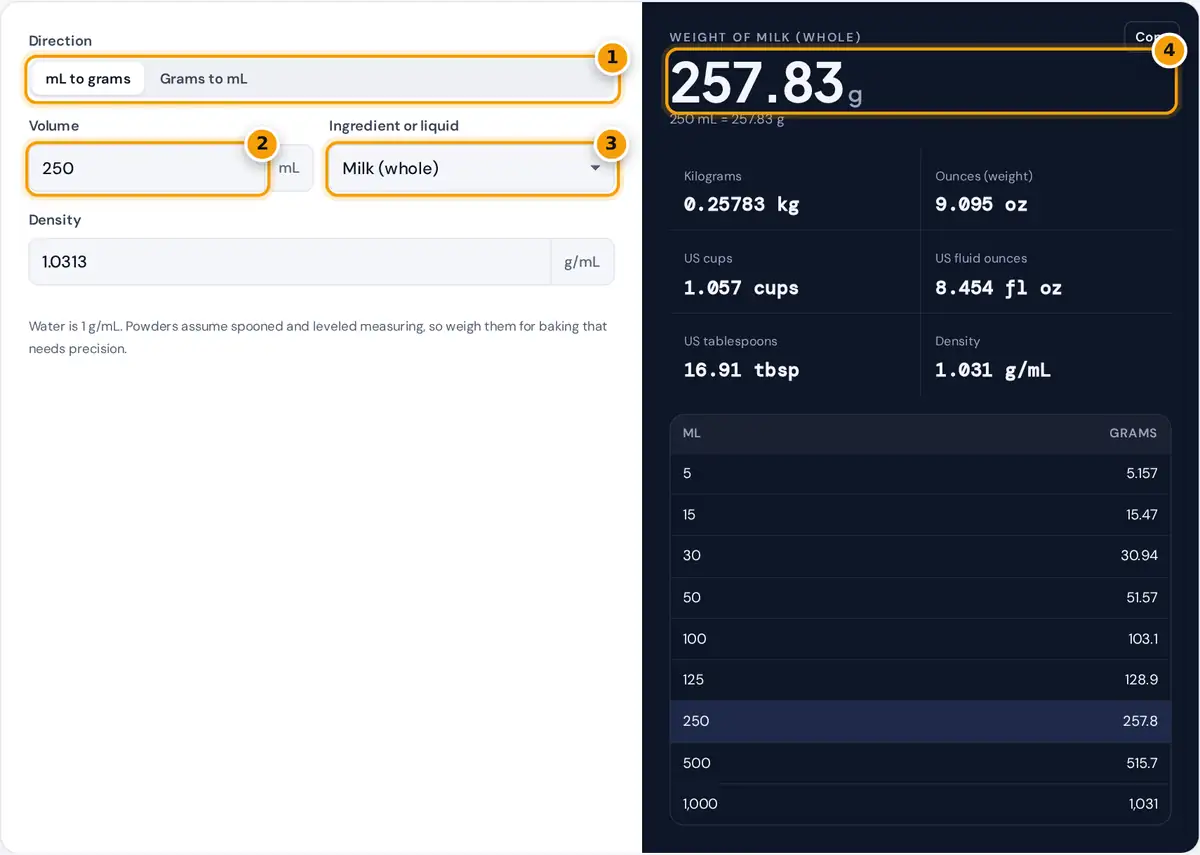
- Choose mL to grams, or grams to mL.
- Type the volume in milliliters.
- Pick the ingredient or liquid, or type your own density below it.
- Read the weight in grams, with ounces, cups and a chart of common volumes.
Type the volume in milliliters and choose the ingredient or liquid from the list. The weight in grams appears at once, with kilograms, ounces, US cups, fluid ounces and tablespoons underneath, and a chart of common volumes for the same ingredient. Switch the direction to Grams to mL when a recipe gives weights and you only have a measuring jug.
The density box fills in automatically from the list. If your ingredient is not there, or you have a measured value from a label or data sheet, type the density in grams per milliliter and the list switches to Other.
mL to Grams Formula
Density links volume and mass. It is the number of grams that one milliliter of a substance weighs.
milliliters = grams ÷ density (g/mL)
density = grams per US cup ÷ 236.5882365
Water is the reference point. At about 4°C a milliliter of pure water weighs 1 g, and at room temperature it weighs 0.998 g, a difference too small to matter in a kitchen. That is why 1 mL of water is treated as 1 g.
Worked Example
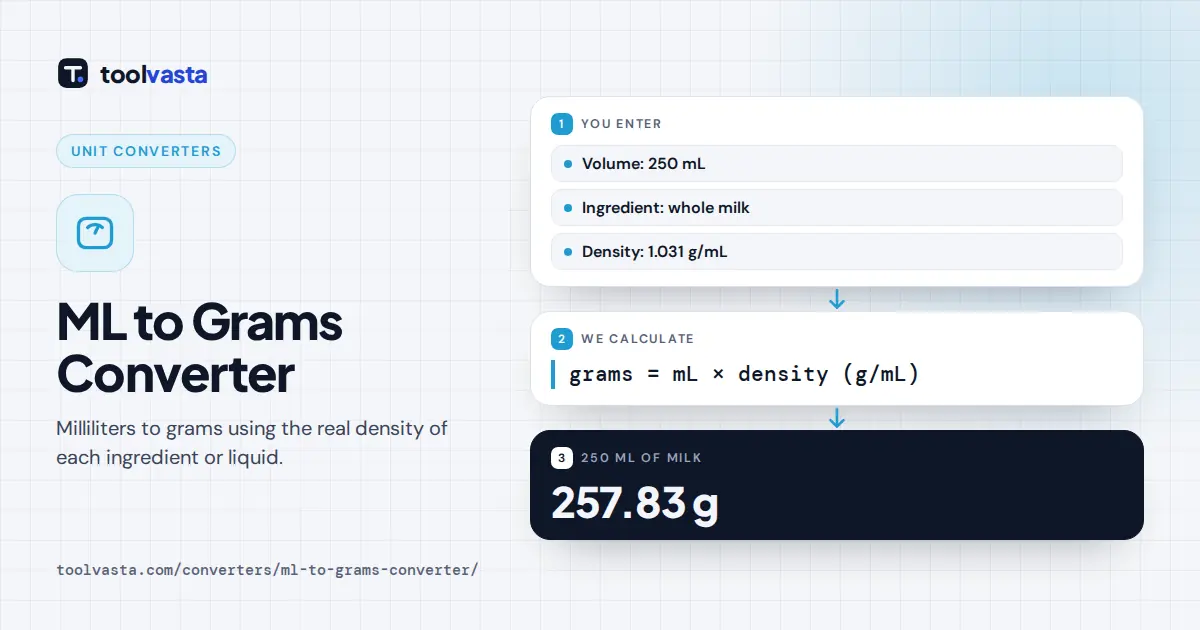
A recipe needs 250 mL of milk and you want to weigh it. Whole milk weighs about 244 g per US cup, which is a density of 244 ÷ 236.588 = 1.031 g/mL. So 250 mL is 250 × 1.031 = 257.8 g. The same 250 mL of vegetable oil is only 230.4 g because oil is lighter than water, and 250 mL of honey is 358.2 g because honey is much denser.
Going the other way, 100 g of all-purpose flour takes up 100 ÷ 0.5072 = 197.2 mL, a little over 3/4 of a US cup.
mL to Grams Chart
| Ingredient | Density | 100 mL | 250 mL | 500 mL |
|---|---|---|---|---|
| Water | 1.000 g/mL | 100 g | 250 g | 500 g |
| Whole milk | 1.031 g/mL | 103.1 g | 257.8 g | 515.7 g |
| Heavy cream | 1.006 g/mL | 100.6 g | 251.5 g | 503 g |
| Vegetable oil | 0.921 g/mL | 92.1 g | 230.4 g | 460.7 g |
| Olive oil | 0.913 g/mL | 91.3 g | 228.2 g | 456.5 g |
| Honey | 1.433 g/mL | 143.3 g | 358.2 g | 716.4 g |
| Granulated sugar | 0.845 g/mL | 84.5 g | 211.3 g | 422.7 g |
| All-purpose flour | 0.507 g/mL | 50.7 g | 126.8 g | 253.6 g |
| Ethanol | 0.789 g/mL | 78.9 g | 197.3 g | 394.5 g |
Why Different Liquids Weigh Differently
Dissolved sugar and fat change density. Honey and syrups are heavy because they are mostly sugar. Oils float on water because they are lighter. Milk is slightly heavier than water thanks to its proteins, lactose and minerals, while alcohol is noticeably lighter. Powders such as flour and cocoa contain a lot of air between particles, so their bulk density depends on how they are packed into the measure.
Tips and Limits
- Kitchen densities are typical values. Brand, temperature and packing can shift them by several percent.
- For powders, a scale is far more reliable than a measuring cup.
- Fluid ounces measure volume and ounces measure weight. One US fluid ounce of water weighs about 1.04 oz.
- For lab or industrial work, use the density from the product’s safety data sheet at the right temperature.
Density, Temperature and Accuracy
Most liquids expand slightly when they warm up, so a milliliter weighs a little less at higher temperatures. Water loses about 0.2% of its density between 4°C and 20°C, oils a bit more. For cooking this is negligible. For chemistry, brewing or fuel calculations, use a density measured at your working temperature and type it into the density box. You can find your own density by weighing a known volume: if 100 mL of a syrup weighs 132 g on a scale, its density is 1.32 g/mL, and every later conversion with that number will be exact for your syrup.
Frequently asked questions
How many grams is 1 mL?
For water, 1 mL weighs about 1 gram. Other substances differ: 1 mL of milk is about 1.03 g, vegetable oil about 0.92 g, honey about 1.43 g and all-purpose flour about 0.51 g. Multiply by the density.
How many grams is 250 mL of water?
About 250 grams, because water has a density of very close to 1 gram per milliliter. At room temperature it is 249.5 grams, a difference too small to matter for cooking or most household uses.
How do I convert mL to grams?
Multiply the volume in milliliters by the density in grams per milliliter. For olive oil at about 0.91 g/mL, 100 mL weighs about 91 grams. Choose the ingredient in the converter and it uses the right density.
How many mL is 100 grams?
It depends on the ingredient. 100 grams of water is 100 mL, 100 grams of oil is about 109 mL, 100 grams of honey is about 70 mL and 100 grams of flour is about 197 mL.
Is 1 mL of milk 1 gram?
Not exactly. Whole milk is slightly denser than water, about 1.03 grams per mL, so 1 liter of milk weighs about 1,031 grams. For small amounts in recipes, treating 1 mL as 1 g is usually close enough.
Why does 1 mL of oil weigh less than 1 mL of water?
Oil is less dense than water, about 0.92 grams per mL compared with 1 gram, which is also why oil floats on water. So 500 mL of vegetable oil weighs only about 460 grams.