How to Use the Fuel Cost Calculator
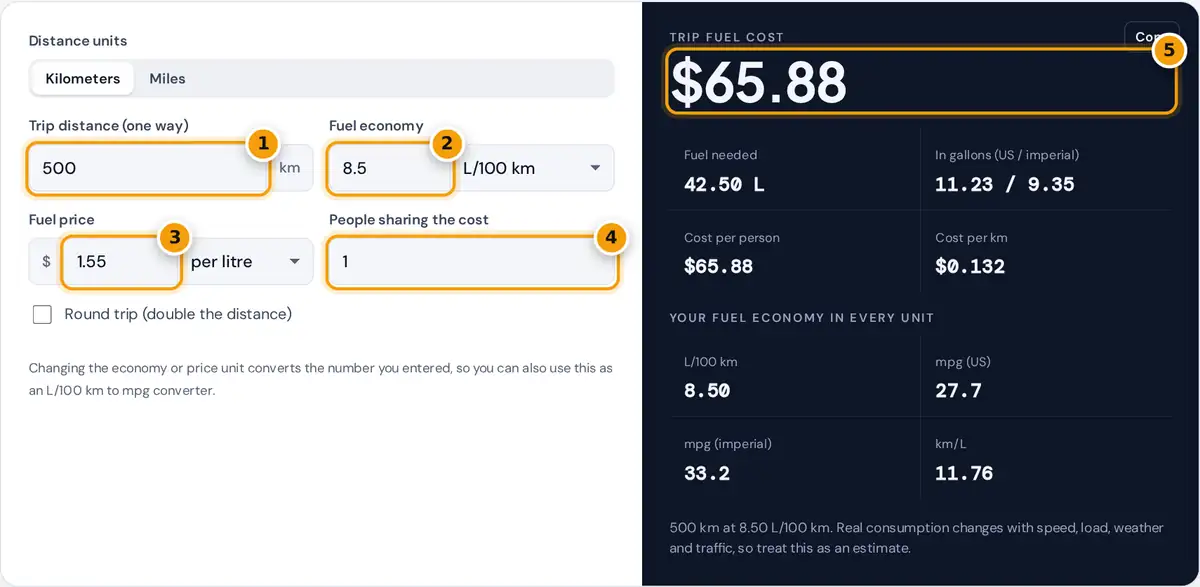
- Enter the trip distance one way, in kilometres or miles.
- Enter your fuel economy and pick the unit: L/100 km, mpg or km/L.
- Enter the gas price and choose per litre or per gallon.
- Set how many people share the cost, and tick round trip if you are coming back.
- Read the trip fuel cost, then check litres needed and cost per person.
Choose kilometers or miles, then enter the one-way trip distance. Type your vehicle's fuel economy and pick its unit: L/100 km, mpg (US), mpg (imperial) or km/L, depending on where the figure originally came from.
Enter the pump price per litre, per US gallon or per imperial gallon. Tick Round trip to double the distance, and set how many people are sharing the cost so each person's share appears instantly.
Changing the economy or price unit converts the number already in the box. That makes this gas trip calculator a quick L/100 km to mpg converter too, with your economy shown in every unit below.
Fuel Cost Formula
Every trip estimate starts with fuel used. Multiply the distance in kilometers by your L/100 km rating and divide by 100 to get litres, then multiply those litres by the price paid at the pump.
trip cost = fuel used (L) × price per litre
L/100 km = 235.215 ÷ mpg (US) L/100 km = 282.481 ÷ mpg (imperial)
L/100 km = 100 ÷ km/L
1 mile = 1.609344 km 1 US gal = 3.785411784 L 1 imperial gal = 4.54609 L
Other units are converted to L/100 km first. Divide 235.215 by US mpg, or 282.481 by imperial mpg. For a km/L rating, simply divide 100 by that figure, so 12.5 km/L equals 8 L/100 km.
The mpg scales differ because an imperial gallon holds 4.546 litres and a US gallon holds 3.785 litres. A car rated 30 mpg (US) shows about 36 mpg (imperial), yet both mean 7.84 L/100 km.
Worked Examples
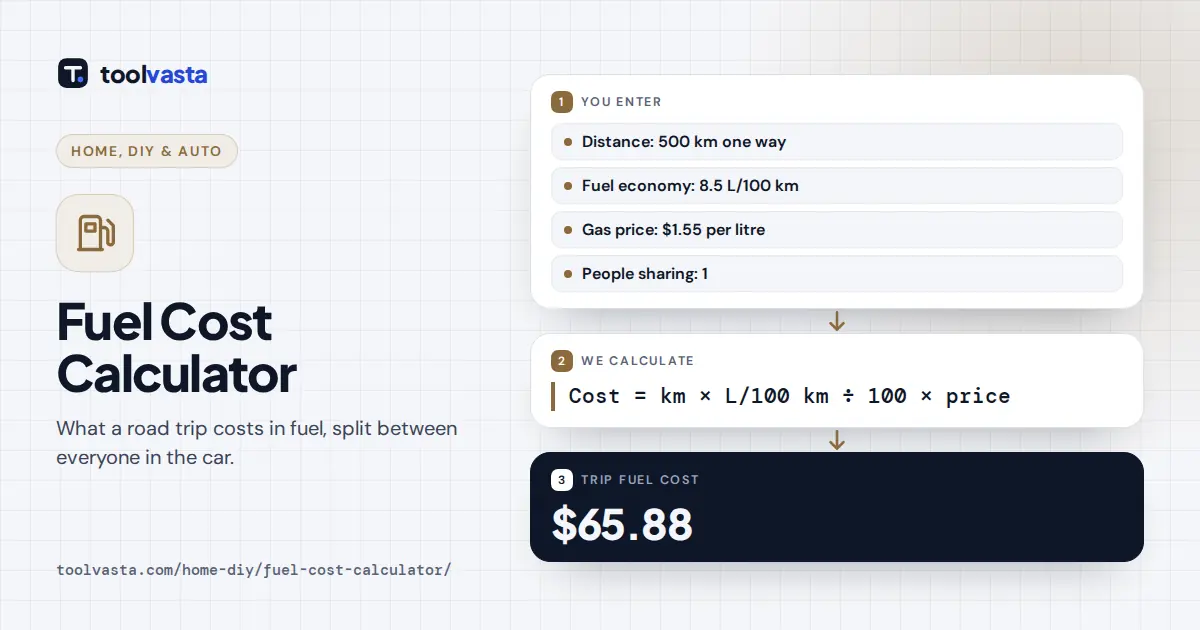
Take a typical Canadian example: a 500 km highway drive in a car using 8.5 L/100 km burns 500 × 8.5 ÷ 100 = 42.5 L. At $1.55 per litre, the trip costs 42.5 × 1.55 = $65.88 in fuel.
That works out to about 13.2 cents per kilometer, and two people splitting it pay $32.94 each. The same car achieves 27.7 mpg (US), 33.2 mpg (imperial) and 11.76 km/L, as the results panel shows.
| Trip | Fuel | Price | Cost |
|---|---|---|---|
| 500 km at 8.5 L/100 km | 42.5 L | $1.55 per litre | $65.88 |
| Same trip, round trip | 85 L | $1.55 per litre | $131.75 |
| 300 miles at 25 mpg (US) | 12 US gal | $3.50 per US gal | $42.00 |
A 300 mile trip at 25 mpg (US) needs 300 ÷ 25 = 12 US gallons. At $3.50 per US gallon that is $42.00, or 14 cents per mile, and 25 mpg (US) equals 9.41 L/100 km.
Fuel Economy Conversion Table
Use this table to translate a rating from one system to another. Lower is better for L/100 km, while higher is better for both mpg scales and km/L, which often confuses drivers comparing different sources.
| L/100 km | mpg (US) | mpg (imperial) | km/L |
|---|---|---|---|
| 5.0 | 47.0 | 56.5 | 20.0 |
| 6.0 | 39.2 | 47.1 | 16.7 |
| 7.0 | 33.6 | 40.4 | 14.3 |
| 8.0 | 29.4 | 35.3 | 12.5 |
| 10.0 | 23.5 | 28.2 | 10.0 |
| 12.0 | 19.6 | 23.5 | 8.3 |
| 15.0 | 15.7 | 18.8 | 6.7 |
Natural Resources Canada publishes official ratings in L/100 km in its Fuel Consumption Guide, with separate city, highway and combined figures for each model. Look up your exact vehicle there before relying on a guess.
For a trip that mixes towns and open road, use the combined rating. City ratings are higher because of stops and idling, and highway ratings assume steady speeds that real traffic and weather rarely allow.
Splitting Gas Costs and Cost per Kilometer
Enter the number of passengers sharing the drive, and the cost per person appears beside the total. For a carpool or group road trip, this settles who owes what before anyone reaches the first station.
Ticking Round trip doubles the distance. The 500 km example becomes 1,000 km and 85 L, or $131.75 in total at $1.55, which is $32.94 each for four people splitting the cost of gas evenly.
The cost per kilometer or mile is also useful outside road trips. Multiply it by your daily commute distance to see what driving to work costs, then compare transit fares with this gas cost calculator.
Getting a Realistic Estimate
Your own measured consumption beats any official label or estimate. Fill the tank, reset the trip meter, drive normally, then at the next fill-up divide the litres added by kilometers driven and multiply by 100.
- Higher speed raises consumption noticeably, especially above 110 km/h.
- A roof box, towing or a full load adds drag and weight.
- Winter tires, cold starts and short trips in winter all increase fuel use.
Keep the correct tire pressure listed on the door jamb, since soft tires add rolling resistance. Removing an empty roof rack between trips is another simple way to bring real consumption closer to the rating.
Fuel prices often vary between provinces and along a route, so an average of the prices you expect is more accurate than today's local figure. Statistics Canada tracks monthly average retail gasoline prices by city.
What This Calculator Does Not Include
The result above covers the cost of fuel only. Tolls, parking, ferry fares, tire wear, maintenance and insurance are extra, so a full trip budget should add those costs separately from the figure shown here.
Electric vehicles need a slightly different method: multiply your kWh/100 km rating by the distance and your electricity rate. Plug-in hybrids switch between both systems, so split the trip by how far each mode covers.
Gas prices change daily and consumption shifts with speed, load, weather and traffic. Treat every result as an estimate for planning rather than a quote, and add a small buffer for detours along the way.
Frequently asked questions
How do I calculate the fuel cost of a trip?
Multiply the distance in kilometers by your L/100 km figure and divide by 100 to get litres, then multiply by the price per litre. A 500 km trip at 8.5 L/100 km and $1.55 per litre costs $65.88.
How do I convert L/100 km to mpg?
Divide 235.215 by L/100 km for US mpg, or divide 282.481 by L/100 km for imperial mpg. For example, 8 L/100 km is 29.4 mpg (US) or 35.3 mpg (imperial).
Why are imperial mpg numbers higher than US mpg?
An imperial gallon holds 4.546 litres and a US gallon holds 3.785 litres. A car travels further on the larger gallon, so the same vehicle shows about 20% more imperial mpg.
What is a good L/100 km?
Many compact cars are rated around 6 to 8 L/100 km combined, while large SUVs and pickups often use 10 to 14 L/100 km. Hybrids can reach 4 to 5 L/100 km.
How do I calculate litres per 100 km myself?
Fill the tank, reset the trip meter and drive normally, then fill up again. Divide the litres you added by the kilometers driven and multiply by 100 to get your real L/100 km.
How do I split gas costs with friends?
Enter the trip distance, fuel economy and price, tick Round trip if you are returning, and set the number of people sharing. The calculator divides the total fuel cost evenly between them.