How to Use the Mileage Reimbursement Calculator
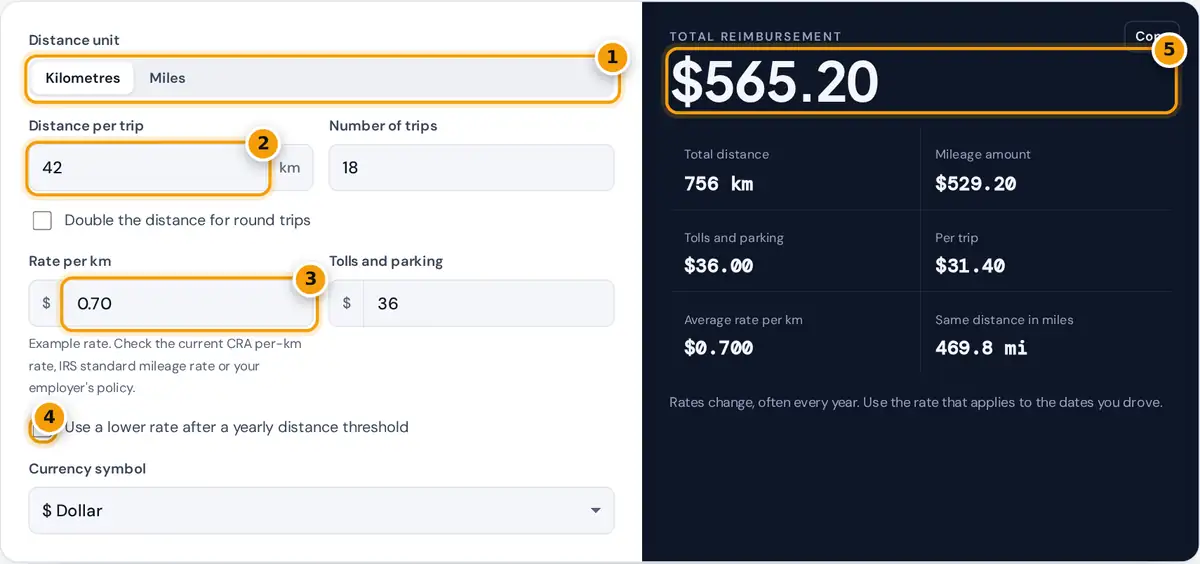
- Choose kilometres or miles.
- Enter the distance per trip and the number of trips.
- Enter the current official or employer rate, plus tolls and parking.
- Tick the tiered option if a lower rate applies after a yearly threshold.
- Read the total reimbursement, distance and amount per trip.
Choose kilometres or miles, then enter the distance of one business trip and how many trips you made in the period. Tick the round trip box if the distance you entered is one way. Enter the reimbursement rate per kilometre or mile your employer pays, or the rate set by your tax authority, and add any tolls and parking you paid, which are usually claimed separately.
Some allowance schedules pay a higher rate up to a yearly distance and a lower rate after it. Tick Use a lower rate after a yearly distance threshold, enter the threshold and the second rate, and enter the distance you have already claimed this year so the calculator applies the right rate to each part of this claim. The result shows the total reimbursement, the distance, the amount per trip and the average rate.
Mileage Reimbursement Formula
flat rate: amount = distance × rate
tiered: amount = d1 × rate 1 + (distance − d1) × rate 2
d1 = min(distance, threshold − already claimed)
total = amount + tolls and parking
The tier split counts the distance claimed earlier in the year, so a claim that crosses the threshold is paid partly at each rate. If you have already passed the threshold, the whole claim uses the second rate. One mile is exactly 1.609344 kilometres, which the calculator uses to show the distance in the other unit.
Official rates are set and updated by tax authorities, often yearly. In Canada, the CRA publishes reasonable per-kilometre allowance rates; in the United States, the IRS publishes standard mileage rates. Enter the current figure from the official source.
Worked Example
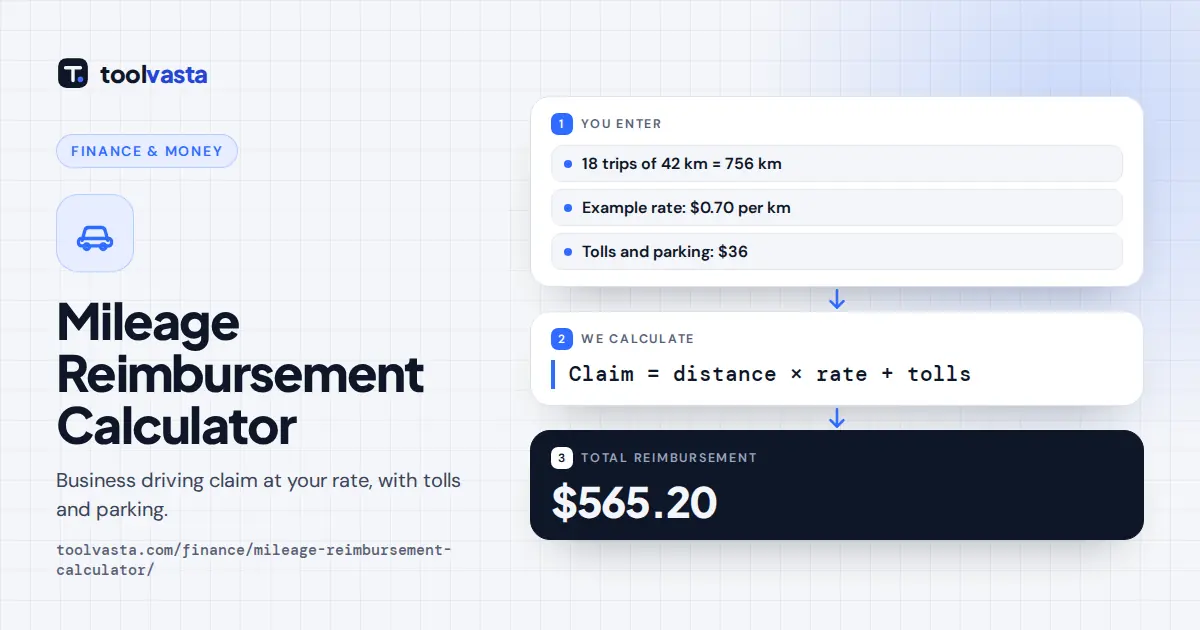
You drove 42 km to a client site 18 times, a total of 756 km. At an example rate of $0.70 per km the mileage amount is $529.20, and with $36 of parking the claim is $565.20, or $31.40 per trip. The same 756 km is 469.8 miles.
If the trips were round trips, the distance doubles to 1,512 km. With an example tiered schedule of $0.70 for the first 5,000 km a year and $0.64 after that, and 4,500 km already claimed this year, 500 km is paid at the first rate and 1,012 km at the second, for a total of $1,033.68 including parking.
| Claim | Distance | Rate | Total |
|---|---|---|---|
| 18 one-way trips of 42 km, $36 parking | 756 km | $0.70 | $565.20 |
| Same trips as round trips, tiered | 1,512 km | $0.70 then $0.64 | $1,033.68 |
| 10 trips of 120 miles | 1,200 mi | $0.67 | $804.00 |
Rates in the table are examples only, not official figures.
How an allowance is paid can matter for tax. A per-distance allowance at a reasonable rate can be treated differently from a flat monthly car allowance, so check the rules that apply to you and keep your trip log with each claim.
Tips for Mileage Claims
- Keep a log for every trip: date, destination, purpose and distance. Tax authorities and employers can ask for it.
- Commuting between home and a regular workplace is usually personal driving, not business mileage.
- Check whether your employer pays a flat rate or follows the official schedule, and whether the allowance is taxable.
- Use the rate for the period you drove. If rates change mid-year, split the claim.
- Claim tolls and parking with receipts, as they are often reimbursed on top of the per-distance rate.
Assumptions and Limits
The calculator multiplies distance by the rates you enter and does not decide whether driving counts as business use or whether an allowance is taxable. Default rates are examples; always use the current official or employer rate. See the Canada Revenue Agency or the Internal Revenue Service for the current figures. Amounts work in any currency.
Frequently asked questions
How do you calculate mileage reimbursement?
Multiply the business distance by the reimbursement rate per kilometre or mile, then add tolls and parking. For example, 756 km at $0.70 per km is $529.20 before parking.
What is the current CRA per-kilometre rate?
The CRA publishes reasonable automobile allowance rates that usually change each year, with a higher rate for the first 5,000 km. Check the current figures on canada.ca and enter them in the calculator.
What is the IRS standard mileage rate?
The IRS sets a standard mileage rate for business use of a vehicle, usually updated each year and sometimes mid-year. Look up the rate for the dates you drove on irs.gov and enter it.
How does a tiered mileage rate work?
A higher rate applies up to a yearly distance threshold and a lower rate after it. The calculator splits each claim based on the distance you have already claimed earlier in the year.
Should I count round trips?
Count the full distance you drove for business. If you enter a one-way distance for trips where you returned, tick the round trip box so the calculator doubles the distance.
Are tolls and parking included in the mileage rate?
Usually not. Most policies reimburse tolls and business parking separately with receipts, on top of the per-distance rate. Check your employer's policy or the tax rules that apply to you.