How to Use the Retirement Income Calculator
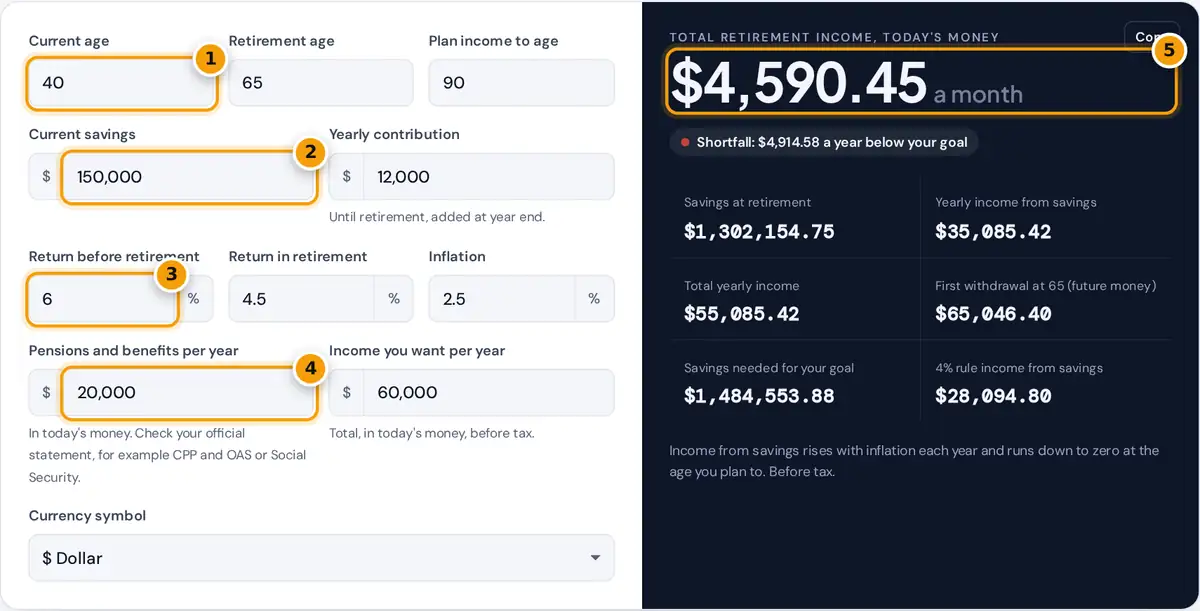
- Enter your current age, retirement age and the age to plan income to.
- Enter your savings so far and what you add each year.
- Set returns before and during retirement and inflation.
- Add pensions and benefits from your statements and the income you want.
- Read your monthly income in today's money and the savings your goal needs.
Enter your current age, the age you plan to retire and the age you want your savings to last until. Many planners use 90 or 95 so there is a margin for a long life. Add what you have saved so far, what you add each year, and the returns you expect before and during retirement. A lower return in retirement reflects a more cautious mix of investments.
Enter the pensions and government benefits you expect each year in today's money, using the estimate on your official statement, and the total yearly income you would like. The calculator shows your savings at retirement, the income they can pay, your total monthly income in today's money, and the savings you would need to reach your goal. The drawdown table shows the balance at every age.
How Retirement Income Is Calculated
first withdrawal W = S ÷ Σk=0..N−1 [(1 + g) ÷ (1 + r2)]k
income in today's money = W ÷ (1 + g)Y
savings needed = (goal − pensions) × (1 + g)Y × the same sum
Y is the number of years until retirement and N the number of years of retirement. Withdrawals are taken at the start of each year and rise with inflation g, so your buying power stays level. The remaining balance earns the retirement return r2 and reaches zero after the final withdrawal.
The 4% rule figure is shown for comparison: 4% of your savings at retirement, converted to today's money. It is a rule of thumb from historical market studies, not a guarantee.
Worked Example
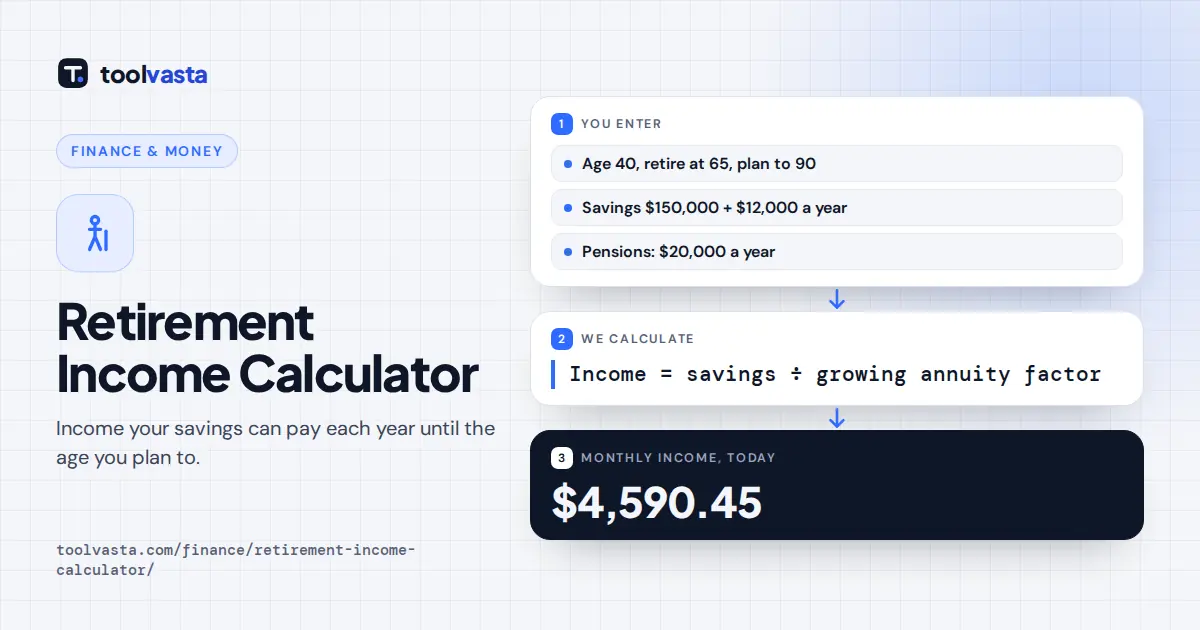
You are 40 with $150,000 saved and add $12,000 a year at a 6% return until 65. Your savings reach $1,302,154.75. With a 4.5% return in retirement, 2.5% inflation and income planned to age 90, the first withdrawal is $65,046.40, which is $35,085.42 in today's money. Adding $20,000 of pensions and benefits gives $55,085.42 a year, or $4,590.45 a month.
That is $4,914.58 a year below a $60,000 goal. To reach it from savings alone you would need $1,484,553.88 at retirement. The 4% rule would suggest only $28,094.80 a year from the same savings, a more cautious figure.
| First-year income per $100,000 saved | 20 years | 25 years | 30 years |
|---|---|---|---|
| 3% return | $5,234.51 | $4,237.92 | $3,573.86 |
| 4.5% return | $5,970.42 | $4,995.29 | $4,350.22 |
| 6% return | $6,751.34 | $5,812.84 | $5,201.52 |
Each row assumes 2.5% inflation, with income rising every year and savings fully used by the end of the period.
Retirement income usually comes from several sources at once. Government and workplace pensions provide a base that rises with inflation in many plans, and personal savings fill the gap up to the lifestyle you want. Separating the two in the calculator shows how much of your goal depends on investment returns and how much is already covered.
Tips for Retirement Income Planning
- Plan to a later age than you expect to reach. Running out of money at 85 is a bigger problem than leaving some behind.
- Use the estimates on your official pension and benefit statements rather than guesses. Start dates change the amounts.
- Remember tax. The income shown is before tax, and withdrawals from many retirement accounts are taxable.
- Test a lower return in retirement. A one-point drop changes income more than most people expect.
- Delaying retirement helps twice: more years of saving and fewer years of withdrawals.
Assumptions and Limits
The projection uses steady returns and inflation. Real markets vary, and poor returns early in retirement can shorten how long savings last. Contributions are fixed in money terms and added at the end of each year. Pensions and benefits are assumed to rise with inflation. Taxes, fees and required minimum withdrawals are not modeled. Amounts work in any currency. This is an educational estimate, not financial advice; see the SWP calculator for a monthly withdrawal plan.
Frequently asked questions
How much income will my retirement savings provide?
It depends on the amount saved, the return in retirement, inflation and how many years the money must last. The calculator spreads your savings over those years with income rising each year for inflation.
What is the 4% rule?
The 4% rule suggests withdrawing 4% of your savings in the first year of retirement and raising that amount with inflation. It comes from historical studies of 30-year retirements and is a guideline, not a guarantee.
Should I include government pensions?
Yes. Enter the yearly amounts from your official statements in today's money, such as CPP and OAS in Canada or Social Security in the United States. They reduce how much your savings must provide.
What return should I assume in retirement?
Many people use a lower return in retirement than before it, because portfolios usually hold more bonds and cash. Test a few rates to see how sensitive your income is to the assumption.
What does today's money mean?
It means amounts adjusted back to current prices, so you can compare them with what things cost now. The calculator divides future income by cumulative inflation up to your retirement date.
Is the retirement income shown before or after tax?
It is before tax. Withdrawals from many retirement accounts and most pensions are taxable, so your spending money will be lower. Check the rules for your accounts and country.