How to Use the Debt to Income Ratio Calculator
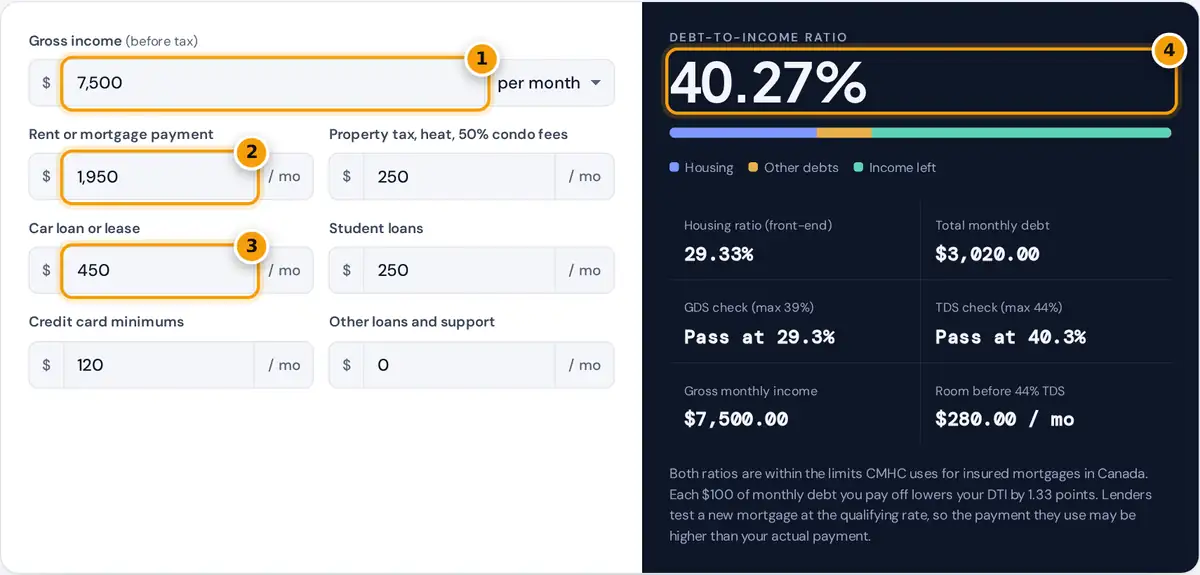
- Enter your gross income before tax, and pick per month or per year beside it.
- Enter your rent or mortgage payment, then property tax, heat and half of condo fees.
- Add car, student loan, credit card minimum and other monthly debt payments.
- Read your debt-to-income ratio, then check the housing ratio and the GDS and TDS pass or fail.
Enter your gross income before tax, either by month or by year. Then enter each regular monthly debt payment: rent or mortgage, property tax and heating, car payments, student loans and minimum credit card payments.
Add any other loan, line of credit or support payment, and leave a field at 0 if it does not apply. The results update as you type, so you can test different scenarios in seconds.
The calculator shows your total debt-to-income ratio, your housing ratio and whether each one sits within the GDS and TDS limits Canadian lenders use. It also shows how much monthly room remains under the limit.
- Count: mortgage or rent, property tax, heating, car loans, student loans, credit card minimums, lines of credit, alimony or child support.
- Do not count: groceries, utilities other than heat, phone bills, insurance or subscriptions.
Debt-to-Income Ratio Formula
Your DTI ratio is total monthly debt payments divided by gross monthly income, multiplied by 100. A $480 monthly debt payment on $1,000 of monthly income, for example, gives a debt-to-income ratio of exactly 48%.
Housing ratio (front-end) = housing costs / gross monthly income × 100
GDS = (mortgage payment + property tax + heating + 50% of condo fees) / gross monthly income
TDS = (GDS costs + all other debt payments) / gross monthly income
The front-end ratio counts housing costs only. The back-end ratio adds every other debt, so it is always the larger figure and the one most lenders look at first when they assess a loan application.
Always use your gross income, the amount before tax and payroll deductions. Using take-home pay would make your ratio look higher than the figure a lender calculates, because lenders work from income before any deductions.
Worked Example: $90,000 a Year
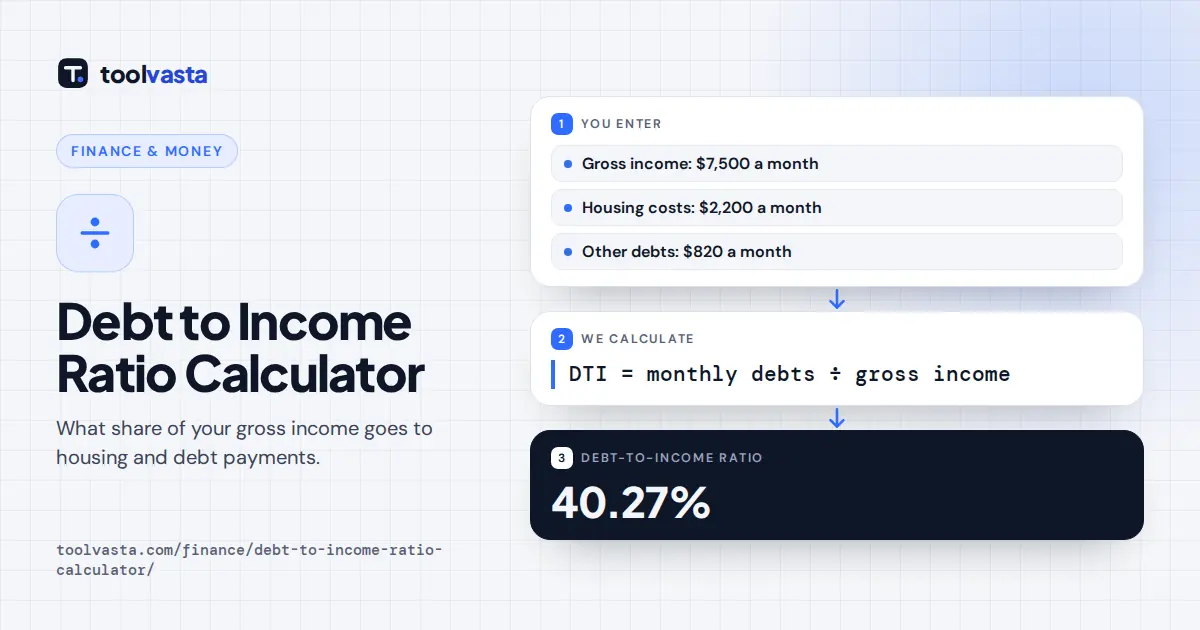
Say you earn $90,000 a year, which is $7,500 a month before tax. Your mortgage payment is $1,950, and property tax and heating add $250, so your monthly housing costs come to $2,200 in total.
You pay $450 on a car loan, $250 on student loans and $120 in credit card minimums. Total debt payments are $3,020, which gives a debt-to-income ratio of 40.27% and a housing ratio of 29.33%.
Both figures sit inside the 39% GDS and 44% TDS limits, with $280 a month of room before you reach 44%. On a $60,000 income, the same debts would push your total DTI to 60.40%.
GDS and TDS Limits in Canada
In Canada, lenders call the two ratios gross debt service (GDS) and total debt service (TDS). For insured mortgages, CMHC sets maximums of 39% GDS and 44% TDS. Both ratios always use gross monthly income.
| Ratio | What it counts | Maximum for insured mortgages |
|---|---|---|
| GDS (front-end) | Mortgage, property tax, heating, 50% of condo fees | 39% |
| TDS (back-end) | GDS costs plus car, student, credit card and other debt payments | 44% |
Uninsured lenders set their own similar limits. When you apply for a new mortgage, the payment is tested at the qualifying rate under the federal stress test, so ratios on paper can exceed real costs.
A ratio over the limit usually means a smaller mortgage approval, not an automatic refusal. Lenders also weigh your credit score, down payment and job history, so the ratio is one part of the picture.
What Is a Good Debt-to-Income Ratio?
A lower ratio is always better. Many lenders treat a DTI of about 36% or less as healthy, a ratio between roughly 37% and 49% as acceptable but stretched, and 50% or more as high.
In the United States, it is called the front-end and back-end debt-to-income ratio. A guideline often quoted there is 28% for housing and 36% for all debt, though each loan program sets its own maximum.
The Consumer Financial Protection Bureau explains how US lenders use the ratio. Whatever the country, a ratio well below the limit leaves room for rate changes at renewal, home repairs, job changes and other surprises.
How to Lower Your Debt-to-Income Ratio
You can lower your ratio by cutting the debt side, raising the income side or both. Paying off small balances completely removes their minimum payment from the calculation, which often helps more than partial paydowns.
Avoid new car loans or credit before you apply for a mortgage. Consolidating high-interest debt into one lower payment can also help, as long as you do not add new borrowing on the cleared cards.
On the income side, a co-borrower's income or a documented pay raise improves the ratio straight away, without changing any debts. To see what home price your ratios support, try the mortgage affordability calculator next.
Assumptions and Limits
The calculator uses the payments you enter exactly as they are. Lenders may instead use a set percentage of a credit card or line of credit balance rather than your actual monthly minimum payment amount.
Lenders may also count only part of variable income, such as commissions, overtime or self-employed earnings, and often look for a steady, documented history first. Your approved ratio can therefore differ noticeably from this estimate.
Results are estimates for planning only, not a lending decision. A debt-to-income ratio does not appear on your credit report, but the same debts and how you repay them do affect your credit score directly.
Frequently asked questions
What is a good debt-to-income ratio?
Lower is better. In Canada, insured mortgages allow up to 44% for total debt service and 39% for housing costs. A ratio well below those limits gives you more room to qualify and to handle surprises.
How do I calculate my debt-to-income ratio?
Add up your monthly debt payments, including housing, and divide by your gross monthly income before tax. Multiply by 100 to get a percentage. For example, $3,020 of debts on $7,500 of income gives 40.27%.
Does rent count in debt-to-income ratio?
For a general DTI, yes, rent is counted as a housing payment. When you apply for a mortgage, lenders replace your rent with the proposed mortgage payment, property tax and heating costs.
What is the difference between GDS and TDS?
GDS counts housing costs only: mortgage payment, property tax, heating and half of any condo fees. TDS adds all other debt payments, such as car loans, student loans, lines of credit and credit cards.
Is DTI based on gross or net income?
DTI uses gross income, before tax and payroll deductions. Using net income would make the ratio look higher than lenders calculate it, so always enter your pay before deductions.
Does my debt-to-income ratio affect my credit score?
No. Credit bureaus do not record your income, so the ratio itself is not part of your score. The balances and payment history behind it do affect your credit score, however.