How to use the time and a half calculator
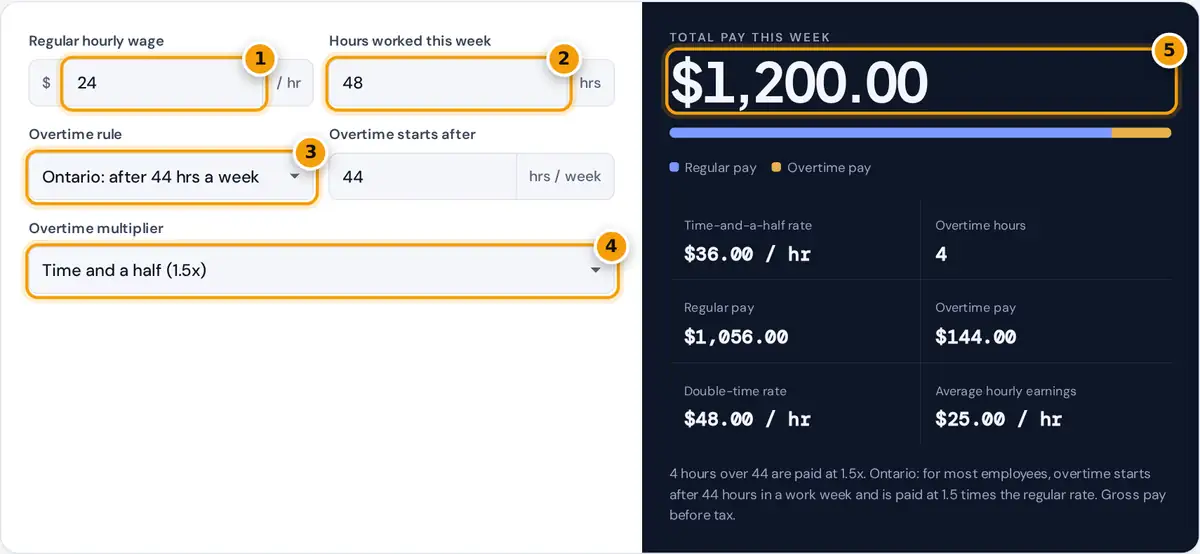
- Enter your regular hourly wage.
- Enter the hours you worked this week.
- Pick your overtime rule: Ontario, federal, BC, US FLSA or a custom threshold.
- Choose time and a half, double time or 1.75x.
- Read your total pay, then check the overtime rate, overtime hours and regular pay.
Enter your regular hourly wage and the total hours you worked in the week. Choose the overtime rule for where you work, and the calculator splits your hours into regular and overtime hours, pays the overtime at the multiplier you choose and adds it all up. To use a different weekly threshold, for example one set by a collective agreement, type it into Overtime starts after or choose Custom threshold.
Time and a half formula
Overtime hours = hours worked − threshold (if positive)
Weekly pay = regular hours × wage + overtime hours × wage × 1.5
Worked example
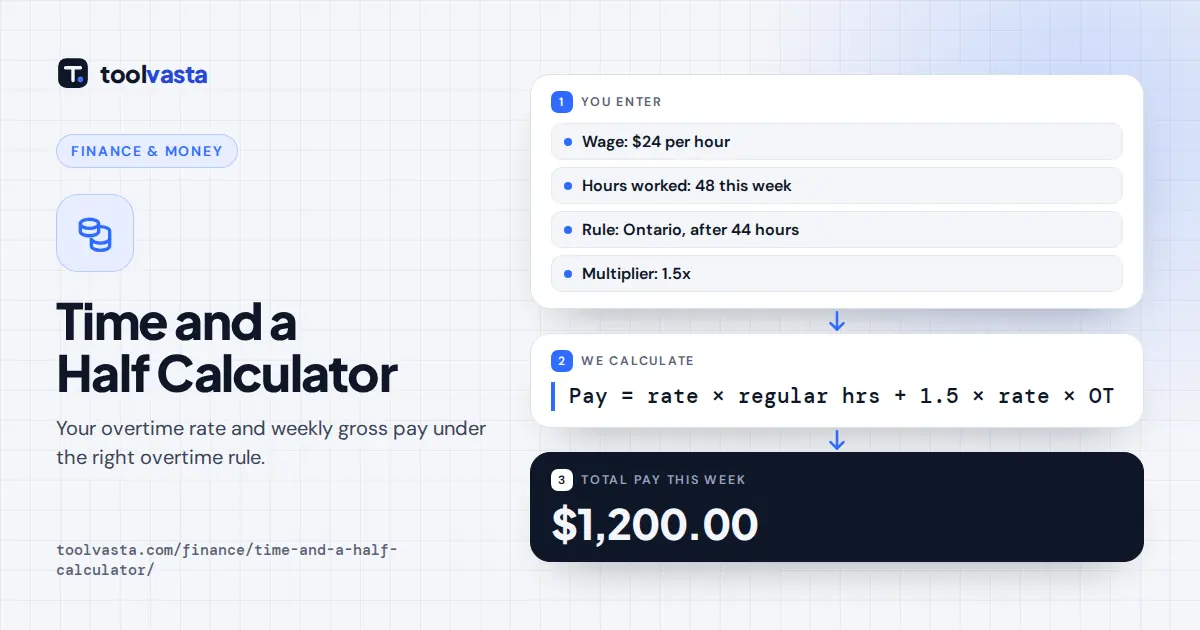
You earn $24 an hour in Ontario and work 48 hours in a week. Overtime starts after 44 hours, so 44 hours are paid at $24 ($1,056.00) and 4 hours at the time-and-a-half rate of $36 ($144.00). Your gross pay for the week is $1,200.00, which averages $25.00 an hour. Under the federal or U.S. rule, overtime would start after 40 hours: 8 hours at $36 is $288, for a total of $1,248.00.
Overtime rules in Canada and the U.S.
| Jurisdiction | Overtime starts after | Rate |
|---|---|---|
| Ontario | 44 hours in a work week | 1.5x |
| Federally regulated (Canada Labour Code) | 8 hours a day or 40 hours a week | At least 1.5x |
| British Columbia | 8 hours a day or 40 hours a week | 1.5x, and 2x after 12 hours in a day |
| United States (FLSA) | 40 hours in a workweek | At least 1.5x |
Sources: Ontario's guide to the Employment Standards Act (updated February 2026), federal labour standards on hours of work, the B.C. Employment Standards Act, section 40 and the U.S. Department of Labor. Other provinces and states set their own thresholds, and some jobs are exempt, so check the rules that apply to you.
Daily overtime
Some rules count overtime by the day as well as by the week. In B.C. and in federally regulated workplaces, hours over 8 in one day are overtime even if the weekly total is under 40. This calculator applies a weekly threshold. If you worked long days, add up your daily overtime hours and use them with a threshold that matches, or use the time clock calculator to total your shifts first.
Time and a half vs double time
Time and a half pays 1.5 times your regular wage, so $20 becomes $30 an hour. Double time pays twice your wage, so $20 becomes $40. Double time is required in some cases, such as long days in B.C., and is common in union agreements and for work on statutory holidays. Choose the 2x multiplier to see a week paid at double time.
Assumptions
All hours above the threshold are paid at the one multiplier you choose. Shift premiums, statutory holiday pay, averaging agreements and banked time off in lieu of pay are not included. Results are gross pay before tax and deductions.
Frequently asked questions
How do I calculate time and a half?
Multiply your regular hourly wage by 1.5. If you earn $24 an hour, time and a half is $36 an hour.
What is time and a half for $20 an hour?
$30 an hour. Eight hours of overtime at that rate pays $240.
When does overtime start in Ontario?
For most employees in Ontario, overtime starts after 44 hours in a work week and is paid at 1.5 times the regular rate.
Is overtime after 40 or 44 hours in Canada?
It depends on the jurisdiction. Federally regulated workplaces and B.C. use 40 hours a week plus 8 hours a day, while Ontario uses 44 hours a week.
What is double time?
Double time is twice your regular wage. In B.C., hours over 12 in a day are paid at double time.