How to Use the Smith Maneuver Calculator
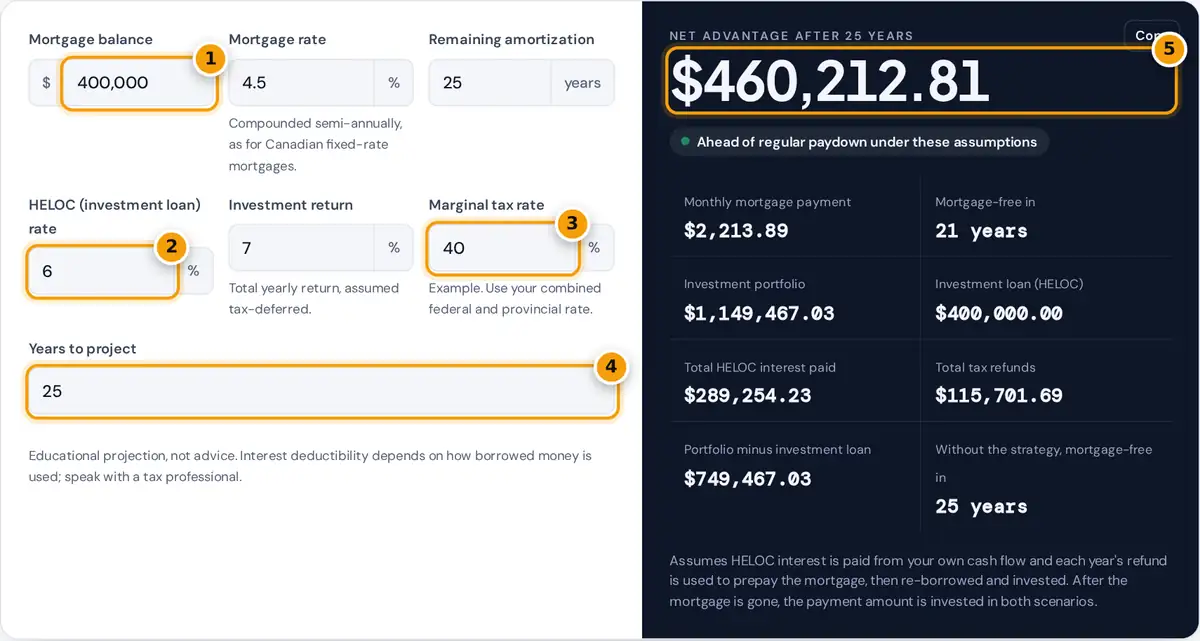
- Enter your mortgage balance, rate and remaining amortization.
- Enter the HELOC rate and the investment return you expect.
- Enter your own combined marginal tax rate.
- Choose how many years to project.
- Read the net advantage, portfolio, HELOC, interest paid and refunds.
Enter your mortgage balance, rate and remaining amortization. The calculator works out your regular monthly payment using semi-annual compounding, the convention for Canadian fixed-rate mortgages. Then enter the rate on the HELOC portion of a readvanceable mortgage, the yearly return you expect from the investments, and your marginal tax rate, the rate that applies to your last dollar of income. The tax rate is an example: use your own combined federal and provincial rate.
The result compares two households with the same mortgage and the same payment. One simply pays down the mortgage. The other applies the Smith Maneuver. You see the net advantage after the years you choose, the portfolio and investment loan built up, the HELOC interest paid, the tax refunds and when each household becomes mortgage-free. The yearly table downloads as CSV.
How the Projection Works
HELOC interest = HELOC balance × HELOC rate ÷ 12, paid from your cash flow
yearly refund = HELOC interest for the year × marginal tax rate
refund prepays the mortgage, which is re-borrowed and invested too
net advantage = (portfolio − HELOC − mortgage − interest paid) − (regular household's net position)
Your total debt stays about the same, but over time it shifts from the mortgage to the investment loan. In Canada, interest on money borrowed to earn income from a business or property, such as dividend-paying investments, can generally be deductible, which is what produces the refund. Using refunds to prepay the mortgage speeds up the conversion.
The strategy only adds value if the after-tax return on the investments exceeds the after-tax cost of the borrowing. Leverage magnifies losses as well as gains.
Worked Example
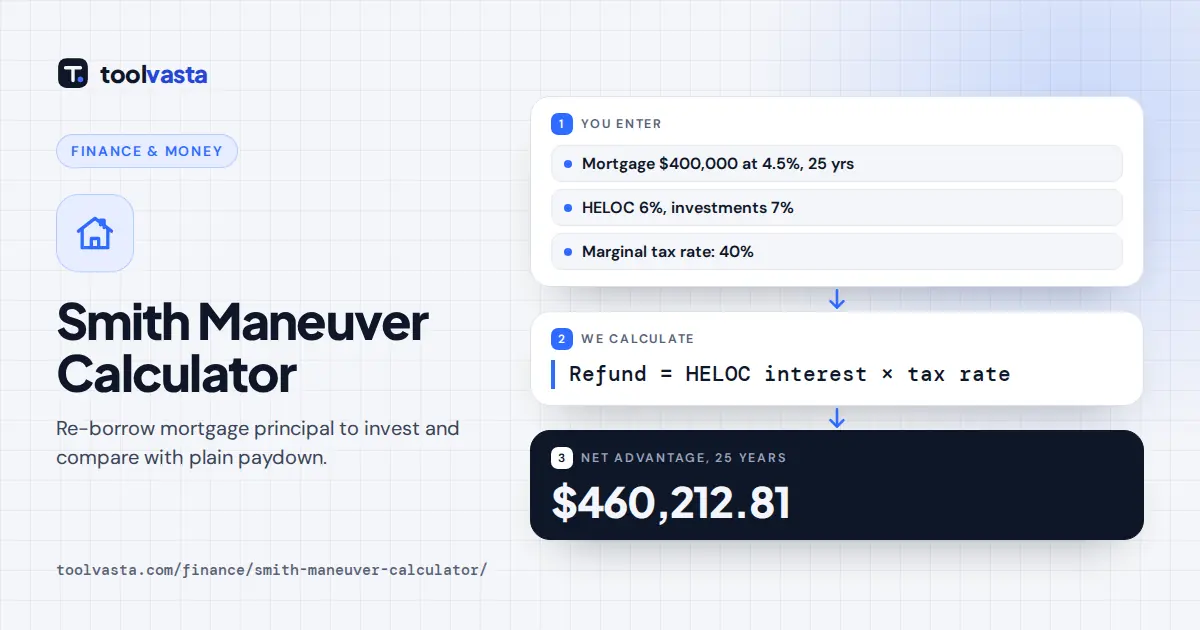
A $400,000 mortgage at 4.5% over 25 years costs $2,213.89 a month. With a 6% HELOC, a 7% investment return and a 40% marginal tax rate, the projection after 25 years shows a portfolio of $1,149,467.03 and a HELOC of $400,000.00. You would pay $289,254.23 of HELOC interest and receive $115,701.69 in refunds. The mortgage is gone after 21 years instead of 25.
After counting the interest paid, the strategy is ahead by $460,212.81. With a 4% return instead of 7%, the advantage falls to $130,359.85, which shows how much depends on investment returns.
| Scenario (25 years) | Portfolio | Net advantage |
|---|---|---|
| 7% return, 40% tax rate | $1,149,467.03 | $460,212.81 |
| 4% return, 40% tax rate | $819,614.07 | $130,359.85 |
Because the household using the Smith Maneuver pays HELOC interest out of pocket, its monthly cash outlay is higher than the regular household's. The comparison subtracts that interest, at face value, from the final result, so the net advantage reflects both the extra cost and the extra investments. If you would have to cut other saving to pay the interest, the real advantage is smaller.
Points to Consider
- You need a readvanceable mortgage, where the HELOC limit rises as you pay down principal. Not every lender offers one.
- Keep investment borrowing separate from personal spending. Mixing funds can make interest non-deductible.
- HELOC rates are usually variable. A rise in rates increases the cost while the investments may fall at the same time.
- Investments held in a non-registered account are taxed on dividends and gains, which this projection does not deduct.
- Ask a fee-only advisor or tax professional to review the plan for your situation before starting.
Assumptions and Limits
This is a simplified, neutral model and not financial or tax advice. It assumes constant rates and returns, tax-deferred investment growth, interest paid from your cash flow and refunds received once a year. It ignores taxes on investment income, fees, rate changes and market crashes, all of which can turn the result negative. Interest deductibility follows the Income Tax Act and CRA guidance; see the Canada Revenue Agency for the rules on deducting carrying charges.
Frequently asked questions
What is the Smith Maneuver?
It is a Canadian strategy where you re-borrow the principal you repay on your mortgage through a readvanceable HELOC and invest it. Interest on the investment loan may be tax-deductible, producing a refund that can speed up mortgage repayment.
Is the Smith Maneuver legal in Canada?
Borrowing to invest and deducting eligible interest is permitted under Canadian tax law when the borrowed money is used to earn income from business or property. Get professional advice to make sure your setup qualifies.
What are the risks of the Smith Maneuver?
You keep a large loan for longer, HELOC rates can rise and investments can fall. If returns are below the after-tax cost of borrowing, you can end up worse off than simply paying down the mortgage.
Do I need a readvanceable mortgage?
Yes, in practice. A readvanceable mortgage combines a mortgage with a HELOC whose limit grows as you repay principal, so you can re-borrow what you pay down without reapplying.
How is the tax refund calculated?
The calculator multiplies the HELOC interest for the year by your marginal tax rate. A 40% rate on $10,000 of deductible interest gives a $4,000 refund, which is then used to prepay the mortgage.
Does this calculator give financial advice?
No. It is an educational projection using your own assumptions. Real results depend on markets, rates, tax rules and how the strategy is set up. Speak with a qualified advisor before using leverage.