How to Use the Prorated Rent Calculator
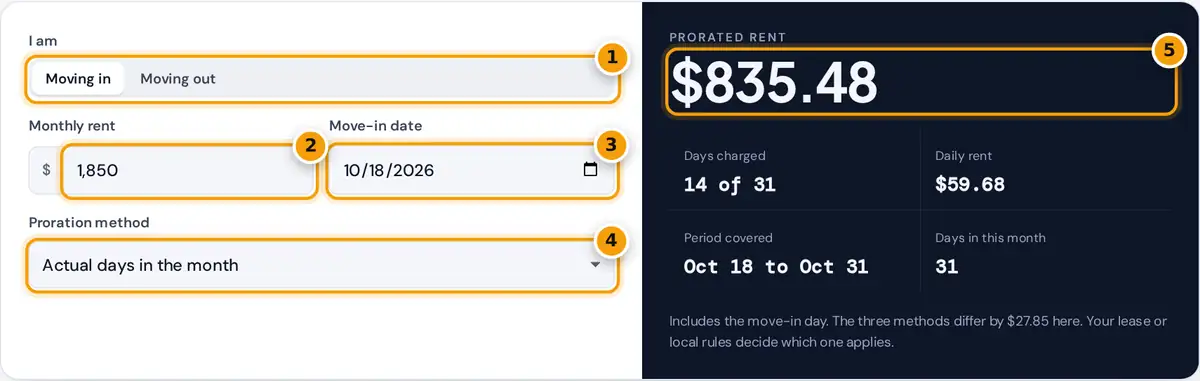
- Choose whether you are moving in or moving out.
- Enter the full monthly rent.
- Pick your move-in or move-out date. The move-in day is included.
- Choose the proration method your lease uses: actual days, 365-day year or 30-day month.
- Read the prorated rent, the days charged and the daily rent.
Choose moving in or moving out, enter the full monthly rent and pick the date. For a move-in, the prorated rent calculator charges rent from that day through the very last day of the month.
For a move-out, it charges from the first of the month through your last day in the unit. Both the move-in day and the move-out day count as days occupied, because you hold the keys.
Pick the method your lease uses. The comparison table shows the daily rate and amount for all three methods at once, so this prorate calculator also shows how much the method changes the partial month.
Prorated Rent Formulas
Yearly: (rent × 12) ÷ days in the year × days occupied
30-day month: rent ÷ 30 × days occupied
The most common method divides the monthly rent by the actual days in the month, then multiplies that daily rate by the days occupied. The daily rate changes from month to month under this method.
The yearly method takes annual rent, which is monthly rent times 12, and divides it by 365 days, or 366 in leap years. That produces the same daily rate in every month of the year.
The 30-day method, also called the banker's month, divides rent by 30 regardless of the calendar. The calculator caps that result at one full month, so a 31-day month never costs more than normal rent.
Worked Example: Moving In on October 18
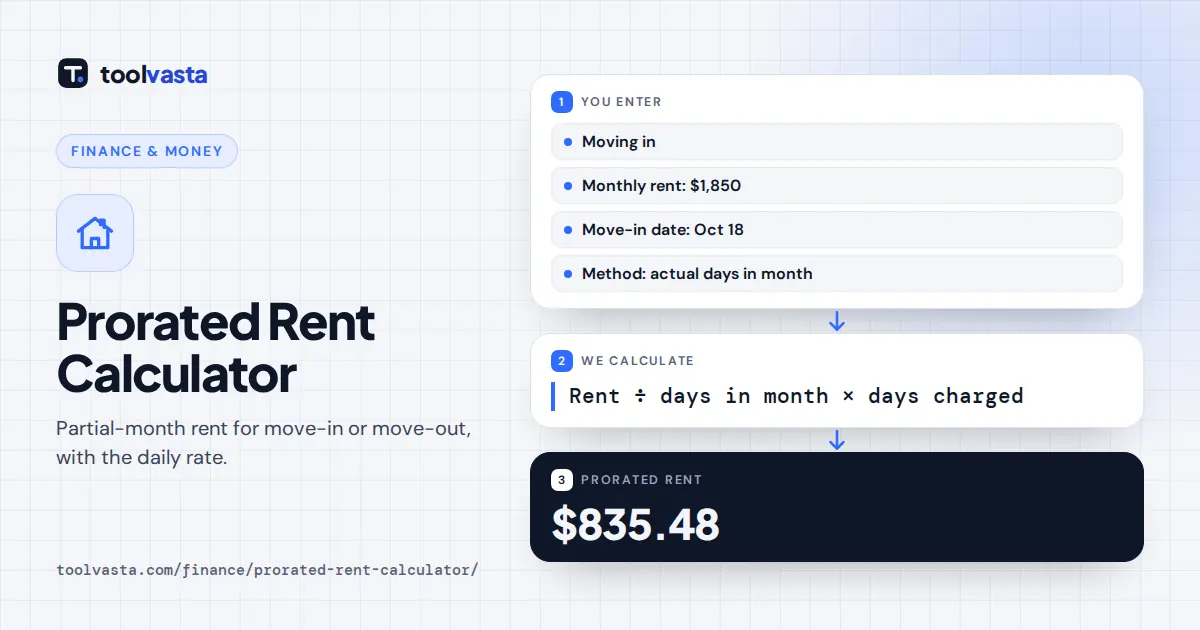
Rent is $1,850 a month and you move in on October 18, 2026. October has 31 days, and counting the move-in day you occupy October 18 to 31, which is 14 days in total here.
Under the days-in-month method the daily rate is $59.68 and the charge is $835.48. The yearly method gives $851.51, and the 30-day method gives $863.33, with every single amount on screen rounded to the cent.
The gap between the cheapest and dearest method is $27.85 here. Landlords often collect this partial amount along with the first month's rent, so ask exactly which total is due before you sign anything else.
| Method | Daily rate | 14 days of October |
|---|---|---|
| Days in month (31) | $59.68 | $835.48 |
| Yearly (365 days) | $60.82 | $851.51 |
| 30-day month | $61.67 | $863.33 |
February and Other Short Months
Month length changes the result more than people expect. Under the days-in-month method, February has only 28 days in 2026, so the same $1,850 rent produces a higher daily rate of $66.07 instead of $59.68.
Moving in on February 15, 2026 also leaves 14 days to pay, but the charge becomes $925.00. The yearly method still gives $851.51 and the 30-day method still gives $863.33 for those same 14 days.
So in a 31-day month the actual-days method favors the tenant, while in February it favors the landlord. Knowing this in advance can help both sides pick a fair method before the lease is signed.
Which Proration Method Should You Use?
No single method is universally required. The choice is a matter for the landlord and tenant, so the lease agreement or a move-in letter should name the method in writing before any money changes hands.
Most residential leases use actual days in the month. Commercial leases and leases priced by the year often use annual rent divided by 365, while the 30-day method appeals to many for its simple arithmetic.
Landlords often prorate to reduce vacancy and start occupancy sooner. If a dispute arises, show the calculation with the daily rate and days counted, which usually settles any disagreement over the amount owed very quickly.
| Method | Daily rate | Typical use |
|---|---|---|
| Actual days in the month | Changes each month | Most residential leases |
| Annual rent ÷ 365 | Same all year | Leases priced by year, commercial leases |
| 30-day month (banker's month) | Same all year | Simple calculations |
Prorated Rent in Canada
Residential tenancy rules are set by each province and territory. In many provinces a tenancy can start on any day, and the partial first month is agreed in the written tenancy agreement between both parties.
Notice to end a monthly tenancy usually has to line up with the end of a rental period. Ontario's renting rights guide explains this, so a mid-month move-out does not always reduce the rent owed.
Rent increases, the security deposit and every notice period are regulated separately. British Columbia publishes its rules through the Residential Tenancy Branch, and other provinces and territories run similar offices that answer questions from tenants.
Assumptions and Extra Charges
The calculator handles one partial month at a time. For a stay that spans longer, add the full months at the normal rent, then add the prorated amount for the first or last month separately.
Utilities, parking and storage billed monthly are not included automatically. Prorate them separately with the same daily method, or check the lease, because some fixed fees are charged in full whatever the actual move date.
A lease renewal normally continues on the same billing date, so no proration is needed unless the dates leave a gap or overlap. Results are estimates, and your lease or provincial rules decide what applies.
Frequently asked questions
How do I calculate prorated rent?
Divide the monthly rent by the number of days in the month to get a daily rate, then multiply by the days you occupy the unit. For example, $1,850 for 14 days of October is $835.48.
Is the move-in day included in prorated rent?
Yes. Rent is normally charged for the move-in day, so moving in on the 18th of a 31-day month means paying for 14 days, from the 18th through the 31st inclusive.
What is the 30-day method for prorating rent?
It divides the monthly rent by 30 for every month, which is why it is called the banker's month. It is simple, but it charges slightly more in 31-day months and less in February.
Do landlords have to prorate rent?
Usually not. Prorating is a matter of agreement in most places, so a landlord may start the tenancy on the 1st instead. Check your provincial rules and get any prorated arrangement in writing.
How do I prorate rent for a move-out?
Count the days from the first of the month to your move-out day, including that day, and multiply by the daily rate. Remember that your notice usually must end on the last day of a rental period.
Does prorated rent apply to utilities?
Not automatically. Utilities and parking billed monthly follow the lease terms. Many landlords prorate them with the same daily method, while metered utilities are simply billed for the actual usage period.