How to Use the Rent Increase Calculator
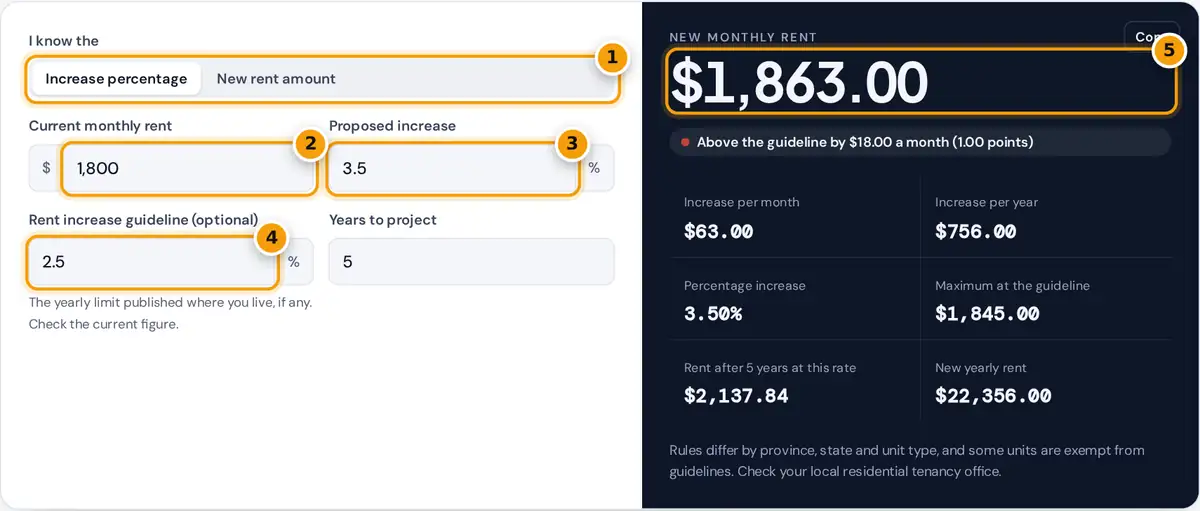
- Choose whether you know the increase percentage or the new rent.
- Enter the current monthly rent.
- Enter the proposed increase from the notice.
- Type this year's guideline where you live, and the years to project.
- Read the new rent, the increase and whether it is within the guideline.
Choose whether you know the increase as a percentage or as a new rent amount. Enter the current monthly rent and either the percentage in the notice or the new rent. The calculator shows the new rent, the increase per month and per year, and the percentage, so a tenant can check a notice and a landlord can check the figure before sending one.
If your province, state or city sets a yearly rent increase guideline, type the current figure in the guideline box. The calculator then shows the maximum rent at that guideline and whether the proposed rent is above or within it. Finally, choose how many years to project to see how the rent grows if the same percentage repeats each year.
Rent Increase Formulas
increase % = (new rent ÷ current rent − 1) × 100
maximum at guideline = current rent × (1 + guideline %)
rent after n years = current rent × (1 + increase %)n
Increases compound. A 3.5% raise applied five years in a row adds 18.8% in total, not 17.5%, because each year's increase is calculated on a rent that already went up. The projection table shows this year by year, along with the total extra paid compared with today's rent.
Landlords can use the same numbers to plan. Entering the guideline shows the exact maximum rent to the cent, which helps avoid a notice that exceeds the limit by a few dollars through rounding.
Worked Example
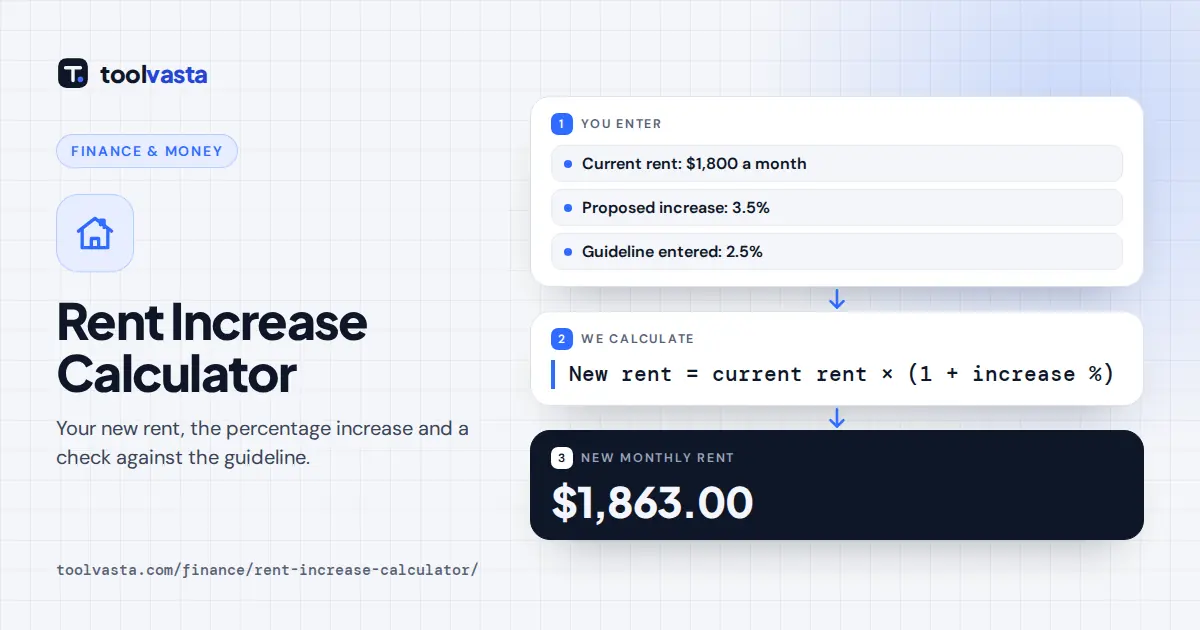
A tenant pays $1,800 a month and receives a notice for a 3.5% increase. The new rent is 1,800 × 1.035 = $1,863.00, an increase of $63.00 a month or $756.00 a year. If the guideline where they live is 2.5% for the year, the maximum rent under the guideline would be $1,845.00, so the proposed rent is $18.00 a month, or 1.00 percentage point, above it.
If the rent kept rising by 3.5% a year, it would reach $1,928.20 in year two and $2,137.84 after five years. Over those five years the tenant would pay several thousand dollars more than at today's rent, which the last column of the table totals.
Rent Increase Guidelines in Canada
Several Canadian provinces, including Ontario, British Columbia and Manitoba, publish an annual rent increase guideline that caps how much rent can rise for most existing tenancies, and other jurisdictions have their own rules. Guidelines change every year and some units are exempt, so this calculator does not hard-code them. Look up the current figure for your province and enter it. Ontario's rules are explained on its residential rent increases page.
| Current rent | +2% | +2.5% | +3% | +5% |
|---|---|---|---|---|
| $1,200 | $1,224.00 | $1,230.00 | $1,236.00 | $1,260.00 |
| $1,500 | $1,530.00 | $1,537.50 | $1,545.00 | $1,575.00 |
| $1,800 | $1,836.00 | $1,845.00 | $1,854.00 | $1,890.00 |
| $2,200 | $2,244.00 | $2,255.00 | $2,266.00 | $2,310.00 |
| $2,800 | $2,856.00 | $2,870.00 | $2,884.00 | $2,940.00 |
Tips for Tenants and Landlords
- Check how much written notice your jurisdiction requires and how often rent can be raised. Many places allow only one increase every 12 months.
- Some provinces let landlords apply for an increase above the guideline for major repairs or large tax increases. These usually need approval from the tenancy board.
- New units, some newer buildings and certain types of housing may be exempt from guidelines. Confirm whether your unit is covered.
- Budget for the projected rent, not only next year's. Small yearly increases add up quickly.
- Keep copies of every notice and receipt in case of a dispute.
Assumptions and Limits
The calculator does math only. It does not know the current guideline, the notice rules or the exemptions where you live, and it is not legal advice. Projections assume the same percentage every year, while real increases vary. For a dispute, contact your provincial or local residential tenancy office.
Frequently asked questions
How do I calculate a rent increase percentage?
Divide the new rent by the current rent, subtract 1 and multiply the result by 100. Going from $1,800 to $1,863 a month is an increase of 3.5%.
How much can my landlord raise the rent?
It depends on where you live. Several Canadian provinces set a yearly rent increase guideline for most units, and some places have no cap. Check the current figure with your residential tenancy office.
Does this calculator include the Ontario or BC guideline?
No. Guidelines change every year and some units are exempt, so you enter the current figure yourself. The calculator then checks whether a proposed rent is within it.
How do I calculate my new rent?
Multiply the current rent by one plus the increase written as a decimal. A 2.5% increase on $1,800 is 1,800 times 1.025, which equals $1,845 a month.
How often can rent be increased?
Many jurisdictions allow one increase every 12 months with written notice given months in advance. Rules vary, so confirm the notice period and timing that apply to your tenancy.
Why does my rent grow faster than the percentage suggests?
Because increases compound. Each year's percentage applies to the already increased rent, so five years at 3.5% raise the rent by about 18.8%, not 17.5%.