How to Use the Appreciation Calculator
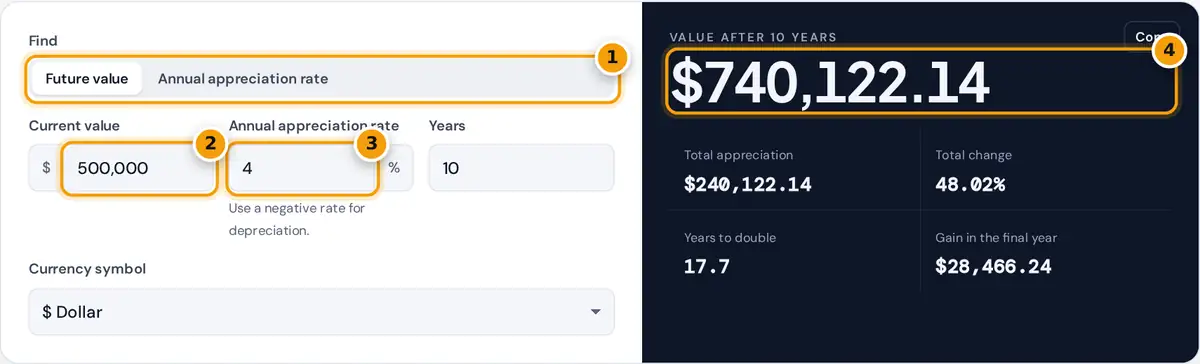
- Choose future value or annual appreciation rate.
- Enter the current value of the home or asset.
- Enter the yearly appreciation rate and the number of years.
- Read the future value, total gain and the years to double.
To project a future value, enter what the asset is worth today, the yearly appreciation rate you want to assume and the number of years. The calculator compounds the rate each year and shows the future value, the total gain, the percentage change and how long the value takes to double. A negative rate models depreciation, as with most vehicles and equipment.
To measure past performance, switch to Annual appreciation rate and enter the purchase price, the current or sale value and how long you have owned the asset. You get the average compound rate per year, which lets you compare a home, a piece of land or a collectible with other investments. The year-by-year table downloads as a CSV file.
Appreciation Formulas
annual appreciation rate = (current value ÷ purchase price)1/years − 1
years to double = ln 2 ÷ ln(1 + r)
Appreciation compounds: each year's gain is calculated on a value that already includes earlier gains. That is why 4% a year for 10 years adds 48% rather than 40%. The rate formula is the same as a compound annual growth rate, so it gives the steady yearly rate that would turn the purchase price into today's value.
The simple average gain per year divides the total gain by the years owned. It is easy to understand but overstates the rate on later years and is not comparable with interest rates.
Worked Example
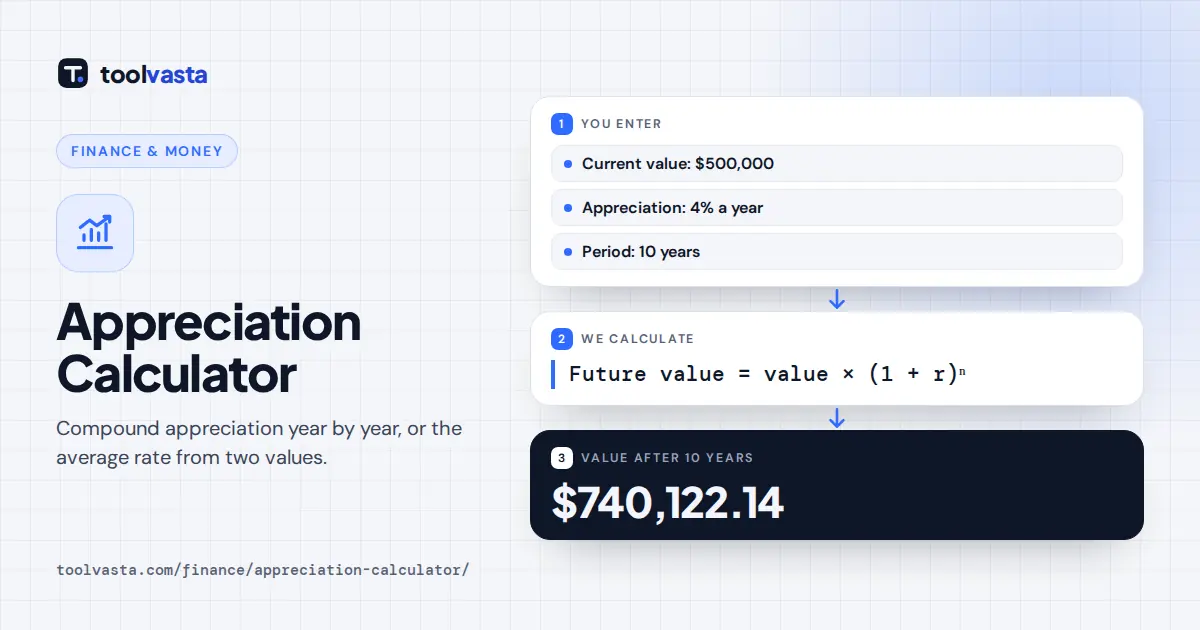
A home worth $500,000 that appreciates 4% a year is worth $740,122.14 after 10 years, a gain of $240,122.14 or 48.02%. At 4% the value doubles in about 17.7 years.
A property bought for $300,000 and worth $450,000 after 8 years has appreciated $150,000, or 50%. The average annual appreciation rate is 5.199%. A $30,000 vehicle that loses 15% a year is worth $13,311.16 after five years.
| $500,000 at | 5 years | 10 years | 20 years |
|---|---|---|---|
| 2% a year | $552,040.40 | $609,497.21 | $742,973.70 |
| 3% a year | $579,637.04 | $671,958.19 | $903,055.62 |
| 4% a year | $608,326.45 | $740,122.14 | $1,095,561.57 |
| 5% a year | $638,140.78 | $814,447.31 | $1,326,648.85 |
Small differences in the rate grow large over long periods, so test a range rather than a single figure.
For real estate, the rate you use matters more than any other input. A home in a fast-growing city and a rural property can move at very different speeds, and a decade of strong gains can be followed by flat years. Many owners therefore test a cautious, a middle and an optimistic rate rather than relying on one number.
Collectibles, art and land behave differently again. They pay no income, prices can be hard to verify and selling costs can be high, so the appreciation rate needs to be higher just to match an investment that pays interest or dividends. Measuring the past rate with the second mode is a good reality check before you buy more.
Tips for Estimating Appreciation
- Base the rate on long-term local history, not the last year or two. Short periods can be far above or below the trend.
- Remember that appreciation is not profit. For a home, subtract selling costs, renovations, property tax and maintenance.
- Compare appreciation with inflation. A 3% rise during 3% inflation is no real gain in buying power.
- For a rental property, add the rental income on top of appreciation to judge the total return.
- Use a negative rate to estimate how much a car, boat or equipment will be worth when you sell it.
Assumptions and Limits
The calculator applies one steady rate every year. Real values rise and fall with markets, interest rates and the condition of the asset. Past appreciation does not predict future appreciation. Amounts work in any currency. This is an estimate, not an appraisal. To see what a sale would leave you after costs, try the home sale proceeds calculator.
Frequently asked questions
How do you calculate appreciation?
Multiply the current value by one plus the annual rate, raised to the number of years. A $500,000 home growing 4% a year is worth about $740,122 after 10 years.
How do I calculate the appreciation rate of my home?
Divide the current value by the purchase price, raise the result to the power of one divided by the years owned, and subtract one. A home that rose from $300,000 to $450,000 in 8 years gained about 5.2% a year.
What is the difference between appreciation and depreciation?
Appreciation is an increase in value over time, while depreciation is a decrease. The same formula handles both: use a positive rate for appreciation and a negative rate for depreciation.
Is appreciation the same as return on investment?
No. Appreciation only measures the change in value. Return on investment also includes income such as rent and costs such as taxes, maintenance, interest and selling fees.
Why does compound appreciation grow faster than simple?
Each year's gain is added to the value, and the next year's gain is calculated on that larger amount. Over long periods, this compounding adds noticeably more than a flat yearly amount.
What appreciation rate should I use for real estate?
Use the long-term average for your local market from a reliable source, and test higher and lower rates. Local conditions vary widely, and no rate is guaranteed.