How to Use the Debt Payoff Calculator
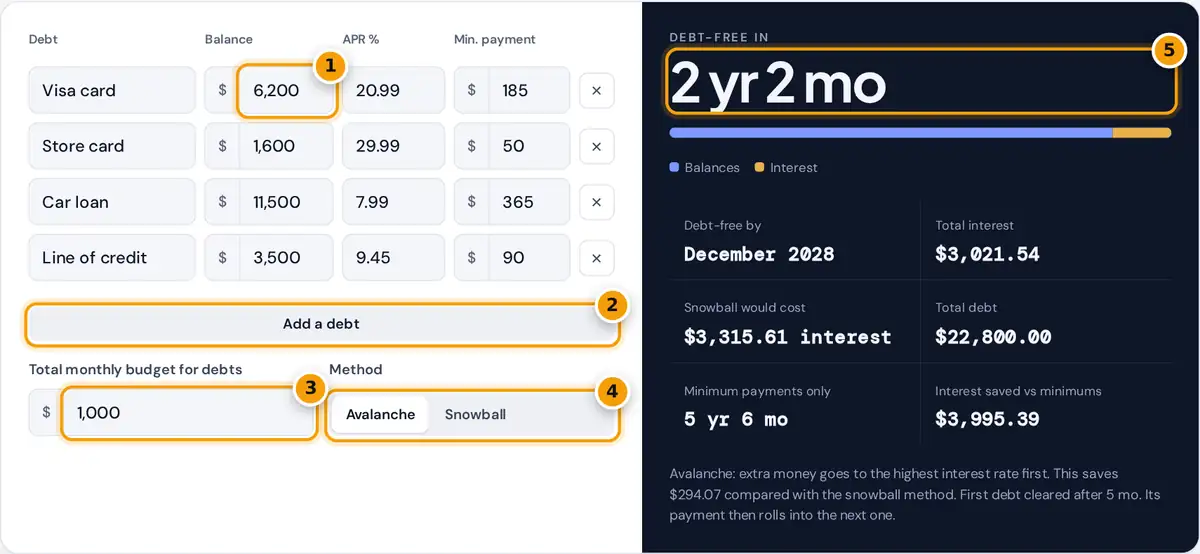
- Enter each debt's balance, APR and minimum payment. Use Add a debt for more rows.
- Add a row for every credit card, loan or line of credit you want in the plan.
- Enter the total you can pay toward all debts each month.
- Choose avalanche to save the most interest, or snowball to clear small balances first.
- Read how long until you are debt-free, then compare total interest with the other method.
List each debt with its balance, its interest rate as an APR and the minimum payment the lender currently requires each month. Add rows for more debts, or remove the sample rows with the × button.
Then enter your total monthly budget for all your debts combined. It must cover every minimum payment, and anything above the minimums becomes the extra money that drives the plan forward and shortens your timeline.
Next, pick the avalanche or snowball method. The calculator shows your debt-free date, total interest, the cost of the other method, the minimums-only comparison and a payoff order table listing when each balance reaches zero.
Debt Avalanche vs Debt Snowball
Both methods pay the minimum on every debt and send extra money to one target debt. When that debt is gone, its payment rolls over to the next target, so your total payment never shrinks.
Pay the minimum on every debt
Extra = monthly budget − minimums paid, applied to the target debt until it reaches zero
The debt avalanche targets the highest interest rate first. Mathematically it always costs the least interest, or at worst ties with the alternative, because every extra dollar goes where it is being charged the most.
The debt snowball targets the smallest balance first, whatever its rate. You close whole accounts sooner, which many people find motivating, but the plan can cost more when a large debt carries a high rate.
Worked Example: Four Debts and $1,000 a Month
Four debts total $22,800: a Visa card of $6,200 at 20.99% with a $185 minimum, a store card of $1,600 at 29.99% with a $50 minimum, and two larger loans described in the next paragraph.
A car loan of $11,500 at 7.99% needs $365 a month, and a line of credit of $3,500 at 9.45% needs $90. Together the minimums total $690, leaving $310 extra from a $1,000 monthly budget.
| Plan with the example debts | Debt-free in | Total interest |
|---|---|---|
| Avalanche, $1,000 a month | 2 yr 2 mo | $3,021.54 |
| Snowball, $1,000 a month | 2 yr 3 mo | $3,315.61 |
| Minimum payments only | 5 yr 6 mo | $7,016.94 |
With the avalanche, the store card goes first, then the Visa card, the line of credit and finally the car loan, for $3,021.54 of total interest. The snowball takes one month longer and costs $3,315.61.
Which Method Should You Choose?
If your goal is to save money, choose the avalanche. In the example it saves $294.07 compared with the snowball, simply by attacking the 29.99% store card and the Visa card before the cheaper debts.
If you have several small balances and need quick wins for motivation, the snowball can justify a small extra cost. Behavior often matters more than math: the best plan is the one you stick with.
The gap between methods is widest when a small debt has a low rate and a large debt has a high rate. When balances and rates line up, both methods give almost the same answer.
Why Minimum Payments Take So Long
Paying only the minimums on the same four debts would take 5 years 6 months and cost $7,016.94 in interest. That is about $3,995 more than the avalanche plan, all interest saved by structure alone.
The difference comes from rollover. In a minimums-only plan, each freed payment simply disappears when a debt ends, while the avalanche and snowball keep your whole budget working until the very last balance is gone.
Revolving debt makes this worse in real life, because many credit card minimums shrink as balances fall. Keeping your payment fixed at today's amount, as this calculator does, is the easiest way around that trap.
Making the Plan Work
Stop adding new charges to the debts you are paying off, or the plan will slip month after month. A small emergency fund helps, since surprise bills then do not end up on a card.
- Ask your card issuer for a lower rate, or move a high-rate balance with a balance transfer offer.
- Put raises, bonuses and tax refunds toward the target debt.
- Compare a few monthly budgets, because the size of the budget changes the date most.
Debt consolidation into one lower-rate loan can simplify payments, but only if the new rate really is lower and the old cards stay paid off. Check every fee before you sign anything with a lender.
If your debts feel unmanageable, a non-profit credit counseling agency can help you budget and negotiate with creditors. The FCAC guide to credit counseling also explains debt management plans and when a consumer proposal fits.
Assumptions and Limits
Interest is charged monthly at APR / 12, rates stay the same, no new debt is added and every payment arrives on time. Real lenders may calculate daily interest, so treat every result as an estimate.
Minimum payments stay at the amounts you enter, and the minimums-only comparison pays each minimum with no rollover. Promotional rates that expire, annual fees and late fees are not modeled, so the estimates may differ.
Most plans leave out the mortgage and focus on cards, lines of credit, car loans and student loans. For more support, the federal managing debt resources cover budgets, collection agencies and other options for Canadians.
Frequently asked questions
What is the debt avalanche method?
You pay the minimum on every debt and put all extra money toward the debt with the highest interest rate. When it is paid off, its payment moves to the next highest rate. It costs the least total interest.
What is the debt snowball method?
You pay the minimum on every debt and put the extra toward the smallest balance first. Each debt you clear frees its payment for the next smallest. It gives quick wins but can cost more interest.
Is the avalanche or snowball method better?
Avalanche saves the most money because it targets the most expensive debt first. Snowball can keep you motivated with early wins. Often the difference is small, so pick the one you will stick with.
How long will it take to pay off my debt?
It depends on your balances, rates and monthly budget. Enter them above to see your debt-free date. Raising the monthly budget is usually the most effective way to shorten the timeline.
Should I include my mortgage?
Usually not. Mortgages have low rates and long terms, so most payoff plans focus on credit cards, lines of credit, car loans and student loans, then deal with the mortgage separately later.
Why does paying only the minimum take so long?
Minimums are set low, so most of each payment covers interest. In the example, minimum payments only take 5 years 6 months and cost $7,016.94 in interest, versus $3,021.54 with the avalanche plan.