How to Use the Rent Split Calculator
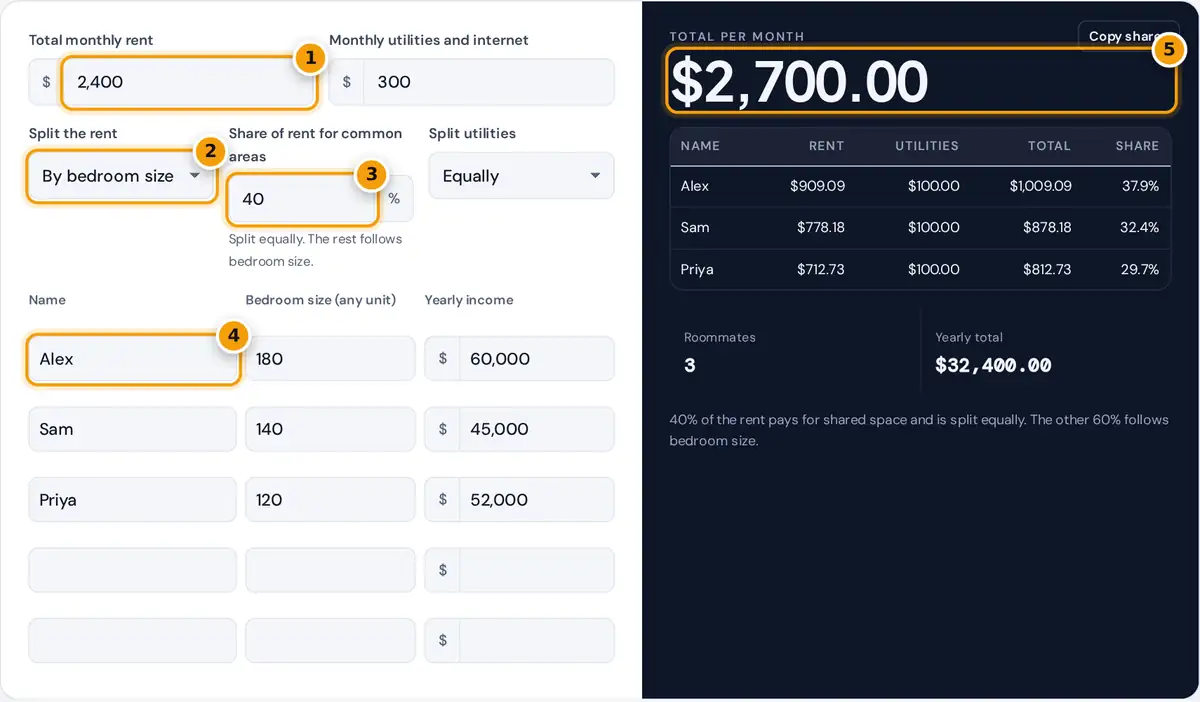
- Enter the total monthly rent and shared utilities.
- Choose to split by bedroom size, by income or equally.
- Set the share of rent that pays for common areas.
- Enter each roommate's name, bedroom size and income if needed.
- Read the total and each person's rent, utilities and share.
Enter the total monthly rent and the monthly cost of shared utilities and internet. Choose how to split the rent. By bedroom size is the most common fair method for roommates: part of the rent covers the kitchen, living room and bathrooms that everyone uses, and is split equally, while the rest follows the size of each bedroom. Set the common-area share to match your home.
By income suits couples or friends with very different earnings who want each person to put the same share of income toward housing. Equally gives everyone the same amount. Add each roommate's name, bedroom size (any unit works, as long as you use the same one for everyone) and yearly income if you need it. Choose whether utilities follow the rent split or are shared equally.
Rent Split Formulas
by income: share = person's income ÷ total income
equal: share = 1 ÷ people
rent owed = total rent × share
utilities = total utilities ÷ people (or × share)
Shares always add up to 100% of the rent. The common-area percentage is a judgement call: a home with a big shared living space and small bedrooms deserves a higher common share, while a place where everyone mostly stays in their own room suggests a lower one. Something between 30% and 50% suits many shared homes.
Couples often prefer the income method because it keeps housing equally affordable for both partners. Roommates who are not a couple usually prefer the room-size method, because it ties what each person pays to the space they get. Whichever method you choose, use the same split for the deposit so any refund is easy to share.
Worked Example
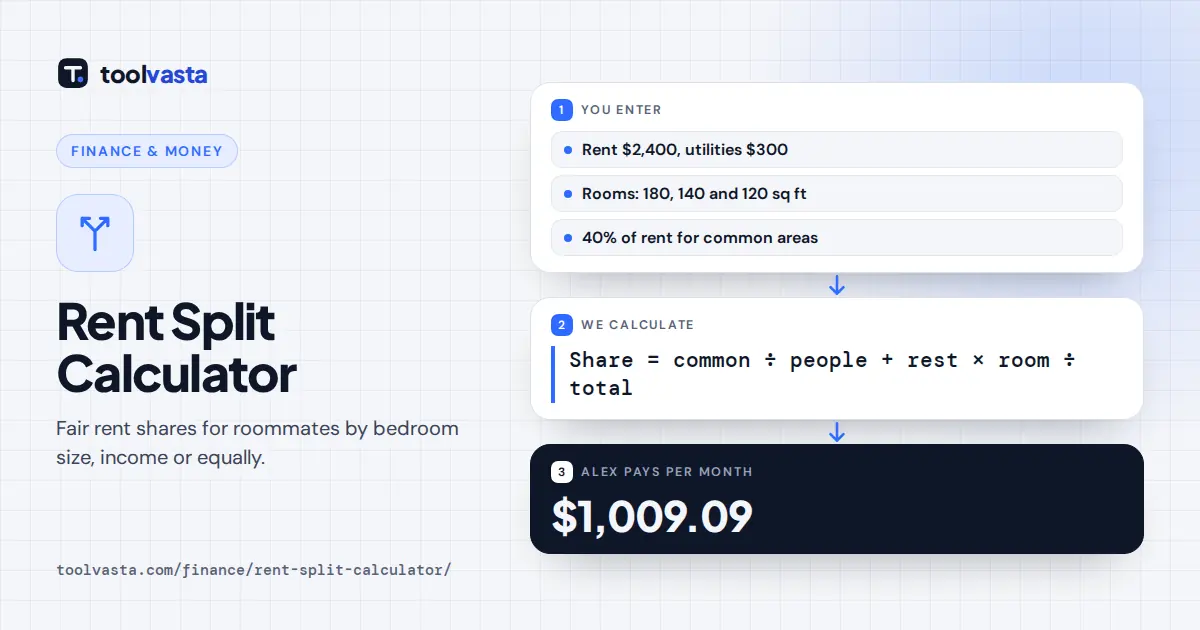
Three roommates share a $2,400 apartment with $300 of utilities. Bedrooms are 180, 140 and 120 sq ft, a total of 440. With 40% of the rent for common areas, $960 is split equally at $320 each. The other $1,440 follows room size: Alex pays $589.09, Sam $458.18 and Priya $392.73. Adding $100 each for utilities, the monthly totals are $1,009.09, $878.18 and $812.73.
Split by income instead, with incomes of $60,000, $45,000 and $52,000, Alex pays 38.2% of the rent ($917.20), Sam 28.7% ($687.90) and Priya 33.1% ($794.90). An equal split would be $800 of rent each, or $900 with utilities.
Comparing Split Methods
| Method | Best for | Watch out for |
|---|---|---|
| Equal | Similar rooms, similar budgets | Unfair when one room is much bigger |
| Bedroom size | Roommates with different rooms | Ignores private bathrooms and balconies |
| Income | Couples and partners | Needs openness about income |
Features that make one room better, such as a private bathroom or a parking spot, can be handled by adding a little to that person's bedroom size until everyone agrees the result is fair.
Tips for Roommates
- Agree on the method before you sign the lease and write it down, including how utilities, internet and streaming are split.
- Remember that on a joint lease each tenant can be responsible for the whole rent if someone leaves, depending on your local tenancy rules.
- Review the split if someone moves rooms, a partner moves in, or the rent goes up.
- Use the copy button to share the exact figures so nobody has to redo the math.
- Set up automatic transfers to whoever pays the landlord so rent is never late.
Assumptions and Limits
The calculator uses the sizes and incomes you enter and rounds each share to the cent, so totals can differ by a cent. It does not handle partial months, which our prorated rent calculator covers. Fairness is ultimately an agreement between roommates, so use these figures as a starting point for that conversation. Amounts work in any currency.
Frequently asked questions
How do you split rent fairly between roommates?
A common method charges part of the rent for shared spaces equally and splits the rest by bedroom size. With different budgets, splitting by income is another fair option many couples use.
How do I split rent by room size?
Choose a share for common areas, split it equally, then divide the remaining rent by each bedroom's share of the total bedroom area. A 180 sq ft room out of 440 gets 40.9% of that part.
How should couples split rent by income?
Divide each partner's income by the combined income, then multiply by the rent. A partner earning 60% of the household income pays 60% of the rent, so both contribute the same share of earnings.
Should utilities be split by room size too?
Usually utilities are split equally because everyone uses heat, water and internet similarly. If one person works from home all day, you could agree to split them like the rent instead.
What percentage of rent should be for common areas?
There is no fixed rule. Many roommates use 30 to 50 percent, higher when shared spaces are large and bedrooms are small, and lower when bedrooms are the main living space.
What if one bedroom has a private bathroom?
Add some extra area to that bedroom's size, such as the bathroom's floor area, so its owner pays a little more. Agree on the adjustment together before you calculate.