How to Use the Food Cost Calculator
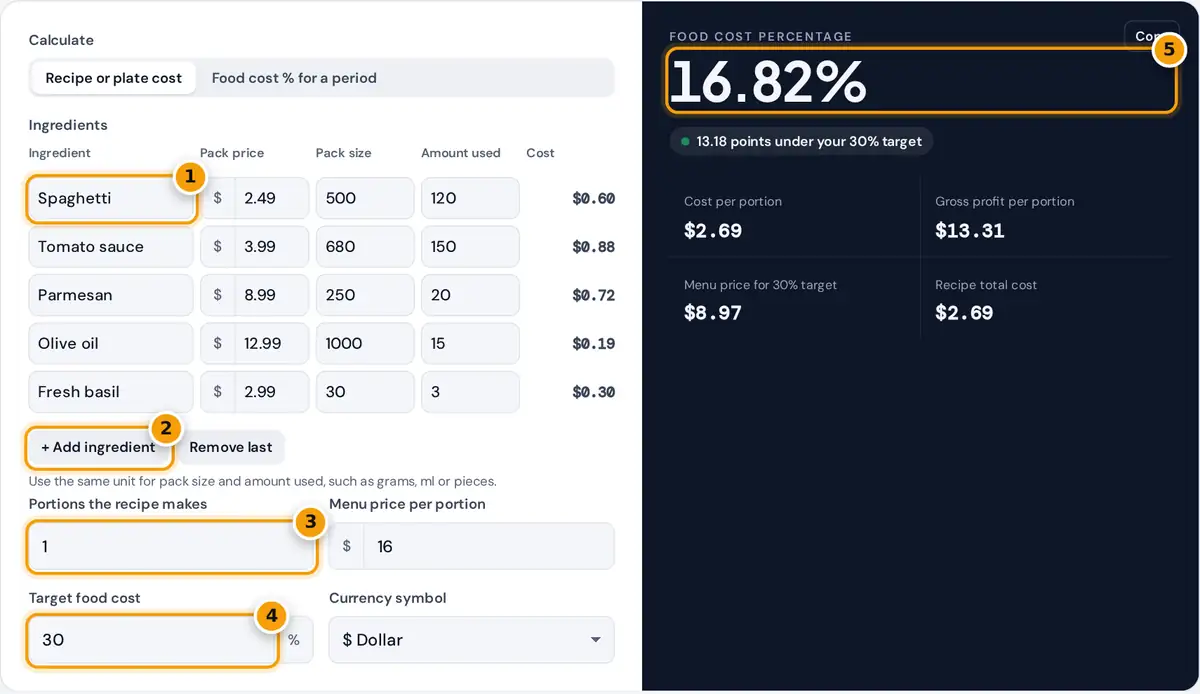
- List each ingredient with its pack price, pack size and amount used.
- Add rows for every ingredient, garnish and sauce.
- Enter the portions the recipe makes and the menu price.
- Set your target food cost percentage.
- Read the food cost %, plate cost and the price that hits your target.
In recipe mode, list each ingredient with the price you pay for a pack, the size of the pack and how much of it goes into the recipe. Use the same unit for pack size and amount used: grams with grams, millilitres with millilitres, or pieces with pieces. The calculator shows the cost of each line, then the recipe total. Enter how many portions the recipe makes and the menu price of one portion.
The result is the food cost percentage of the dish, the cost and gross profit per portion, and the menu price that would hit your target food cost. Period mode works for a whole kitchen: enter beginning inventory, purchases, ending inventory and food sales for a week or month to get your actual food cost percentage.
Food Cost Formulas
plate cost = recipe total ÷ portions
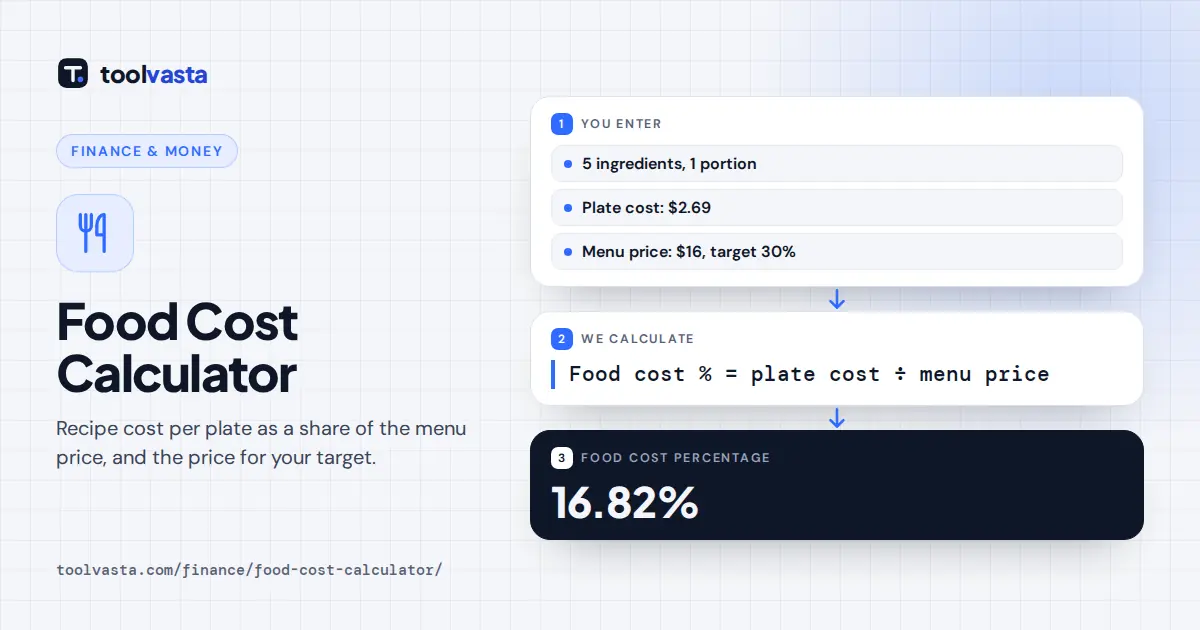
food cost % = plate cost ÷ menu price
menu price for a target = plate cost ÷ target %
period food cost = beginning inventory + purchases − ending inventory
Food cost percentage shows what share of each sale goes to ingredients. The rest, the gross profit, has to cover labor, rent, utilities and profit. Dividing the plate cost by the target percentage gives the price that keeps the dish on target, a method many kitchens use as a starting point before adjusting for the market.
Period food cost uses the cost of goods sold formula. Counting inventory at the start and end of the period captures what was actually used, including waste, spoilage and over-portioning that recipe costing misses.
Worked Example
A pasta dish uses 120 g of spaghetti from a $2.49 pack of 500 g, 150 ml of sauce from a $3.99 jar of 680 ml, 20 g of parmesan from $8.99 for 250 g, 15 ml of olive oil from $12.99 per liter and 3 g of basil from $2.99 for 30 g. The plate costs $2.69. At a $16 menu price the food cost is 16.82%, leaving $13.31 of gross profit, and a 30% target would allow a price as low as $8.97.
For a month with $8,000 of opening inventory, $22,000 of purchases, $7,500 of closing inventory and $75,000 of food sales, food used is $22,500 and food cost is 30.00%.
| Ingredient | Pack | Used | Line cost |
|---|---|---|---|
| Spaghetti | $2.49 for 500 g | 120 g | $0.60 |
| Tomato sauce | $3.99 for 680 ml | 150 ml | $0.88 |
| Parmesan | $8.99 for 250 g | 20 g | $0.72 |
| Olive oil | $12.99 for 1,000 ml | 15 ml | $0.19 |
| Fresh basil | $2.99 for 30 g | 3 g | $0.30 |
Food cost percentage is only one part of prime cost, which adds labor to food and drink costs. A dish that is cheap to make but slow to prepare can still be expensive overall, so review both numbers when you change the menu.
Tips to Control Food Cost
- Cost every recipe, including garnishes, oil and sauces. Small items add up across hundreds of plates.
- Use yield-adjusted quantities. If a vegetable loses a fifth of its weight in trimming, enter the amount bought, not the amount served.
- Update ingredient prices when suppliers change them. A recipe costed last year may now run several points higher.
- Compare recipe cost with period food cost. A large gap points to waste, theft or portions larger than the recipe.
- Price for gross profit too. A dish with a higher food cost percentage can still earn more dollars per plate.
Assumptions and Limits
Recipe costing assumes exact portions and no waste, so actual food cost usually runs higher. Period mode is only as accurate as your inventory counts and should exclude non-food items and drinks unless you track them together. Targets vary by concept and menu, so choose one that fits your business. Amounts work in any currency. For pricing beyond food, see the markup calculator.
Frequently asked questions
How do you calculate food cost percentage?
Divide the cost of the ingredients in a dish by its menu price and multiply by 100. A plate that costs $2.69 to make and sells for $16 has a food cost of about 16.8%.
How do I calculate the cost of a recipe?
For each ingredient, divide the pack price by the pack size and multiply by the amount used. Add the lines together, then divide by the number of portions for the cost per plate.
What is a good food cost percentage?
It depends on the type of restaurant and menu. Many operators set targets somewhere around a quarter to a third of the price, but your own costs, labor and prices decide the right figure.
How do I set a menu price from food cost?
Divide the plate cost by your target food cost as a decimal. A $2.69 plate with a 30% target needs a price of about $8.97, which you then adjust for the market and competition.
How do I calculate food cost for a month?
Add beginning inventory and purchases, subtract ending inventory, then divide by food sales for the month. This captures waste and portioning, not just recipe costs.
Why is my actual food cost higher than my recipe cost?
Waste, spoilage, over-portioning, staff meals, theft and price changes all raise actual cost above the recipe figure. Compare the two regularly to find where the difference comes from.