How to Use the Barista FIRE Calculator
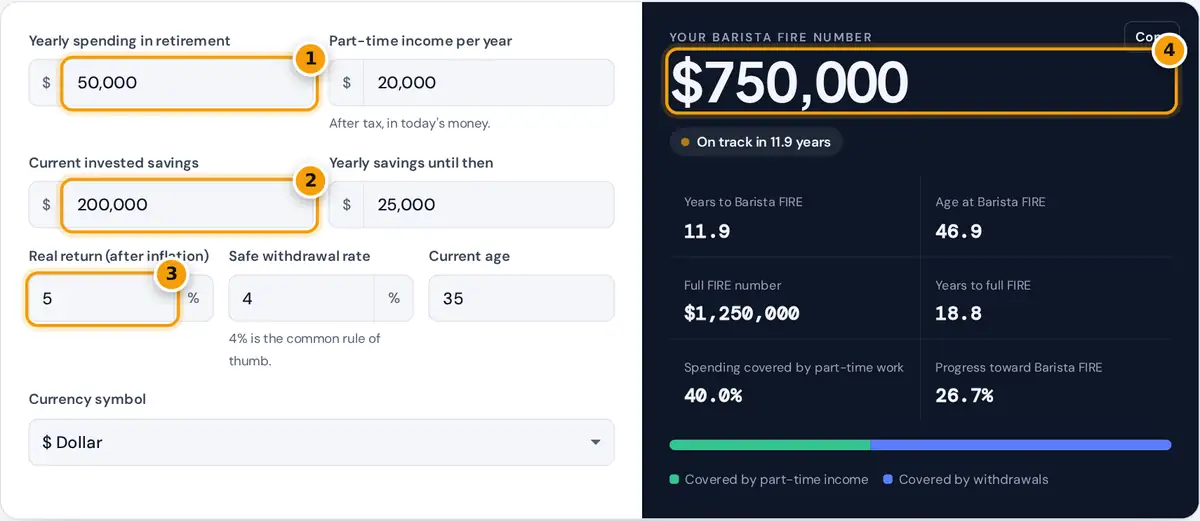
- Enter your yearly spending and expected part-time income.
- Enter your invested savings and what you save each year.
- Set the real return, withdrawal rate and your current age.
- Read your Barista FIRE number, years and age to reach it, and full FIRE.
Enter what you expect to spend each year once you leave full-time work, and the after-tax income you could earn from part-time or flexible work. The name comes from the idea of working a few shifts at a coffee shop, partly for income and partly for workplace benefits, but any lighter work counts: consulting, seasonal jobs or a small business.
Then enter your current invested savings, how much you add each year until you make the switch, the return you expect after inflation and your safe withdrawal rate. The calculator shows your Barista FIRE number, how many years it takes to reach it and at what age, and compares it with the full FIRE number you would need to stop working completely. The table tracks your progress toward both every year.
Barista FIRE Formula
full FIRE number = yearly spending ÷ withdrawal rate
years to target n = ln[(target + C ÷ r) ÷ (savings + C ÷ r)] ÷ ln(1 + r)
With a 4% withdrawal rate, the target is 25 times the yearly gap your portfolio must fill. Part-time income shrinks that gap, so the Barista FIRE number can be far smaller than full FIRE. The years formula assumes you add C at the end of each year and your portfolio grows at the real return r.
Using a real, after-inflation return keeps every figure in today's money, so the spending and income you enter do not need to be inflated.
Worked Example
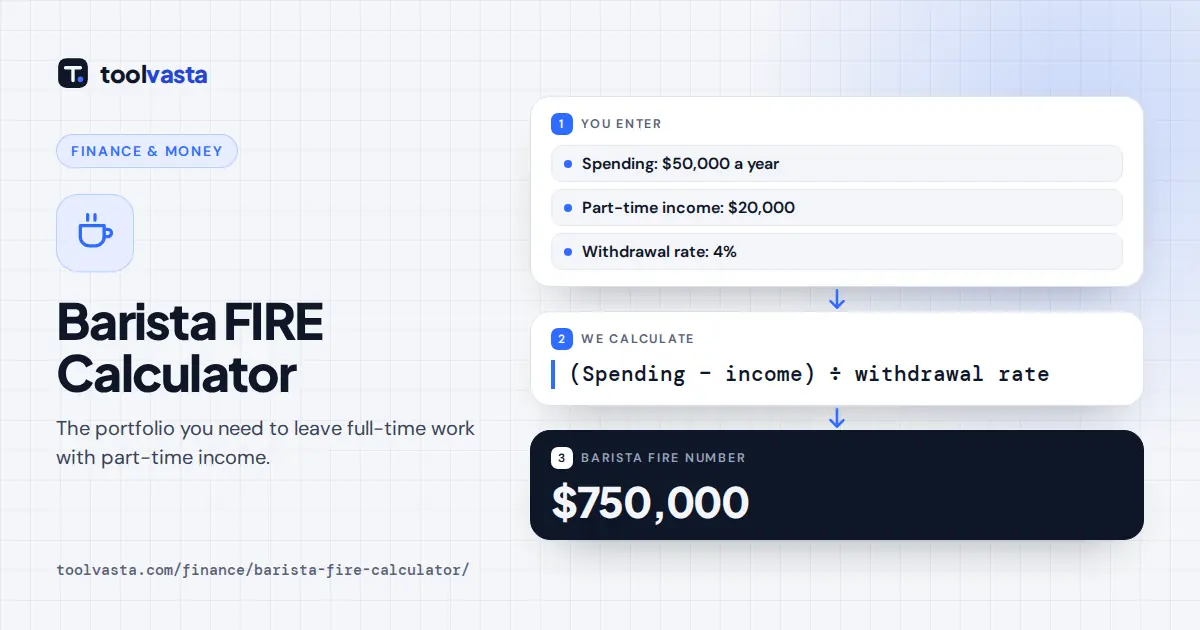
You plan to spend $50,000 a year and can earn $20,000 from part-time work, which covers 40% of your spending. Your portfolio must provide the other $30,000, so at a 4% withdrawal rate your Barista FIRE number is $750,000. Full FIRE would need $1,250,000.
Starting at age 35 with $200,000 invested, saving $25,000 a year and earning a 5% real return, you reach $750,000 in 11.9 years, at about age 46.9. Full FIRE would take 18.8 years. Barista FIRE lets you step back from full-time work about seven years sooner.
| Yearly spending | No part-time income | $15,000 part-time | $25,000 part-time |
|---|---|---|---|
| $40,000 | $1,000,000 | $625,000 | $375,000 |
| $60,000 | $1,500,000 | $1,125,000 | $875,000 |
| $80,000 | $2,000,000 | $1,625,000 | $1,375,000 |
All figures use a 4% withdrawal rate. Every $1,000 of yearly part-time income lowers the target by $25,000.
Barista FIRE sits between two other milestones. Coast FIRE is reached when your savings could grow to a full retirement fund on their own, while full FIRE means withdrawals alone cover your spending. The table below the calculator tracks your progress toward both the Barista and full targets, so you can see how much longer full independence would take if you kept saving.
Tips for Planning Barista FIRE
- Budget for health coverage and benefits you may lose when leaving full-time work. In some countries they are a major reason to keep a part-time job.
- Be realistic about part-time pay and how long you want to keep working. Your portfolio still has to cover everything when you stop.
- Keep investing during the barista years if you can. Even small contributions let the portfolio grow toward full FIRE.
- A lower withdrawal rate, such as 3.5%, adds a safety margin for long retirements.
- Check government pensions and retirement accounts. Access ages and penalties affect when you can draw on savings.
Assumptions and Limits
The calculator uses a steady real return and fixed yearly savings. Markets vary, and a downturn soon after you cut back can strain the plan. The safe withdrawal rate is a guideline from historical studies, not a guarantee. Taxes on withdrawals are not modeled, so enter spending that includes them. This is an educational estimate, not financial advice. For a fuller picture of income in later life, see the retirement income calculator.
Frequently asked questions
What is Barista FIRE?
Barista FIRE is a form of financial independence where you leave full-time work once your investments can cover part of your spending, and a part-time job covers the rest, often including benefits.
How do you calculate your Barista FIRE number?
Subtract your expected part-time income from your yearly spending, then divide by your safe withdrawal rate. With $50,000 of spending, $20,000 of income and a 4% rate, the number is $750,000.
What is the difference between Barista FIRE and Coast FIRE?
With Barista FIRE your portfolio pays part of your spending now while you work part-time. With Coast FIRE you stop saving and let investments grow untouched, while work covers all current spending.
Is the 4% rule safe for early retirement?
It was based on 30-year retirements in historical US data. Early retirees face longer periods, so many choose 3.5% or keep flexible spending. Part-time income in Barista FIRE also adds a buffer.
Should I use a real or nominal return?
Use a real return, meaning the expected return minus inflation. That keeps every result in today's money, so your spending and income targets do not need to be adjusted for future prices.
What happens when I stop part-time work completely?
Your portfolio must then cover all spending, so you need to reach the full FIRE number or have other income, such as a pension. Keep investing during the part-time years to close the gap.