How to Use the APR Calculator
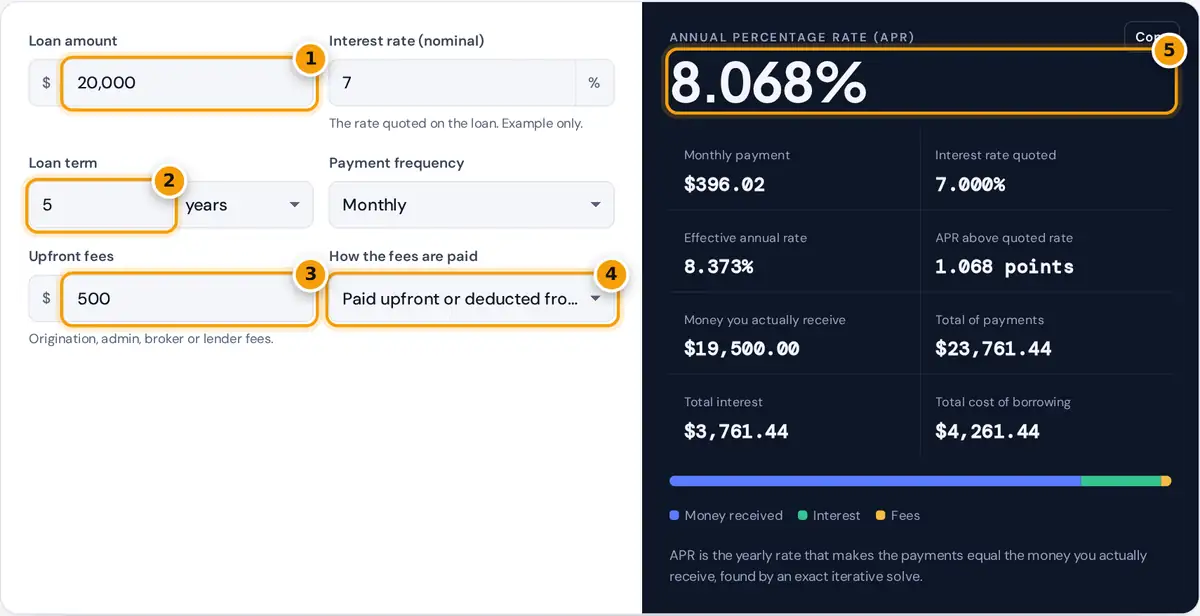
- Enter the loan amount and the quoted interest rate.
- Enter the loan term and choose the payment frequency.
- Enter the upfront fees charged on the loan.
- Choose whether fees are paid upfront or added to the loan.
- Read the APR, then the payment, effective rate and total cost.
Enter the loan amount, the nominal interest rate the lender quotes, the term in years or months and how often you pay. Then enter the upfront fees, such as an origination, administration or broker fee, and choose how they are paid. Fees paid upfront or deducted from the loan mean you receive less than the loan amount. Fees added to the loan mean you receive the full amount but repay a bigger balance.
The calculator works out the payment at the quoted rate, then searches for the yearly rate at which those payments exactly repay the money you actually received. That rate is the APR. It also shows the effective annual rate, total interest and the total cost of borrowing, so two offers with different rates and fees can be compared fairly.
How APR Is Calculated
solve for x: money received = payment × (1 − (1 + x)−n) ÷ x
APR = x × payments per year
effective annual rate = (1 + x)payments per year − 1
cost of borrowing = total of payments − money received
There is no simple formula for x, so the calculator finds it by an iterative solve: it repeatedly halves the range of possible rates until the present value of the payments matches the money received to well beyond a cent. This mirrors the actuarial method used for APR disclosures, where APR is the periodic rate times the number of periods per year.
Worked Example
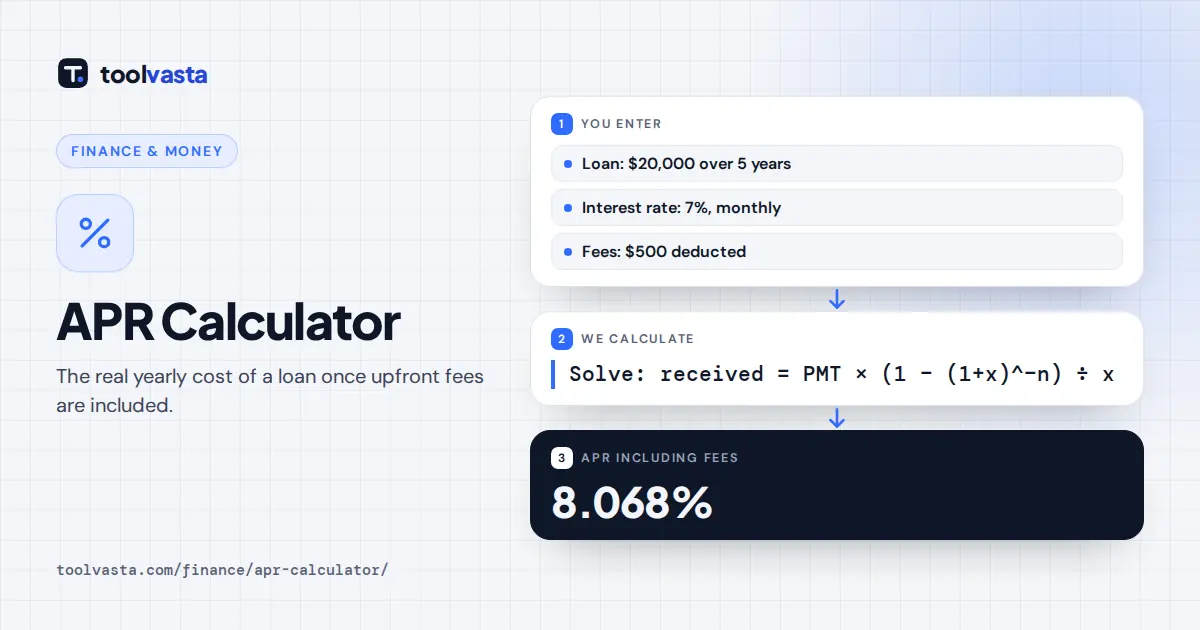
A $20,000 loan at 7% for five years with monthly payments costs $396.02 a month. A $500 fee is deducted, so you receive $19,500. Solving for the rate at which 60 payments of $396.02 repay $19,500 gives an APR of 8.068%, about 1.07 points above the quoted rate. The effective annual rate is 8.373%.
The payments total $23,761.44, of which $3,761.44 is interest. Adding the fee, the total cost of borrowing is $4,261.44. If the $500 fee is added to the loan instead, the payment rises to $405.92 and the APR is 8.041%. Without any fee, APR equals the 7% quoted rate.
How Fees Change APR
| Loan | Rate | Fee | APR |
|---|---|---|---|
| $20,000 over 5 years | 7% | $0 | 7.000% |
| $20,000 over 5 years | 7% | $500 deducted | 8.068% |
| $20,000 over 5 years | 7% | $500 financed | 8.041% |
| $10,000 over 3 years, bi-weekly | 9% | $250 deducted | 10.758% |
| $300,000 over 25 years | 5% | $3,000 deducted | 5.101% |
The same fee raises the APR far more on a small, short loan than on a large, long one, because it is spread over fewer payments and dollars. In Canada, lenders disclose the cost of borrowing and APR under federal rules, and the Financial Consumer Agency of Canada explains how to compare loan offers.
Tips for Comparing Loans
- Compare APRs, not quoted rates, when offers have different fees. The lower APR is the cheaper loan over its full term.
- Check which fees the lender includes. Optional insurance and some third-party charges may be left out of the disclosed APR.
- If you plan to repay early, upfront fees cost you more than the APR suggests, because they are spread over fewer payments.
- For mortgages, compare terms with the same length and payment frequency, and ask about prepayment penalties.
- Use the effective annual rate to compare with savings rates or investments that compound.
Assumptions and Limits
The calculator assumes equal payments at a fixed rate, the first payment one period after the loan starts, and fees paid at the start. Interest compounds once per payment period, so it does not model Canadian mortgage semi-annual compounding. Lender disclosures can differ slightly in day counts and fee treatment. Amounts work in any currency, and this is an estimate, not a loan offer.
Frequently asked questions
What is APR?
APR, the annual percentage rate, is the yearly cost of a loan including interest and most upfront fees. It is the rate at which the payments exactly repay the money you actually receive.
How is APR different from the interest rate?
The interest rate sets the payment on the loan balance. APR also counts fees, so it is higher whenever there are fees. With no fees, APR and the interest rate are the same.
How do I calculate APR with fees?
Find the payment at the quoted rate, then solve for the rate at which those payments repay the loan amount minus fees. The calculator does this iterative solve for you.
Why is the effective annual rate higher than APR?
APR multiplies the periodic rate by the number of payments per year and ignores compounding. The effective annual rate compounds it, so a 7% APR paid monthly is about 7.23% effective.
Is a lower APR always better?
For the full term, a lower APR means a cheaper loan. If you will repay early, compare total costs over the time you expect to keep the loan, because upfront fees weigh more.
Does APR include all fees?
Not always. Rules decide which charges are included, and optional insurance or some third-party fees can be left out. Enter every fee you must pay to see the true cost.