How to Use the Mortgage Refinance Calculator
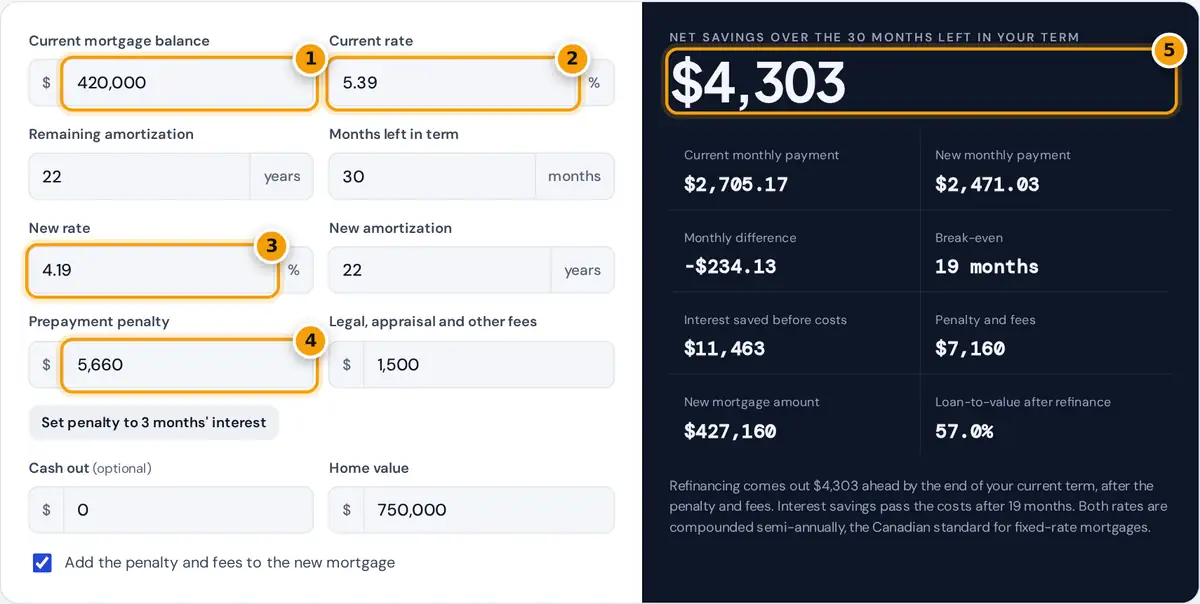
- Enter your current mortgage balance.
- Enter your current rate, remaining amortization and months left in the term.
- Enter the new rate and amortization from your refinance quote.
- Add the prepayment penalty and fees, or use the 3 months' interest button.
- Read your net savings, then check the payment change and break-even month.
Enter your current balance, your current rate, the remaining amortization in years and the number of months left in term. Those four numbers describe the mortgage you would keep if you simply waited for renewal.
Next, enter the new rate you have been offered, the amortization you would choose, the prepayment penalty quote and any legal or appraisal fees. The three months' interest button fills in a quick penalty estimate.
Add optional cash out and your home value to check loan-to-value. Tick the box to roll costs into the new loan, or untick it to pay them in cash. The mortgage refinance calculator updates instantly.
How the Refinance Comparison Works
Payment = L × i / (1 − (1 + i)−N)
Net savings = interest if you stay − interest if you refinance − penalty − fees
Canadian fixed-rate mortgages use semi-annual compounding when quoting rates, a disclosure rule rooted in the federal Interest Act. The calculator converts each annual rate into an equivalent monthly rate before working out the monthly payment.
It then runs both mortgages month by month over the comparison window, the months left in your current term. At term end you could renew without any penalty, so that window is the fair test.
Net savings equal the cumulative interest saved minus the penalty and fees. The break-even is the first month when interest saved exceeds those costs; if it never happens within the comparison window, refinancing loses money.
Worked Example: Refinancing $420,000
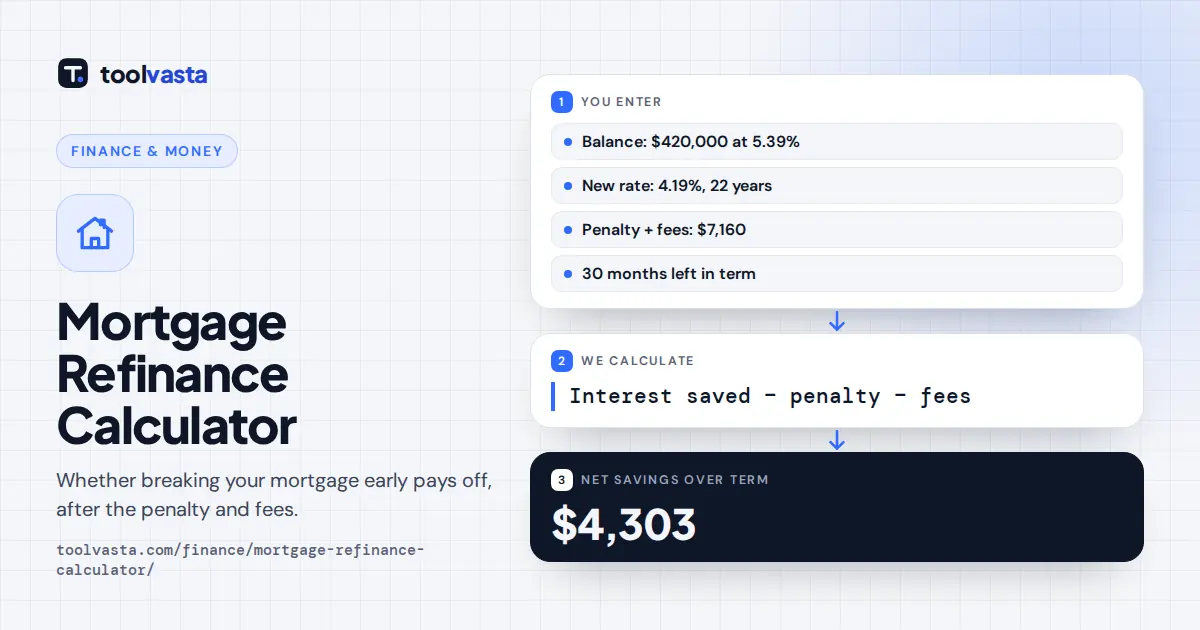
You owe $420,000 at 5.39% with 22 years of amortization and 30 months left. The current payment is $2,705.17 monthly. Three months' interest is $5,659.50, so the penalty is about $5,660, plus $1,500 of fees.
Refinancing at 4.19% over 22 years with $7,160 of costs added makes the new mortgage amount $427,160. The payment falls to $2,471.03, a monthly difference of $234.14, and loan-to-value on a $750,000 home is 57.0%.
Over 30 months, staying costs $54,278 in interest and refinancing costs $42,816. After the $7,160 of costs, net savings are about $4,303, with break-even at month 19. Paying costs in cash raises that to $5,020.
When Does Refinancing Make Sense?
A refinance pays off when the rate drop is large compared with the time left in your term. A one point drop with four years left saves far more than one with six months left.
It can also make sense for debt consolidation. Rolling high-interest debt such as credit cards into the mortgage cuts the rate sharply, although the debt is repaid over decades unless you pay it down faster.
Equity access is another. In Canada you can usually borrow up to 80% of your home's value through a refinance, and the calculator warns when the new loan plus any cash out passes that limit.
Prepayment Penalties: Three Months' Interest or IRD
Breaking a closed mortgage early triggers a prepayment penalty. A variable-rate mortgage normally charges three months' interest, while a fixed-rate mortgage charges the higher of three months' interest or the interest rate differential, called IRD.
The IRD compares your rate with the lender's current rate for the remaining term. When rates have fallen, the IRD can be several times larger than three months' interest, so always request a written quote.
The Financial Consumer Agency of Canada explains how lenders calculate penalties and how to reduce them. Ask about a blend-and-extend, which mixes your old rate with today's rate and may avoid a full penalty altogether.
Closing Costs to Include
Beyond the penalty, a refinance carries closing costs. Expect an appraisal fee to confirm the home's value, legal fees to register the new mortgage, and possibly title insurance or a title search on the property.
Your current lender may add a discharge fee or administration fee when you switch lenders mid-term. Some lenders cover legal and appraisal costs as an incentive, so compare the full cost, not just the rate.
Enter every cost in the fees box, because even $1,500 can push the break-even past the end of your term. A small rate drop rarely survives a large penalty plus several thousand dollars in fees.
Refinance, Renew or Use a HELOC
If your term ends soon, renewal at the end of term is often cheaper than refinancing now. You can renegotiate the rate, switch lenders or change the amortization at renewal without paying any prepayment penalty.
A HELOC lets you borrow against home equity as needed instead of a lump sum. Interest is charged only on what you use, but the rate is usually variable and higher than a mortgage rate.
Any refinance is a new credit application. Lenders check your credit score, ask for proof of income and test you against the mortgage stress test, so approval is not automatic even with plenty of equity.
Assumptions and Limits
The calculator assumes monthly payments, rates that stay fixed for the comparison window and no prepayments. Variable rates that move during the window would change both columns, so treat the result as one possible scenario.
If you extend amortization, the payment drops but more interest falls in later years that this window does not show. Compare the balance columns in the table to see how much principal each path repays.
Results are an estimate for planning only, not financial advice. Before deciding, get a written penalty quote from your current lender and a rate commitment from the new lender, then enter those exact figures here.
Frequently asked questions
Is it worth breaking my mortgage to refinance?
It is worth it when the interest you save over the rest of your current term is larger than the penalty and fees. The calculator shows this as net savings and a break-even month.
How much does it cost to refinance a mortgage in Canada?
The main cost is the prepayment penalty: three months' interest on most variable mortgages, or the higher of that and the interest rate differential on fixed ones. Legal, appraisal and discharge fees add more.
How much can I borrow when I refinance in Canada?
You can usually borrow up to 80% of your home's appraised value when you refinance, minus what you already owe. Lenders still check your income, debts and credit before approving the new mortgage.
What is the break-even point on a refinance?
It is the month when the interest you have saved by switching to the lower rate equals the penalty and fees you paid to switch. Before that month, refinancing has cost you money.
Should I add the penalty to my new mortgage?
Adding it avoids paying cash up front, but you then pay interest on it. In the example, paying $7,160 in cash instead of borrowing it raises net savings from about $4,303 to $5,020.
Should I refinance or wait to renew?
If only a few months remain in your term, waiting to renew is usually cheaper because renewal carries no prepayment penalty. Refinancing early pays only when the rate saving clearly exceeds the costs.