How to Use the NPS Calculator
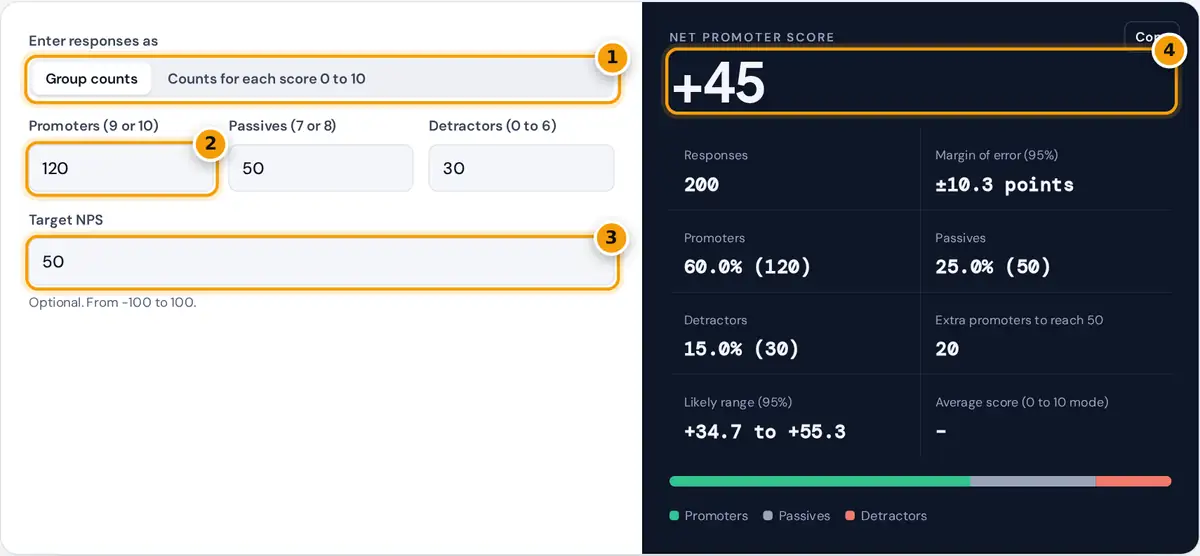
- Choose group counts or counts for each score from 0 to 10.
- Enter the number of promoters, passives and detractors.
- Enter a target score to see how many more promoters you need.
- Read the NPS, margin of error and the share of each group.
Net Promoter Score comes from one survey question: how likely are you to recommend us to a friend or colleague, on a scale from 0 to 10. If you have already grouped the answers, enter the number of promoters (scores of 9 or 10), passives (7 or 8) and detractors (0 to 6). If you have the raw results, switch to Counts for each score and enter how many people chose each number from 0 to 10.
The calculator shows your NPS, the share of each group, the number of responses and the margin of error at 95% confidence, which tells you how much the score could move by chance with a sample of your size. Enter a target score to see how many extra promoters you would need to reach it. The score mode also shows the average rating.
NPS Formula
margin of error = 1.96 × √{[(p + d) − (p − d)2] ÷ n} × 100
extra promoters x: (P + x − D) ÷ (n + x) = target
Passives count toward the total number of responses but not toward the score, so NPS ranges from −100, when everyone is a detractor, to +100, when everyone is a promoter. It is written as a whole number without a percent sign.
The margin of error treats each response as +1 for a promoter, 0 for a passive and −1 for a detractor, and uses the standard error of that average. Small surveys can swing by many points from one sample to the next, so the margin helps you judge whether a change between two surveys is real.
Worked Example
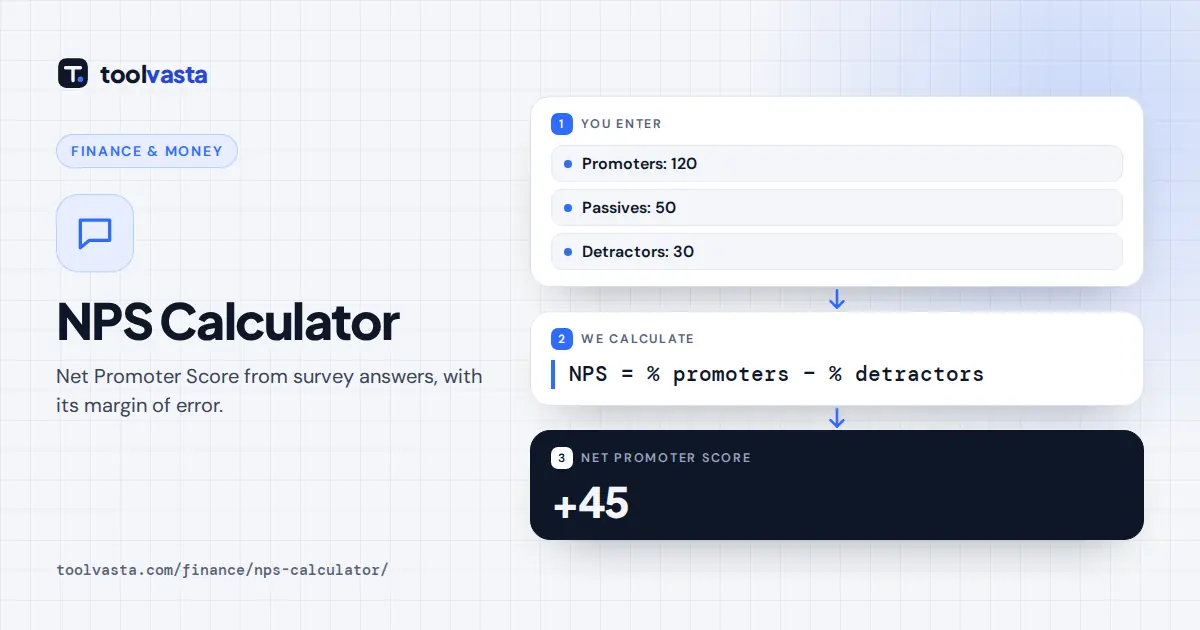
A survey gets 200 responses: 120 promoters, 50 passives and 30 detractors. Promoters are 60.0% and detractors 15.0%, so the NPS is 60 − 15 = +45. The margin of error is ±10.3 points, so the true score is likely between about +35 and +55. Reaching +50 would take 20 more promoters among new responses.
In score mode, 125 answers spread across 0 to 10 with 60 nines and tens, 45 sevens and eights and 20 scores of 6 or below give an NPS of +32, a margin of ±12.9 points and an average score of 7.90.
| Responses | Margin of error for an NPS of +45 |
|---|---|
| 50 | ±20.5 points |
| 100 | ±14.5 points |
| 200 | ±10.3 points |
| 500 | ±6.5 points |
| 1,000 | ±4.6 points |
The margins assume 60% promoters and 15% detractors. Quadrupling the sample roughly halves the margin.
NPS is popular because it reduces customer sentiment to a single number that is easy to track over time. That simplicity is also its weakness: two companies with the same score can have very different mixes of promoters and detractors. Always look at the three groups as well as the score itself.
Tips for Using NPS
- Read the comments behind the scores. The number shows where you stand; the reasons show what to fix.
- Follow up with detractors quickly. Resolving their problem can turn them into passives or promoters.
- Compare scores over time with the same question, channel and customer group. Changing the survey changes the score.
- Look at the margin of error before celebrating or worrying about a change of a few points.
- Benchmark against your own past results first. Scores vary widely by industry and country.
Assumptions and Limits
The calculator assumes a simple random sample of customers. People who choose to answer surveys may be happier or angrier than the average customer, which the margin of error does not cover. The extra promoters figure assumes every new response is a promoter. This tool does not grade scores against industry averages. Net Promoter, NPS and Net Promoter Score are trademarks of their respective owners.
Frequently asked questions
How is NPS calculated?
Subtract the percentage of detractors, who score 0 to 6, from the percentage of promoters, who score 9 or 10. With 60% promoters and 15% detractors the Net Promoter Score is +45.
Do passives count in NPS?
Passives, who score 7 or 8, do not add to or subtract from the score, but they are included in the total number of responses. More passives therefore pull the score toward zero.
What is a good Net Promoter Score?
Any score above zero means more promoters than detractors. What counts as good depends heavily on industry and country, so compare with your own past results and similar businesses where possible.
Why does NPS have a margin of error?
A survey reaches only some customers. The margin of error estimates how far the score might be from the result for all customers. With 200 responses and an NPS of +45 it is about 10 points.
Is NPS a percentage?
No. Although it is calculated from percentages, NPS is reported as a whole number between -100 and +100 without a percent sign, such as +45 or -8.
How many responses do I need for a reliable NPS?
More responses mean a smaller margin of error. At 100 responses the margin is often more than 10 points, while 1,000 responses usually bring it to around 5 points or less.