How to Use the Hourly to Salary Calculator
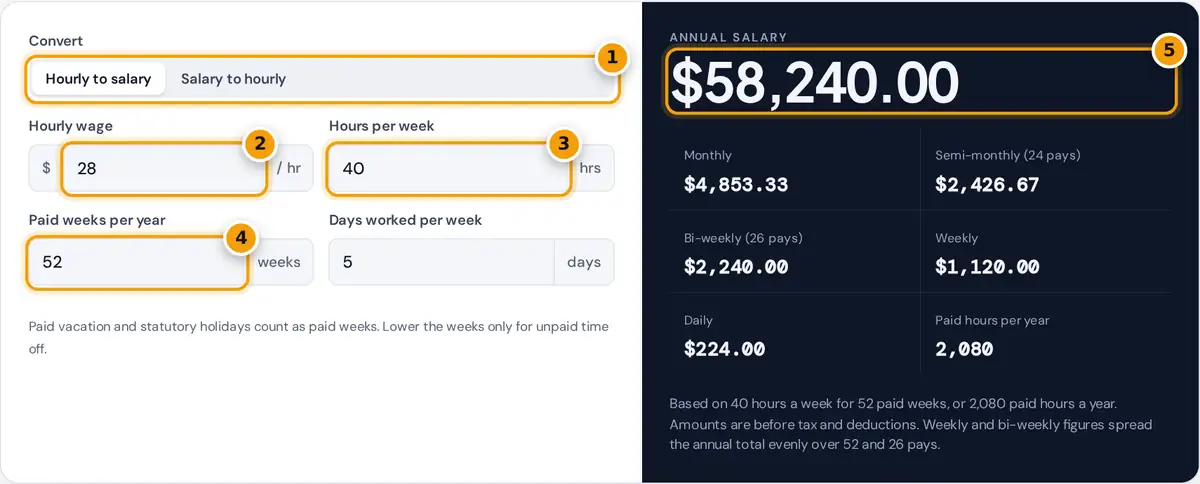
- Choose Hourly to salary, or Salary to hourly to find the hourly rate behind a salary.
- Enter your hourly wage before tax.
- Enter the hours you work in a normal week.
- Enter paid weeks per year. Keep 52 if vacation and holidays are paid.
- Read your annual salary, then check monthly, semi-monthly, bi-weekly, weekly and daily pay.
Choose Hourly to salary, then enter your hourly wage and the hours per week you are paid for. The annual salary appears at once, along with monthly, semi-monthly, bi-weekly, weekly and daily amounts below it.
Keep paid weeks per year at 52 if your employer pays you for vacation and statutory holidays, which is normal for permanent staff in Canada. Lower that number only for weeks that are genuinely unpaid.
Days worked per week only affects the daily figure. To weigh a salaried job offer against an hourly one, switch to Salary to hourly, type the annual salary and the hours you will really work.
Hourly Wage to Annual Salary Formula
Annual pay is your rate multiplied by the hours you are paid in a year. The same relationship works backwards, so dividing a salary by yearly hours gives the equivalent hourly wage for easy comparison.
Hourly wage = annual salary ÷ (hours per week × paid weeks per year)
Monthly = annual ÷ 12, bi-weekly = annual ÷ 26, weekly = annual ÷ 52
A full-time 40-hour week for 52 weeks equals 2,080 paid hours. A 37.5-hour week, common in offices and the public sector, gives 1,950 paid hours, so the same hourly rate produces noticeably less yearly income.
That explains the popular rule of thumb: multiply an hourly wage by about 2,000 for a quick annual estimate. It is close for most full-time schedules, but the calculator uses your exact hours and weeks.
Worked Example: $28 an Hour
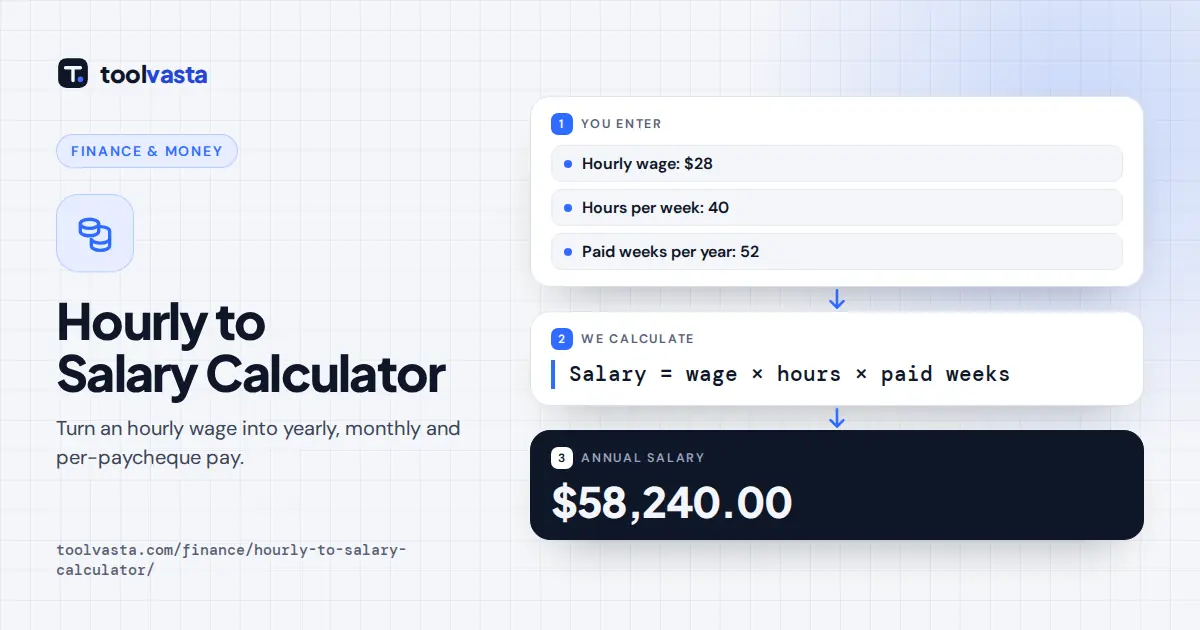
Say you earn $28 an hour for 40 hours a week, 52 paid weeks a year, with vacation included. Your annual salary is $28 × 40 × 52, which equals $58,240 before any deductions are taken off.
Spread evenly across the whole year, that is $4,853.33 per month, $2,426.67 semi-monthly, $2,240.00 every two weeks and $1,120.00 per week. Over a standard five-day week, it works out to $224.00 per day before deductions.
Now compare that with a salaried offer of $65,000 for 45 hours a week. Its hourly rate is $65,000 ÷ (45 × 52) = $27.78, slightly below the $28 hourly job once those five extra hours are counted.
How Much Is Your Hourly Wage Per Year?
The table below shows common hourly rates at two typical full-time schedules, with 52 paid weeks. The salary table under the calculator updates for whatever hours and weeks you enter, from $17 up to $75.
| Hourly wage | 37.5 hrs a week | 40 hrs a week |
|---|---|---|
| $20 | $39,000 | $41,600 |
| $25 | $48,750 | $52,000 |
| $30 | $58,500 | $62,400 |
| $40 | $78,000 | $83,200 |
| $50 | $97,500 | $104,000 |
At $25 an hour, a 40-hour week gives $52,000 a year, while 37.5 hours a week gives $48,750. The $3,250 gap comes entirely from the 130 fewer paid hours across the year, each worth $25.
At $30 an hour, the matching totals are $62,400 and $58,500 respectively. Every figure here is before tax, so use them to compare offers and set targets rather than to plan your actual spending money.
Converting a Salary to an Hourly Rate
Salary to hourly mode works in reverse, dividing the annual salary by your real paid hours. A $60,000 salary at 40 hours a week for 52 weeks becomes $60,000 ÷ 2,080, or about $28.85 an hour.
The true hourly rate falls when the job demands longer weeks. Salaried employees often work extra hours without overtime pay, so enter the hours you expect to work, not the hours printed in the posting.
Unpaid time off works the other way. For a seasonal layoff, unpaid leave or contractor work with gaps between projects, lower the paid weeks so the annual figure reflects the weeks you are actually paid.
Bi-Weekly vs Semi-Monthly Pay
Bi-weekly pay arrives every two weeks, which means 26 paycheques in a normal year. Semi-monthly pay arrives twice a month, usually on fixed dates such as the 15th and the last day, for 24 paycheques.
The annual salary is identical, but each bi-weekly cheque is smaller. On a $58,240 salary, bi-weekly pay is $2,240.00 while semi-monthly pay is $2,426.67, a difference that really matters when you set a monthly budget.
With bi-weekly pay frequency, two months each year contain a third pay date. If you budget around two cheques a month, those two extra deposits become useful money for savings, debt payments or irregular bills.
Gross Pay, Not Take-Home Pay
Every result here is gross pay. Your take-home pay is lower after income tax, CPP or QPP contributions, EI premiums and workplace deductions such as pension plans, union dues or benefits taken off each cheque.
Federal and provincial income tax depends on your total income and province, so check the CRA tax rates and brackets for the current year, or use an after-tax income calculator for a realistic net estimate.
Overtime, shift premiums, tips, commissions and bonuses are not included, so add them separately. Standard hours and overtime rules for federally regulated jobs, such as banks, are listed in the federal hours of work guide.
Frequently asked questions
How much is $25 an hour per year?
At 40 hours a week for 52 paid weeks, $25 an hour is $52,000 a year before tax. At 37.5 hours a week, the same rate works out to $48,750 a year.
How do I convert an hourly wage to a yearly salary?
Multiply the hourly wage by your paid hours per week and then by your paid weeks per year. For a standard 40-hour week, that is simply the hourly wage times 2,080.
How do I convert a salary to an hourly wage?
Divide the annual salary by the paid hours you work in a year. A $60,000 salary for 40 hours a week over 52 weeks is $60,000 divided by 2,080, or $28.85 an hour.
Should I count vacation weeks?
Count paid vacation and paid statutory holidays as paid weeks, so keep the value at 52. Lower the number only for time off that is unpaid, such as a seasonal layoff or unpaid leave.
How much is $30 an hour per year?
At 40 hours a week for 52 weeks, $30 an hour equals $62,400 a year before tax. At 37.5 hours a week, it equals $58,500, about $4,875 a month.
Is this before or after tax?
Before tax. The results are gross pay, before income tax, CPP or QPP contributions, EI premiums and any workplace deductions, so your bank deposits will be smaller than these figures.