How to Use the Credit Card Payoff Calculator
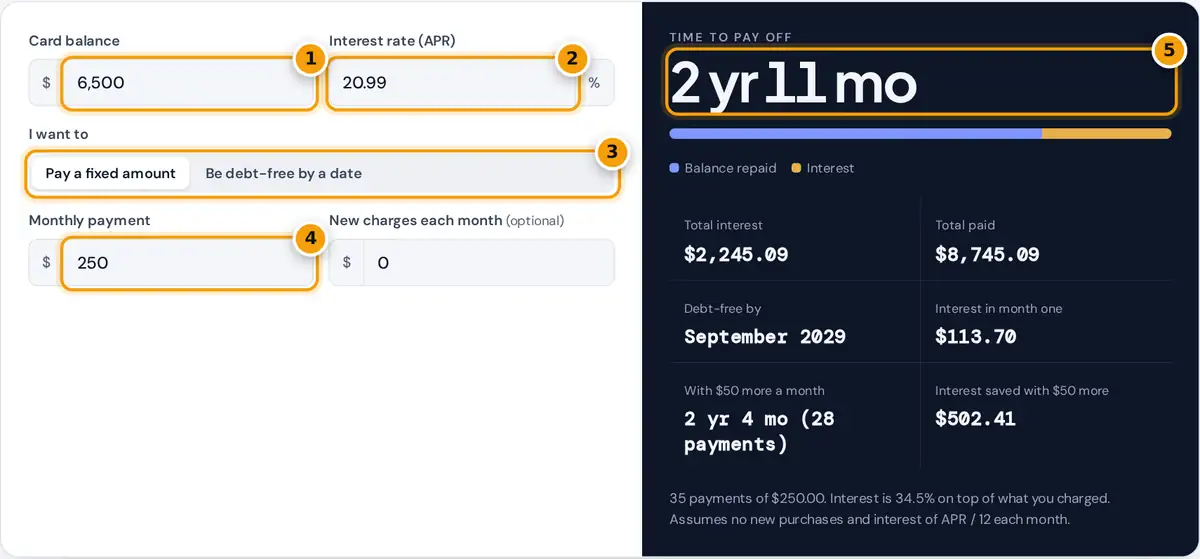
- Enter your current card balance.
- Enter the card's interest rate (APR).
- Choose a fixed monthly payment, or a target date to be debt-free by.
- Enter the monthly payment you can afford.
- Read the time to pay off, then check total interest, your debt-free date and the $50 more option.
Enter your card balance and its annual interest rate, or APR, shown on your monthly statement. The credit card payoff calculator accepts any APR from 0% to 60% and updates the results as you type.
Choose Pay a fixed amount to see how long a set fixed monthly payment takes, or Be debt-free by a date to find the payment that clears the card in a chosen number of months.
If you keep using the card, enter typical monthly new charges to keep the plan realistic. The results show payoff time, total interest, your debt-free date and a payment schedule by year or by month.
How Credit Card Payoff Is Calculated
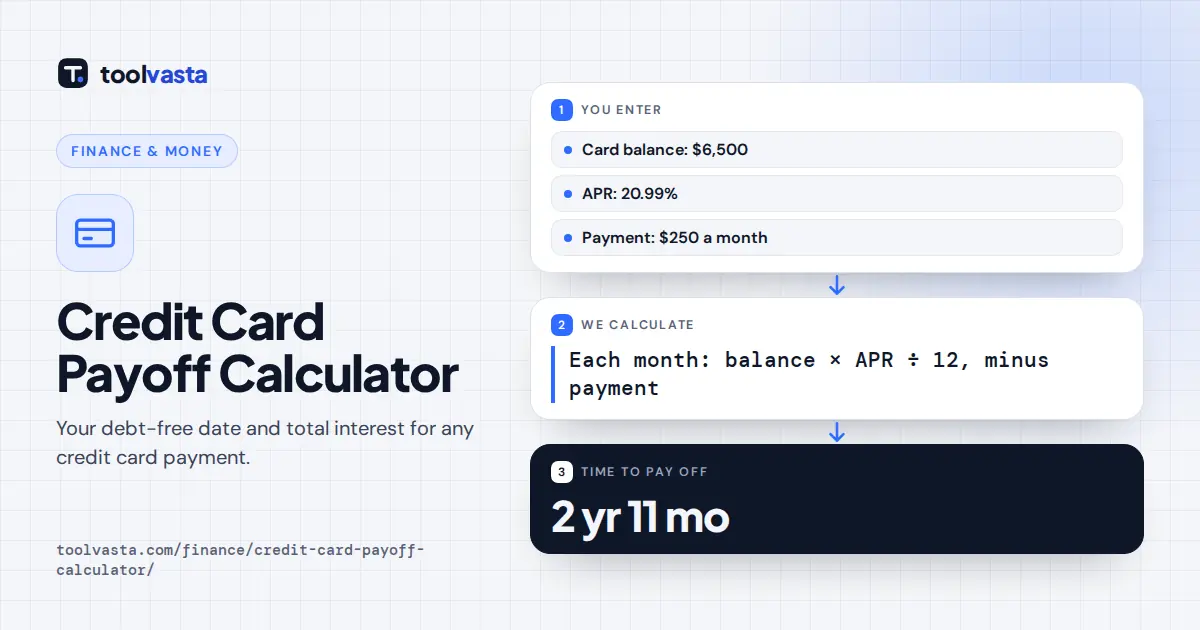
Each month, the calculator adds new charges, then adds interest at the monthly rate, then subtracts your payment. It repeats this cycle until the balance reaches zero and counts the payments needed along the way.
Interest this month = balance × i
New balance = balance + interest − payment
Payment for n months = B × i ÷ (1 − (1 + i)−n)
The part of each payment above the monthly interest reduces your principal balance. Early on, interest takes a large share, but as the balance falls, more of every payment goes toward clearing the debt itself.
If your payment is not larger than the monthly interest, the balance never goes down. In that case the calculator tells you the smallest monthly payment that makes progress, so you can adjust before committing.
Worked Example: $6,500 at 20.99%
You owe $6,500 on a card charging 20.99%. The first month's interest is $113.70, so any payment at or below that amount would never clear the card. Paying $250 a month makes steady progress instead.
At $250 a month, the balance is fully gone after 35 payments, or 2 years 11 months, with $2,245.09 of total interest. You repay $8,745.09 in all, roughly a third more than you originally owed.
Now add an extra $50 and pay $300 monthly: payoff drops to 28 payments with $1,742.68 of interest, saving $502.41. To be debt-free in 24 months instead, the calculator says you need $333.98 a month.
How Your Monthly Payment Changes Payoff Time
The table below uses the same $6,500 balance at 20.99%. It shows how strongly the monthly payment drives both time to pay off and total interest, because interest keeps compounding on whatever you leave unpaid.
| Monthly payment | Time to pay off | Total interest |
|---|---|---|
| $150 | 6 yr 10 mo | $5,772 |
| $200 | 4 yr 1 mo | $3,194 |
| $250 | 2 yr 11 mo | $2,245 |
| $300 | 2 yr 4 mo | $1,743 |
| $350 | 1 yr 11 mo | $1,429 |
| $500 | 1 yr 3 mo | $939 |
Moving from $150 to $200 a month cuts almost three years and about $2,578 of interest. The interest saved grows smaller with each step, but every extra dollar still shortens the payoff and lowers cost.
New charges work in the opposite direction. Paying $250 while adding $100 of new purchases each month stretches repayment to 84 payments, which is exactly why stopping card use matters as much as paying more.
Why Minimum Payments Take So Long
Card issuers set a minimum payment that is often a small percentage of the balance plus interest, or a fixed floor such as $10. Paying only that amount is often called the minimum payment trap.
Because the minimum shrinks as the balance shrinks, this shrinking payment usually means most of each month's money goes to interest. Repayment can stretch over many years, even if you never use the card again.
By law, your monthly statement must estimate how long paying only the minimum would take. The Financial Consumer Agency of Canada shows how even a modest fixed extra payment saves hundreds of dollars in interest.
How Credit Card Interest Works in Canada
Issuers calculate interest with a daily interest rate, which is the APR divided by 365, applied to your daily balance. The daily amounts are added up and charged once per statement period on your bill.
New purchases usually get a grace period of at least 21 days. If you pay in full by the due date, you pay no interest on them. Cash advances usually start charging interest right away.
Once you carry a balance over, interest applies to new purchases too until the balance is cleared. The FCAC credit card payment calculator lets you compare how different cards and rates affect your total costs.
Ways to Pay Off a Credit Card Faster
The fastest results come from paying more and borrowing less. Pick one method you can truly stick to, set the payment to come out automatically, and recheck the plan in the calculator every few months.
- Stop adding new charges to the card you are paying off.
- Move the balance to a lower rate with a balance transfer or a line of credit, but check the transfer fee and what happens when the promotional rate ends.
- Pay more than once a month, since interest builds on your daily balance.
- With several cards, use the debt avalanche (highest rate first) or debt snowball (smallest balance first).
Debt consolidation into one lower-rate loan can simplify your payments. If you are struggling to keep up, a non-profit credit counselling agency can help you build a plan and talk to lenders on your behalf.
Paying on time protects your credit score. Once the card is clear, keep a small emergency fund so a surprise expense never sends you straight back to borrowing at around 20% interest all over again.
Assumptions Behind the Results
The calculator uses a monthly rate of APR / 12 on the balance after any new charges, with the payment made at the end of each month. This keeps the math simple and easy to check.
Card issuers calculate interest daily and may offer a grace period on new purchases, so actual interest can differ by a few dollars. Fees, promotional rates and rate changes are not included in the results.
Treat every result as an estimate for planning. Your card agreement and monthly statement are the final word on interest, fees and minimum payments, so check them carefully before you set up any repayment plan.
Frequently asked questions
How long will it take to pay off $6,500 on a credit card?
At 20.99% APR and $250 a month, it takes 35 months and costs $2,245.09 in interest. Paying $350 a month cuts it to 23 months and about $1,429 of interest.
How much should I pay to clear my credit card in 2 years?
Use the Be debt-free by a date option and enter 24 months. For $6,500 at 20.99%, the payment is $333.98 a month, with about $1,515 of total interest.
How is credit card interest calculated?
Issuers apply a daily rate, the APR divided by 365, to your daily balance and charge the total monthly. This calculator uses APR / 12 on the monthly balance, which gives a very close estimate.
What happens if I only pay the minimum?
The minimum mostly covers interest, so the balance falls slowly and repayment can take many years. A fixed payment above the minimum clears the debt much faster and costs far less interest.
How much does an extra $50 a month save?
On $6,500 at 20.99%, raising the payment from $250 to $300 saves $502.41 in interest and clears the card seven months sooner. The calculator shows this saving for your own numbers.
Is it better to pay off a credit card or save?
Card interest around 20% is far higher than what most savings earn, so paying down the card is usually the better return. Keep a small emergency fund so you do not need to borrow again.