How to Use the NPV Calculator
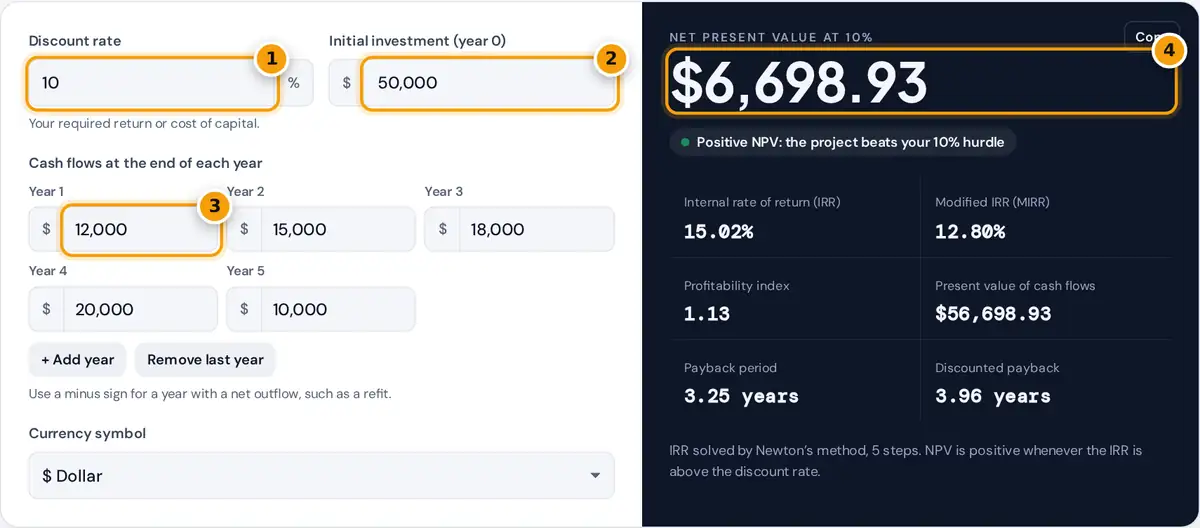
- Enter your discount rate, the return you require from the project.
- Enter the upfront cost as the year 0 investment.
- Fill in the cash flow for each year. Add or remove years with the buttons.
- Read the NPV, then IRR, MIRR, profitability index and both payback periods.
Enter your discount rate first. This is the return you require from the project, often your cost of capital or the return you could earn elsewhere at similar risk. Then enter the initial investment as a positive number: the calculator treats it as money going out at year 0.
Fill in the net cash flow you expect at the end of each year. Use Add year for longer projects, up to 50 years, and type a minus sign for any year with a net outflow, such as a major refit. The result updates as you type and shows the net present value, the internal rate of return, the modified IRR, the profitability index and both payback periods. The table below the tool shows every discount factor and can be downloaded as a CSV file.
NPV, IRR and Payback Formulas
IRR = the rate r at which NPV = 0
MIRR = (FV of inflows at r ÷ PV of outflows at r)1/n − 1
profitability index = PV of future cash flows ÷ C0
payback = years until cumulative cash flow reaches zero
Each future cash flow is divided by (1 + r) raised to the number of years until it arrives, so money received later counts for less. A positive NPV means the project earns more than your discount rate; a negative NPV means it earns less. The IRR has no closed formula, so the calculator finds it with Newton's method and falls back to bisection if Newton's method does not converge.
Payback counts how long it takes for undiscounted cash flows to repay the investment, assuming cash arrives evenly through each year. Discounted payback does the same with present values, so it is always longer and is a stricter test.
Worked Example
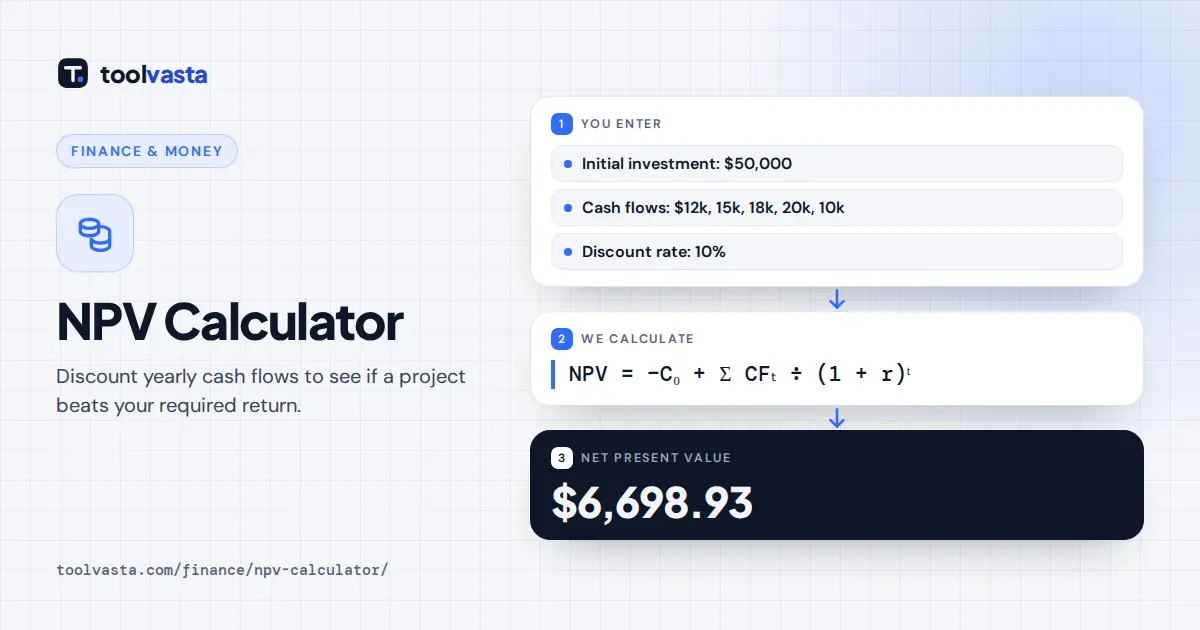
A project costs $50,000 and returns $12,000, $15,000, $18,000, $20,000 and $10,000 over five years. At a 10% discount rate the present values are $10,909.09, $12,396.69, $13,523.67, $13,660.27 and $6,209.21, a total of $56,698.93. Subtracting the $50,000 cost gives an NPV of $6,698.93, so the project clears the 10% hurdle.
The IRR is 15.02%, the MIRR is 12.80% and the profitability index is 1.13. Undiscounted cash flows repay the cost after 3.25 years, while discounted payback takes 3.96 years. At a 15% discount rate the NPV drops to just $19.06, which confirms that the IRR sits just above 15%.
| Year | Cash flow | Discount factor at 10% | Present value | Cumulative PV |
|---|---|---|---|---|
| 0 | −$50,000 | 1.0000 | −$50,000.00 | −$50,000.00 |
| 1 | $12,000 | 0.9091 | $10,909.09 | −$39,090.91 |
| 2 | $15,000 | 0.8264 | $12,396.69 | −$26,694.21 |
| 3 | $18,000 | 0.7513 | $13,523.67 | −$13,170.55 |
| 4 | $20,000 | 0.6830 | $13,660.27 | $489.72 |
| 5 | $10,000 | 0.6209 | $6,209.21 | $6,698.93 |
Tips for Capital Budgeting
- When two projects compete for the same money, prefer the one with the higher NPV. IRR can rank projects of different sizes in the wrong order.
- Use a higher discount rate for riskier projects. The rate is where risk enters an NPV analysis.
- Include working capital you tie up at the start and release at the end, and any salvage value in the final year.
- Cash flows that change sign more than once can produce more than one IRR. MIRR avoids that problem because it assumes cash is reinvested at your discount rate.
- Test a cautious case. Cut every cash flow by 10% and see whether the NPV stays positive.
Assumptions and Limits
Cash flows are assumed to arrive at the end of each year and the discount rate is constant for the whole project. For cash flows on irregular dates, use our XIRR calculator. Taxes, inflation and financing costs are not modeled separately, so enter after-tax cash flows and a rate that matches them. Results work in any currency and are estimates for planning, not investment advice.
Frequently asked questions
How do you calculate NPV?
Divide each future cash flow by one plus the discount rate raised to the year it arrives, add the results, then subtract the initial investment. A positive total means the project earns more than your required return.
What discount rate should I use for NPV?
Use the return you require for this level of risk. Businesses often use their weighted average cost of capital, while individuals may use the return they could earn on a comparable investment elsewhere.
What is the difference between NPV and IRR?
NPV gives the value a project adds in money at your chosen rate. IRR is the rate at which NPV equals zero. They usually agree on accept or reject decisions but can rank projects differently.
What is a good profitability index?
A profitability index above 1.0 means the present value of future cash flows exceeds the initial cost, which matches a positive NPV. Higher values mean more value created per dollar invested.
Why is discounted payback longer than payback?
Discounted payback uses present values, which are smaller than the raw cash flows because later money is worth less. It therefore takes more years for the discounted amounts to repay the investment.
Can NPV be negative even if the project makes money?
Yes. A project can return more cash than it costs and still have a negative NPV if those returns are too small or too late to meet your discount rate.