How to Use the EBITDA Calculator
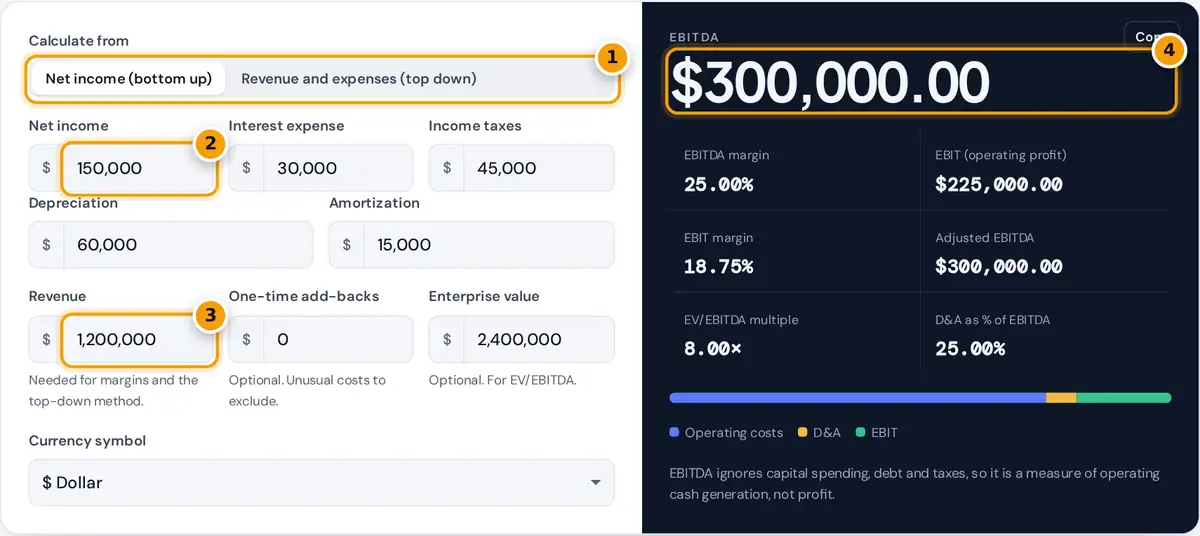
- Choose the net income method or the revenue and expenses method.
- Enter net income, interest, taxes, depreciation and amortization.
- Enter revenue for margins, plus add-backs and enterprise value if you have them.
- Read EBITDA, the margin, EBIT, adjusted EBITDA and EV/EBITDA.
Pick the method that matches the figures you have. The net income method starts at the bottom of the income statement and adds back interest expense, income taxes, depreciation and amortization. The revenue method starts at the top: revenue minus cost of goods sold minus operating expenses, leaving depreciation and amortization out. Both give the same EBITDA when the statement is consistent.
Enter revenue to get the EBITDA margin and EBIT margin. Add one-time items such as a lawsuit settlement, restructuring costs or an owner's personal expenses to see adjusted EBITDA, the version buyers and lenders usually discuss. Enter an enterprise value to get the EV/EBITDA multiple. Amounts work in any currency.
EBITDA Formulas
EBITDA = revenue − COGS − operating expenses (excluding D&A)
EBIT = EBITDA − depreciation − amortization
EBITDA margin = EBITDA ÷ revenue
adjusted EBITDA = EBITDA + one-time add-backs
EV/EBITDA = enterprise value ÷ adjusted EBITDA
EBITDA stands for earnings before interest, taxes, depreciation and amortization. Removing interest and taxes strips out how a company is financed and where it pays tax. Removing depreciation and amortization strips out non-cash charges for past investment. What is left shows how much the core operations generate.
Enterprise value is the market value of equity plus debt minus cash. Dividing it by EBITDA gives a multiple that lets you compare businesses with different debt levels.
Worked Example
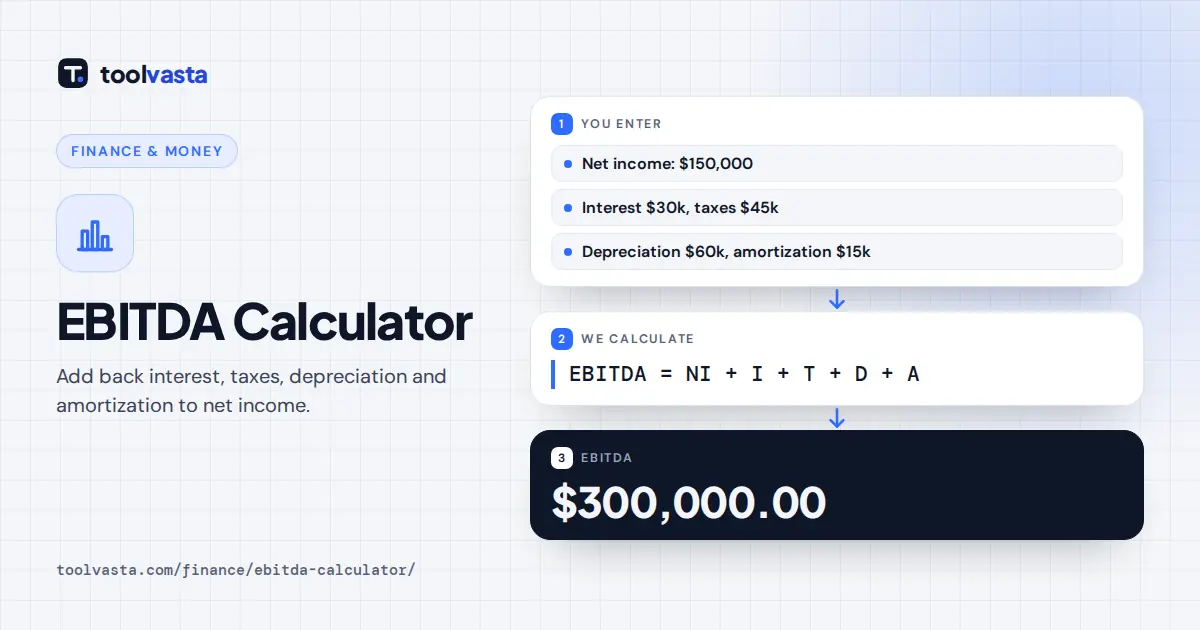
A company reports net income of $150,000, interest expense of $30,000, income taxes of $45,000, depreciation of $60,000 and amortization of $15,000. EBITDA is 150,000 + 30,000 + 45,000 + 60,000 + 15,000 = $300,000. On revenue of $1,200,000, the EBITDA margin is 25.00% and EBIT is $225,000, an 18.75% margin.
Top down, the same company has $600,000 of cost of goods sold and $300,000 of operating expenses before depreciation, which also leaves $300,000. If $40,000 of one-time legal costs are added back, adjusted EBITDA is $340,000, and an enterprise value of $2,400,000 is 7.06 times adjusted EBITDA, against 8.00 times without the add-back.
| Line | Amount | Running total |
|---|---|---|
| Net income | $150,000 | $150,000 |
| + Interest expense | $30,000 | $180,000 |
| + Income taxes | $45,000 | $225,000 (EBIT) |
| + Depreciation | $60,000 | $285,000 |
| + Amortization | $15,000 | $300,000 (EBITDA) |
EBITDA is widely used when businesses are bought and sold, because buyers usually bring their own financing and tax structure. Valuations are often quoted as a multiple of adjusted EBITDA, so every add-back raises the price a seller can argue for. That is also why buyers test each adjustment carefully and ask for evidence that a cost will not return.
Lenders use EBITDA too. Ratios such as debt to EBITDA show how many years of operating earnings it would take to repay borrowing, and loan agreements often set limits on them. Because the definition varies, read how a lender or buyer defines EBITDA before comparing your figure with their requirement.
Tips for Using EBITDA
- Compare EBITDA margins with companies in the same industry. Capital-heavy sectors and service businesses have very different norms.
- Be strict with add-backs. Costs that recur every year are not one-time, and buyers will challenge them.
- Look at capital expenditure as well. A business with high EBITDA can still burn cash if it must keep replacing equipment.
- Use the same EBITDA definition for every company you compare, especially for leases and stock-based pay.
- For pricing and profitability on individual products, our profit margin calculator is a better fit.
Assumptions and Limits
EBITDA is not a measure defined by accounting standards, so companies calculate it differently. It ignores the real cost of replacing assets, interest owed to lenders and taxes owed to governments, so it overstates the cash available to owners. Use it alongside net income and cash flow. This calculator uses only the numbers you enter and is not accounting, tax or valuation advice.
Frequently asked questions
How do you calculate EBITDA?
Add interest expense, income taxes, depreciation and amortization back to net income. Or subtract cost of goods sold and operating expenses, excluding depreciation and amortization, from revenue. Both methods give the same figure.
What is a good EBITDA margin?
It depends on the industry. Software and asset-light businesses often have higher margins than retail or restaurants. Compare your EBITDA margin with similar companies rather than relying on a single benchmark number.
What is the difference between EBITDA and EBIT?
EBIT subtracts depreciation and amortization, while EBITDA adds them back. EBIT is closer to operating profit, while EBITDA is closer to the cash that operations generate before capital spending.
What is adjusted EBITDA?
Adjusted EBITDA adds back unusual or one-time costs, such as restructuring, legal settlements or owner expenses, to show normal earning power. Buyers usually examine each adjustment carefully.
What does the EV/EBITDA multiple tell you?
It compares a company's enterprise value with its EBITDA. A lower multiple can mean a cheaper valuation, but growth, risk and industry all affect what a fair multiple is.
Can EBITDA be negative?
Yes. If operating costs exceed revenue before depreciation and amortization, EBITDA is negative. That means the core business is not generating cash from operations, which is common in early-stage companies.