How to Use the Mortgage Penalty Calculator
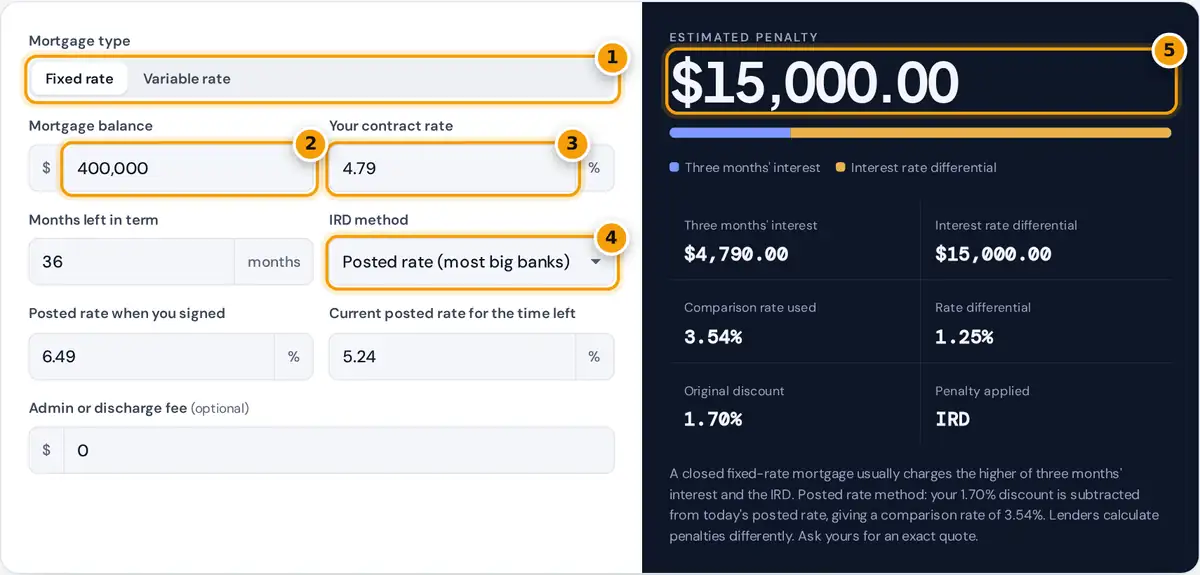
- Choose fixed or variable. Variable-rate mortgages usually pay three months' interest.
- Enter your current mortgage balance.
- Enter your contract interest rate.
- Pick the IRD method: posted rate (most big banks) or contract rate, then fill in the posted rates.
- Read the estimated penalty and compare three months' interest with the IRD.
Choose fixed rate or variable rate first, because the two are penalized differently. Then enter your mortgage balance, your contract rate and the months left in your current term, which your annual mortgage statement shows.
For a fixed-rate mortgage, pick the IRD method your lender uses. Big banks usually use the posted rate method, so you also enter their posted rate on the day you signed and today's posted rate.
Add any discharge fee or administration charge if you know it. The mortgage penalty calculator then shows three months' interest, the IRD, the comparison rate and which penalty would most likely apply to you today.
How Prepayment Penalties Are Calculated
When you break a closed mortgage before the term ends, the lender charges a prepayment penalty to recover the interest it loses. For a fixed rate, it is usually the greater of two separate amounts.
Comparison rate = current rate for the remaining term (minus your original discount, on the posted rate method)
IRD = balance × (contract rate − comparison rate) × months left / 12
Penalty = the greater of the two
Three months' interest is simple: your balance times your annual rate, divided by four. The interest rate differential, or IRD, measures how much less the lender would earn by relending your money at today's rates.
The IRD uses a comparison rate, the lender's current rate for a term close to your remaining term. If rates have risen above your rate, the IRD is zero and three months' interest applies instead.
Worked Examples: FCAC and Posted Rate Methods
The well-known FCAC example uses a $200,000 balance at 6% with 36 months left and a current 3-year term rate of 4%. Three months' interest comes to $3,000, while the IRD is $200,000 × 2% × 3.
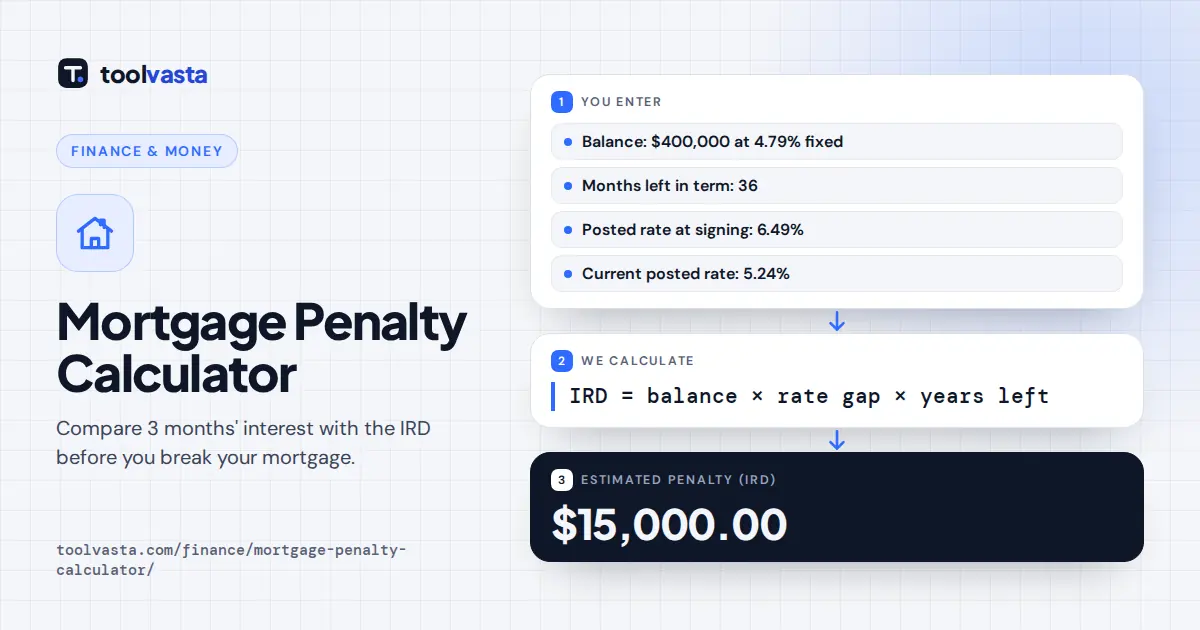
That IRD is $12,000, so the penalty is $12,000 plus any fee. Now take a $400,000 mortgage at 4.79% with 36 months left, signed when the posted rate was 6.49%, giving a discount of 1.70%.
| Scenario | Three months' interest | IRD | Penalty |
|---|---|---|---|
| FCAC example, contract rate method | $3,000 | $12,000 | $12,000 |
| $400,000, posted rate method | $4,790 | $15,000 | $15,000 |
| $400,000, contract rate method | $4,790 | $9,600 | $9,600 |
| $400,000, variable rate | $4,790 | Not used | $4,790 |
The bank's posted 3-year rate today is 5.24%, so the comparison rate is 3.54% and the rate differential is 1.25%. The posted rate IRD is $15,000, against only $9,600 with a 3.99% contract rate comparison.
Why the Posted Rate Method Costs More
Big banks advertise fairly high posted rates, then give most borrowers a discounted rate. On the posted rate method, they subtract your original discount from today's posted rate, which pushes the comparison rate down sharply.
A lower comparison rate widens the gap with your contract rate, and the IRD grows with it. In the example above, one balance and rate produce a penalty $5,400 higher than the contract rate method.
Monoline lenders and many credit unions compare your rate with their current rate instead. Lenders must explain their method in your mortgage documents, so read the prepayment section before you sign or break the contract.
When You Pay No Penalty
An open mortgage can be repaid anytime without a penalty, though it carries a higher rate. A closed mortgage also has no penalty at renewal, when the term ends and you can switch lenders freely.
Porting moves your existing rate and term to a new home, so many lenders fully waive the penalty when you sell and buy. Variable rate mortgages usually charge only three months' interest, never the IRD.
If your term is longer than five years, the federal Interest Act caps the charge at three months' interest after the fifth year. Some low-feature, low-rate mortgages charge a fixed percentage of the balance instead.
Ways to Reduce or Avoid the Penalty
Most closed mortgages include prepayment privileges, often a yearly lump-sum payment of 10% to 20% of the original amount. Using them just before you break lowers the balance that both penalty methods are based on.
- Ask about blend and extend, which mixes your current rate with a new one instead of breaking the mortgage.
- Ask whether the lender will port the mortgage or let a buyer assume it.
- Wait until fewer months remain, since the IRD shrinks as the term runs down.
If you plan to refinance at a much lower rate, work out how many months of interest savings it takes to break even on the penalty. Our mortgage refinance calculator helps you compare both sides.
The Financial Consumer Agency of Canada lists several further ways to reduce penalties. Before you sign anything, always ask your lender for a written quote, because the figure can change daily as posted rates move.
Assumptions and Limits
This is a simple-interest estimate. Some lenders discount the IRD to present value, use the rate for the nearest shorter term or round months differently, so the real penalty can differ from the result shown.
The calculator also leaves out legal costs and any administration fee you do not enter. Rolling the penalty into a new mortgage spreads the cost, but you then pay interest on it for many years.
A penalty on a home you live in is generally not tax deductible, while rules for rental property differ, so ask a tax professional. Treat every figure as an estimate and confirm with your lender.
Frequently asked questions
How is a mortgage penalty calculated in Canada?
For a closed fixed-rate mortgage, the penalty is usually the greater of three months' interest on the balance or the interest rate differential. Variable-rate mortgages usually charge three months' interest only.
What is the interest rate differential (IRD)?
The IRD is the interest the lender loses when you leave early: the gap between your rate and its current rate for the time left, applied to your balance for the remaining months.
Why is my bank's penalty so high?
Many big banks use the posted rate method, which subtracts your original discount from today's posted rate. That lowers the comparison rate, widens the differential and makes the IRD much larger.
Can I avoid a mortgage penalty?
You can often avoid or reduce it by porting the mortgage, using blend and extend, making prepayments first, choosing an open mortgage, or waiting until renewal when the term ends.
How much is three months' interest on $300,000 at 5%?
Multiply $300,000 by 5% and by 3 / 12. The result is $3,750, which is the penalty on a variable-rate mortgage, or the minimum on a fixed-rate mortgage.
Can I add the mortgage penalty to my new mortgage?
Many lenders let you roll the penalty into a refinanced mortgage. It avoids paying cash upfront, but you pay interest on the penalty for the rest of the amortization, so compare total costs first.