How to Use the Car Affordability Calculator
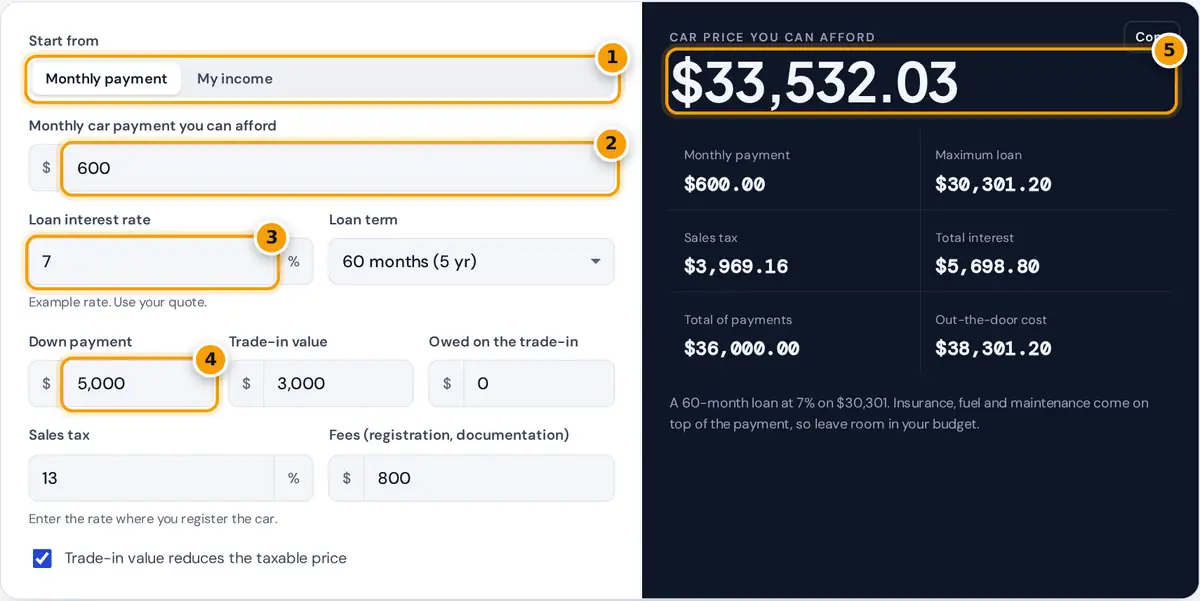
- Start from a monthly payment or from your income.
- Enter the monthly payment you can afford.
- Enter the loan rate and pick the loan term.
- Add your down payment, trade-in, amount owed, tax rate and fees.
- Read the car price you can afford and the out-the-door cost.
Choose Monthly payment if you already know what you can pay each month, or My income to base the payment on a share of your gross income. Enter the interest rate from your lender or dealer quote and pick the loan term. Then add your down payment, the value of any trade-in and anything still owed on it.
Enter the sales tax rate where you will register the car, plus fees such as registration, licensing and documentation. Tick the trade-in box if your trade-in reduces the taxable price where you live, as it does in many places. The calculator works backward from the payment to the most you can pay for the vehicle and shows the loan, tax, interest and out-the-door cost.
Car Affordability Formula
cash available = loan + down payment + trade-in − amount owed
price = (cash available + tax rate × trade-in credit − fees) ÷ (1 + tax rate)
sales tax = tax rate × (price − trade-in credit)
The loan amount comes from the standard present value of a loan payment. Everything you bring, minus fees and tax, goes toward the price. Because tax is charged on the price, the calculator solves for the price that makes the totals balance exactly.
Dealers often quote a payment first. Working backward from your own payment limit keeps the conversation on the total price, which is easier to compare between dealers and with private sales.
If a dealer offers a promotional low rate in exchange for giving up a cash rebate, run both cases. The lower rate raises the loan you can afford, while the rebate lowers the price you pay.
Worked Example
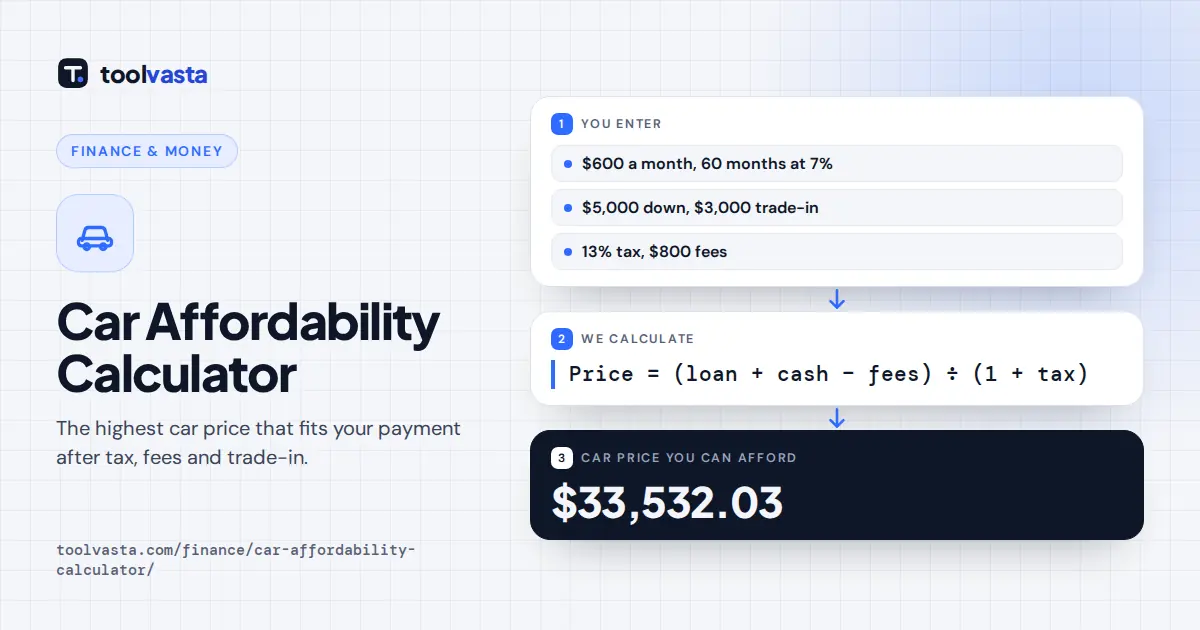
You can pay $600 a month for 60 months at 7%. That supports a loan of $30,301.20. Adding a $5,000 down payment and a $3,000 trade-in with nothing owed, and paying $800 in fees with 13% sales tax charged on the price after the trade-in, the most you can spend on the car is $33,532.03.
The tax is $3,969.16, the interest over the loan is $5,698.80 and the payments total $36,000. The out-the-door cost is $38,301.20. If you base the budget on 10% of an $80,000 income instead, the payment is $666.67 and the affordable price rises to $36,511.50.
How the Term Changes What You Can Afford
| Term at 7% | Loan from $600 a month | Total interest |
|---|---|---|
| 36 months | $19,431.88 | $2,168.12 |
| 48 months | $25,056.12 | $3,743.88 |
| 60 months | $30,301.20 | $5,698.80 |
| 72 months | $35,192.67 | $8,007.33 |
| 84 months | $39,754.37 | $10,645.63 |
Longer terms raise the price you can afford but add a lot of interest and keep you owing more than the car is worth for longer. A popular guideline, the 20/4/10 rule, suggests 20% down, a loan of no more than four years and total car costs under 10% of gross income.
Tips Before You Shop
- Get pre-approved by a bank or credit union so you know your real rate before visiting a dealer.
- Negotiate the vehicle price first, then financing, then the trade-in, so one does not hide the others.
- Budget for insurance, fuel or charging, maintenance, parking and depreciation, not only the payment.
- If you owe more on your trade-in than it is worth, that negative equity is added to the new loan. The calculator includes it through the amount owed.
- Compare the total cost of a shorter loan with a lower price against a longer loan on a more expensive car.
Assumptions and Limits
The calculator assumes monthly payments at a fixed rate and that fees are paid upfront rather than financed. Tax rules for trade-ins, rebates and fees vary by province and state, so enter the rate and settings that apply to you. Results are estimates in any currency, not a loan offer.
Frequently asked questions
How much car can I afford?
Work back from a payment you can comfortably make. At $600 a month for 60 months at 7%, with $5,000 down and a $3,000 trade-in, the most you can spend is about $33,500 including 13% tax and $800 in fees.
What percentage of income should go to a car payment?
Many budgeting guides suggest keeping the car payment around 10 to 15% of gross monthly income, and total car costs including insurance and fuel under about 20%.
What is the 20/4/10 rule for buying a car?
It suggests putting 20% down, financing for no more than four years and keeping total monthly car costs under 10% of gross income. It is a cautious guideline, not a requirement.
Does a trade-in reduce sales tax?
In many provinces and states, sales tax is charged only on the price minus the trade-in value, which saves money. Some places do not allow this, so untick the option if it does not apply.
Is a longer car loan a good idea?
A longer loan lowers the payment but adds interest and keeps you owing more than the car is worth for longer. Choose the shortest term whose payment fits your budget.
Should I include insurance in my car budget?
Yes. The payment is only part of the cost. Insurance, fuel, maintenance and parking can add hundreds per month, so leave room for them when choosing your payment.