How to Use the Mortgage Prepayment Calculator
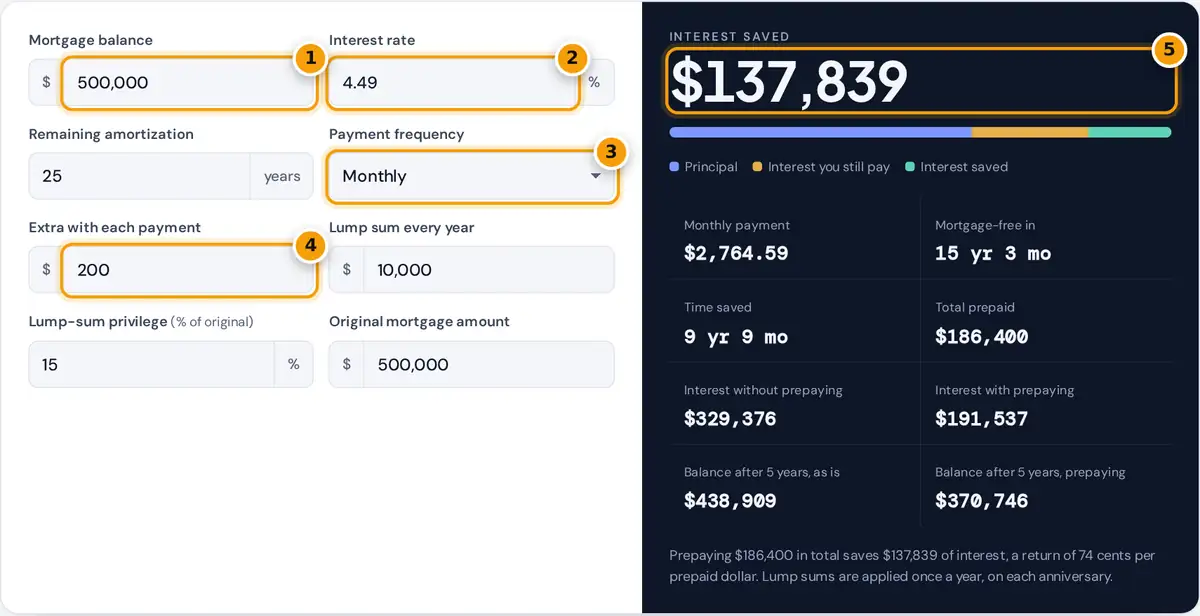
- Enter your current mortgage balance.
- Enter your interest rate. Canadian fixed rates compound semi-annually.
- Choose your payment frequency, such as monthly or accelerated bi-weekly.
- Add an extra amount with each payment, then a yearly lump sum below it.
- Read the interest saved, then check time saved and your new mortgage-free date.
Enter your current balance, interest rate, the years left on your amortization and how often you pay. Add the original mortgage amount as well, because your lender's prepayment privileges are normally based on that figure.
Then add what you plan to prepay: an extra amount with every regular payment, a lump sum once a year, or both. Set your lump-sum privilege so the calculator can warn you about possible penalties.
The calculator runs your mortgage twice, once as it is and once with the prepayments. It shows the interest saved, the time saved, your new payoff date and the balance after a typical 5-year term.
- Extra with each payment: an increase to your regular payment, often allowed up to a set percentage each year.
- Lump sum every year: a one-off payment on each anniversary, for example from a tax refund or bonus.
- Lump-sum privilege: the share of the original mortgage you can prepay each year without a penalty.
How Prepayments Are Calculated
Canadian fixed-rate mortgages are quoted with semi-annual compounding, a convention rooted in the federal Interest Act. The calculator then converts your nominal annual rate into an equivalent rate per payment for your chosen payment frequency.
Interest each payment = balance × i
New balance = balance + interest − payment − extra (− lump sum on each anniversary)
It works out the regular payment, then steps through every payment until the balance reaches zero. Interest is charged on the remaining principal, so a smaller balance means less interest on every single later payment.
Any extra amount and each yearly lump sum go straight to principal. Your regular payment does not change, so the mortgage simply ends sooner and the amortization period becomes noticeably shorter than you originally planned.
Worked Example: A $500,000 Mortgage
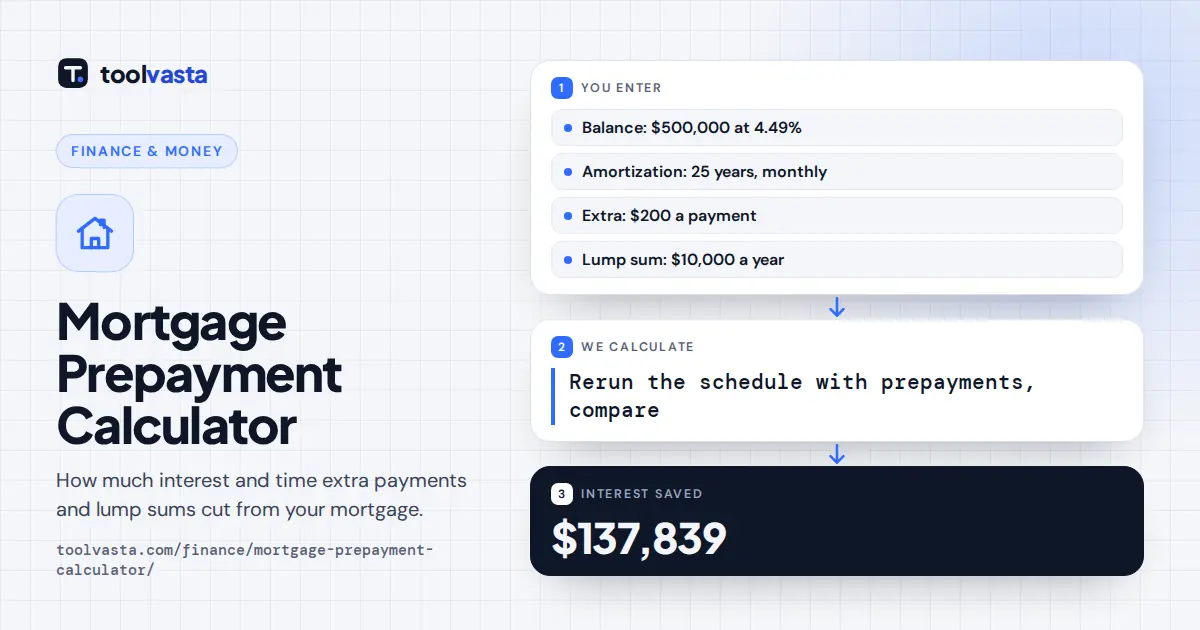
A $500,000 mortgage at 4.49% over 25 years has a monthly payment of $2,764.59. If you never make a single prepayment, the loan costs $329,376 in total of interest over the full 25-year amortization period.
Adding $200 to every payment and a $10,000 lump sum each year clears it in 15 years 3 months, saving 9 years 9 months. Total interest falls to $191,537, a total saving of exactly $137,839.
| Plan | Interest saved | Time saved |
|---|---|---|
| No prepayment | $0 | None |
| $200 extra a month | $43,049 | 2 years 10 months |
| $200 extra plus $10,000 a year | $137,839 | 9 years 9 months |
Across those years you prepay $186,400 in total. After the first 5-year term you owe $370,746 instead of $438,909, which gives you a much smaller balance to renew and far more choices at renewal time.
Prepayment Privileges in Canada
Closed mortgages limit how much you can prepay yearly without a penalty. Common privileges let you pay a lump sum of 10% to 20% of the original amount and raise payments by a similar percentage.
| Prepayment type | How it works | Penalty risk |
|---|---|---|
| Increase regular payment | Raises every payment for the rest of the term | None within the privilege |
| Annual lump sum | One payment straight to principal | Above the privilege on a closed mortgage |
| Accelerated bi-weekly | About one extra monthly payment a year | None |
| Pay off at renewal | Any amount at the end of the term | None |
Unused privilege room usually cannot be carried over to the next year. An open mortgage allows any size of prepayment at any time, but it normally charges a higher interest rate than a closed one.
The calculator assumes a 15% lump-sum privilege unless you change it, and it warns you when a lump sum goes over. Always check the exact limits and anniversary dates written in your own mortgage contract.
Prepayment Penalties
If you prepay more than your privilege on a closed mortgage, the lender charges a prepayment penalty. For fixed rates it is usually the greater of three months' interest or the interest rate differential (IRD).
The IRD can be large when rates have fallen since you signed, because it compensates the lender for the lower rate it now earns. Variable-rate mortgages usually charge only three months' interest, a simpler figure.
The Financial Consumer Agency of Canada explains in detail how lenders calculate penalties. Staying inside your privilege, or prepaying at renewal, avoids the charge entirely, since renewal normally lets you pay any amount you choose.
Lump Sum or Extra Payments?
Both options reduce principal, and timing matters more than method. A dollar prepaid in year one saves interest for the whole remaining amortization, while the same dollar prepaid in year twenty saves very little interest.
Small, regular extra payments from the start can beat one larger payment made at year end. Accelerated bi-weekly payments add about one extra monthly payment a year without using up any of your lump-sum privilege.
Paying down a mortgage at 4.49% is like earning a risk-free 4.49% after tax. That may beat a taxable savings account, but a TFSA or RRSP with a higher expected return can come out ahead.
Assumptions and Limits
The rate stays the same for the whole amortization, payments are made on schedule and lump sums are applied on each anniversary. In reality you will probably renew several times at quite different interest rates.
The calculator does not include penalties, fees or a switch to a new lender. It also does not model mortgage default insurance premiums, which are already part of your balance if your mortgage was insured.
Results are estimates for planning, not a payoff statement. Keep an emergency fund of a few months' expenses before prepaying heavily, and confirm your prepayment privileges, dates and any penalty figures directly with your lender.
Frequently asked questions
How much do I save by paying an extra $200 a month on my mortgage?
On a $500,000 mortgage at 4.49% over 25 years, an extra $200 a month saves $43,049 of interest and pays the mortgage off 2 years 10 months sooner. Enter your own numbers to see your saving.
How much can I prepay on my mortgage without a penalty?
It depends on your contract. Most closed mortgages allow a yearly lump sum of 10% to 20% of the original amount and a payment increase of a similar percentage. Amounts above the privilege usually trigger a penalty.
Is it better to make extra payments or one lump sum?
Both reduce principal. Money prepaid sooner saves more, so small extra payments from the start can beat one larger payment at year end. The best plan uses both within your privilege limits.
Do accelerated bi-weekly payments count as prepayments?
They are not counted against your lump-sum privilege, but they work like a prepayment of about one extra monthly payment each year and shorten a 25-year mortgage by several years.
Does prepaying lower my monthly payment?
Usually not. Your payment stays the same and the mortgage is paid off sooner. At renewal you can ask to keep the payment or reduce it based on the lower balance.
What is the penalty for prepaying too much?
On a closed fixed-rate mortgage the penalty is usually the greater of three months' interest or the interest rate differential. Variable-rate mortgages usually charge three months' interest. Your lender can quote the exact figure.