How to Use the Commercial Loan Calculator
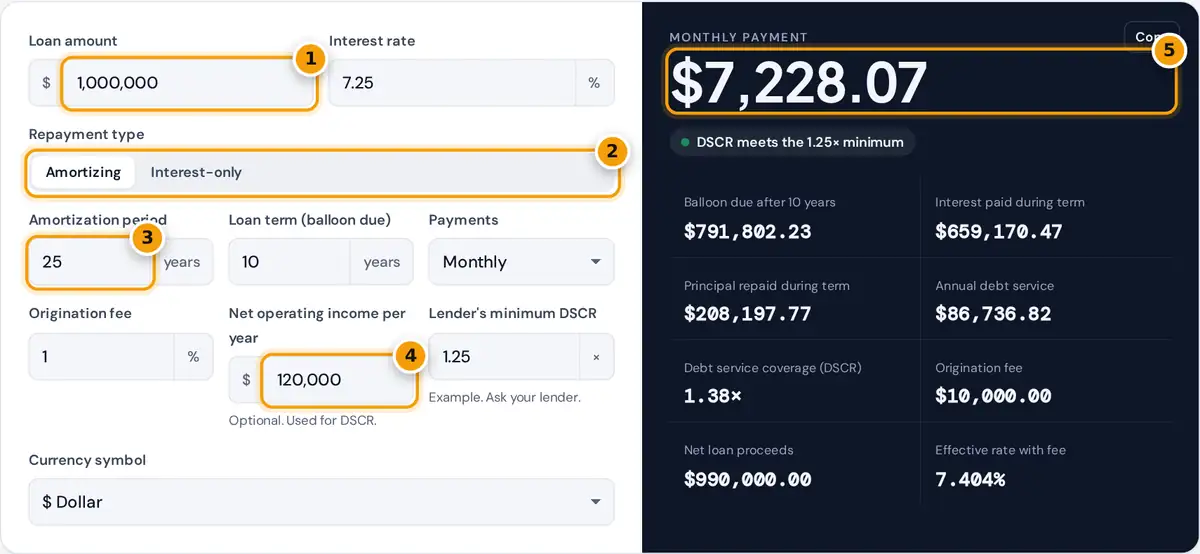
- Enter the loan amount and interest rate.
- Choose amortizing or interest-only repayment.
- Set the amortization, the term when the balloon is due and the payment frequency.
- Add the origination fee, net operating income and your lender's minimum DSCR.
- Read the payment, balloon, DSCR and effective rate after fees.
Enter the loan amount and interest rate, then choose how the loan is repaid. Most commercial mortgages and business term loans are amortizing: payments are sized as if the loan ran for the amortization period, such as 25 years, but the loan comes due at the end of a shorter term, such as 10 years. Whatever is still owed then is the balloon payment, usually refinanced or paid from a sale.
Choose interest-only if you pay just the interest during the term and repay the full amount at maturity. Add the origination fee to see your net proceeds and the effective rate after the fee. Enter the property's or business's net operating income to get the debt service coverage ratio, the figure lenders use to size commercial loans, and compare it with the minimum your lender quotes.
Commercial Loan Formulas
interest-only payment = L × i
balloon = balance after term years of payments
DSCR = net operating income ÷ annual debt service
effective rate: solves L − fee = PV of payments + PV of balloon
The periodic rate i is the annual rate divided by the number of payments a year. Annual debt service is one payment times the number of payments a year. A DSCR of 1.00 means the income exactly covers the payments, while lenders typically want a cushion above that.
The effective rate spreads the fee over the term only, not the full amortization, because the loan is repaid or refinanced at maturity. It is found with Newton's method.
Worked Example
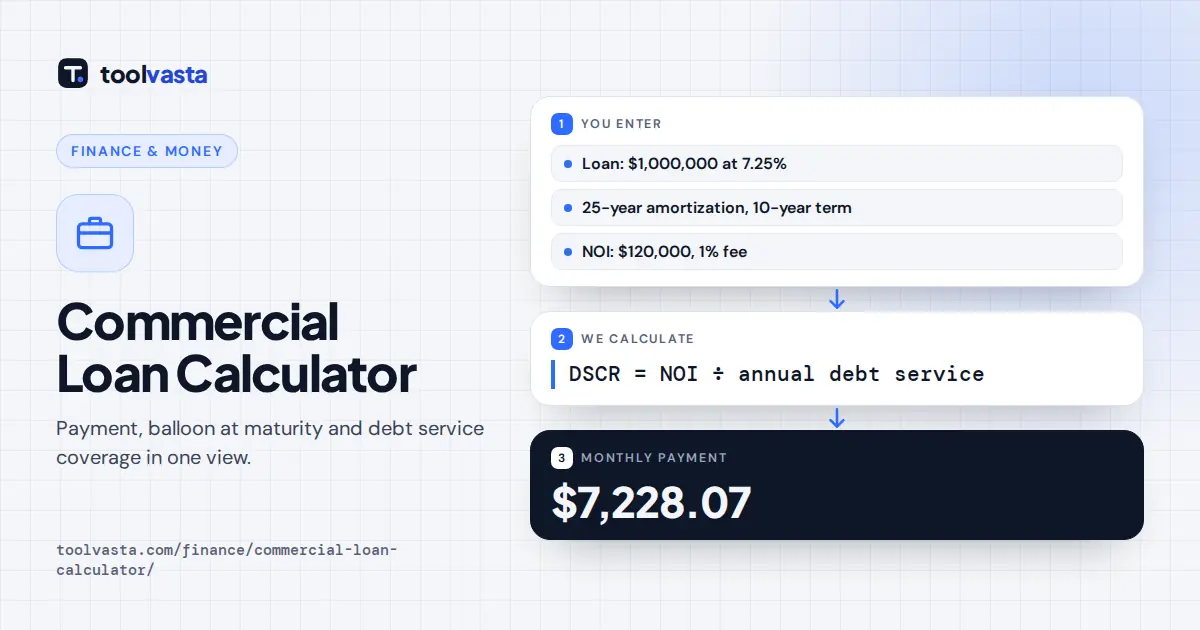
A $1,000,000 loan at 7.25% amortized over 25 years with monthly payments costs $7,228.07 a month, or $86,736.82 a year. After the 10-year term, $791,802.23 is still owed as a balloon. You pay $659,170.47 of interest over the term and repay only $208,197.77 of principal. With $120,000 of net operating income the DSCR is 1.38, above a 1.25 minimum.
A 1% origination fee costs $10,000, so you receive $990,000 and the effective rate over the term is 7.404%. As interest-only, the payment would be $6,041.67 a month, the DSCR would rise to 1.66 and the full $1,000,000 would be due at maturity.
| Amortization on $1,000,000 at 7.25%, 10-year term | Monthly payment | Balloon after 10 years | DSCR at $120,000 NOI |
|---|---|---|---|
| 15 years | $9,128.63 | $458,279.19 | 1.10 |
| 20 years | $7,903.76 | $673,227.41 | 1.27 |
| 25 years | $7,228.07 | $791,802.23 | 1.38 |
| 30 years | $6,821.76 | $863,103.50 | 1.47 |
Longer amortization lowers the payment and raises the DSCR, but leaves a larger balloon to refinance.
Lenders also look at loan-to-value, the loan divided by the appraised value of the property, and at the borrower's experience and credit. A loan that passes the DSCR test can still be reduced if the property value does not support it, so check both figures before you make an offer or sign a term sheet.
Tips for Commercial Borrowers
- Plan the balloon from day one. Refinancing depends on rates, the property's value and your income when the term ends.
- Lenders size loans by DSCR and loan-to-value together. If the DSCR is short, a longer amortization or a smaller loan can fix it.
- Ask about prepayment terms. Commercial loans can carry yield maintenance or defeasance clauses that make early repayment expensive.
- Compare offers on effective rate, not just the quoted rate, so fees are included.
- Use conservative net operating income that allows for vacancies and repairs.
Assumptions and Limits
The calculator assumes a fixed rate, level payments and compounding at the payment frequency. Variable-rate loans, rate resets, reserves and other closing costs are not modeled. Lender rules for DSCR, amortization and fees differ, so treat the results as estimates and confirm with your lender. Amounts work in any currency. For residential properties, see the mortgage calculator.
Frequently asked questions
What is a balloon payment on a commercial loan?
It is the balance still owed when the loan term ends. Because payments are based on a longer amortization, a large balance remains at maturity, which is usually refinanced or repaid from a sale.
What is DSCR?
The debt service coverage ratio is net operating income divided by annual loan payments. A DSCR of 1.38 means the income covers the payments 1.38 times. Lenders set their own minimum.
Why is commercial loan amortization longer than the term?
A long amortization keeps payments affordable for the property's income, while a short term lets the lender review the loan and reset the rate. The difference creates the balloon payment.
How does an origination fee change the cost of a loan?
You pay interest on the full loan but receive less money. The effective rate shows the true cost by spreading the fee over the term, which is higher than the quoted rate.
When does an interest-only commercial loan make sense?
It lowers payments and improves cash flow, which can help during a renovation or lease-up. The full principal is still owed at maturity, so it relies on refinancing or a sale.
Does this commercial loan calculator work for SBA or business loans?
It works for any fixed-rate loan with level payments. Enter the rate, amortization and term your lender quotes. Programs with fees, guarantees or variable rates may cost more than the estimate.