How to Use the SWP Calculator
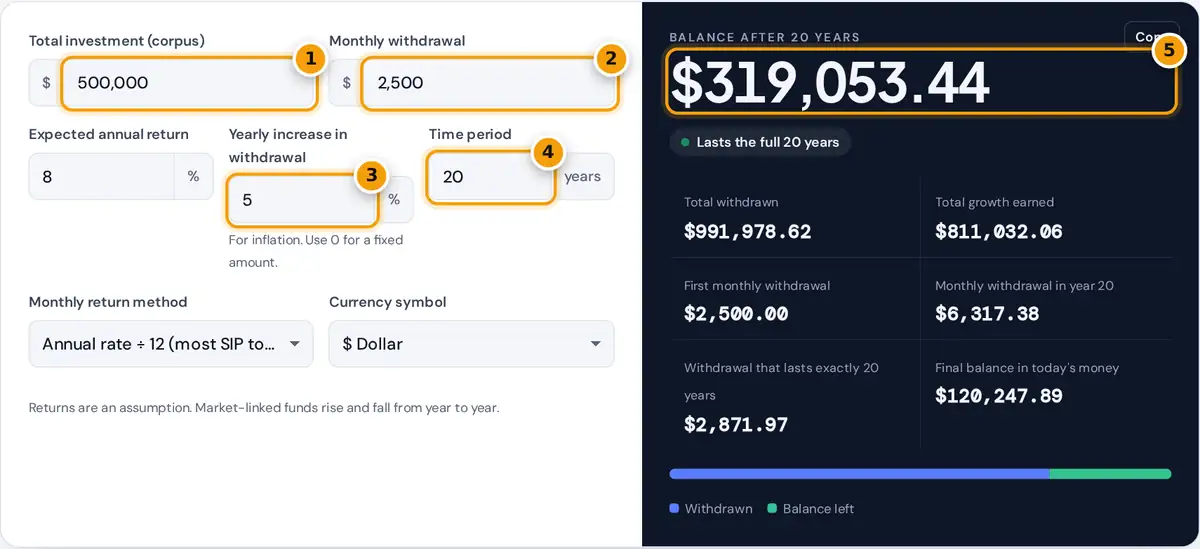
- Enter the lump sum you invest.
- Enter the monthly withdrawal you want to take.
- Set the yearly increase for inflation, or 0 for a fixed amount.
- Choose how many years the plan should run.
- Read the balance left or when the money runs out, plus the safe withdrawal.
Enter the lump sum you are investing, the amount you plan to withdraw each month and the yearly return you expect from the fund. Set the yearly increase to your expected inflation rate if you want the withdrawal to keep its buying power, or to 0 for a fixed monthly amount. Then choose how many years the plan should run.
The result shows the balance left at the end, or, if the money runs out first, exactly when it runs out. You also see the total withdrawn, the growth the fund earned along the way, the monthly amount in the final year and the largest starting withdrawal that lasts exactly your chosen period. The yearly table can be downloaded as a CSV file.
How the SWP Projection Works
each month: balance = balance × (1 + i) − withdrawal
withdrawal in year y = first withdrawal × (1 + increase)y−1
safe withdrawal W = corpus ÷ Σ (1 + increase)⌊(k−1)/12⌋ ÷ (1 + i)k
The balance earns one month of return, then the withdrawal is paid at the end of the month. The withdrawal steps up once a year, at the start of each new year of the plan. If the balance before a withdrawal is smaller than the amount due, the calculator pays out what is left and reports that month as the depletion point.
Most SIP and SWP calculators divide the annual rate by 12. The compound option converts the annual rate into the exact monthly rate that grows to the same yearly return, which gives slightly lower results.
Worked Example
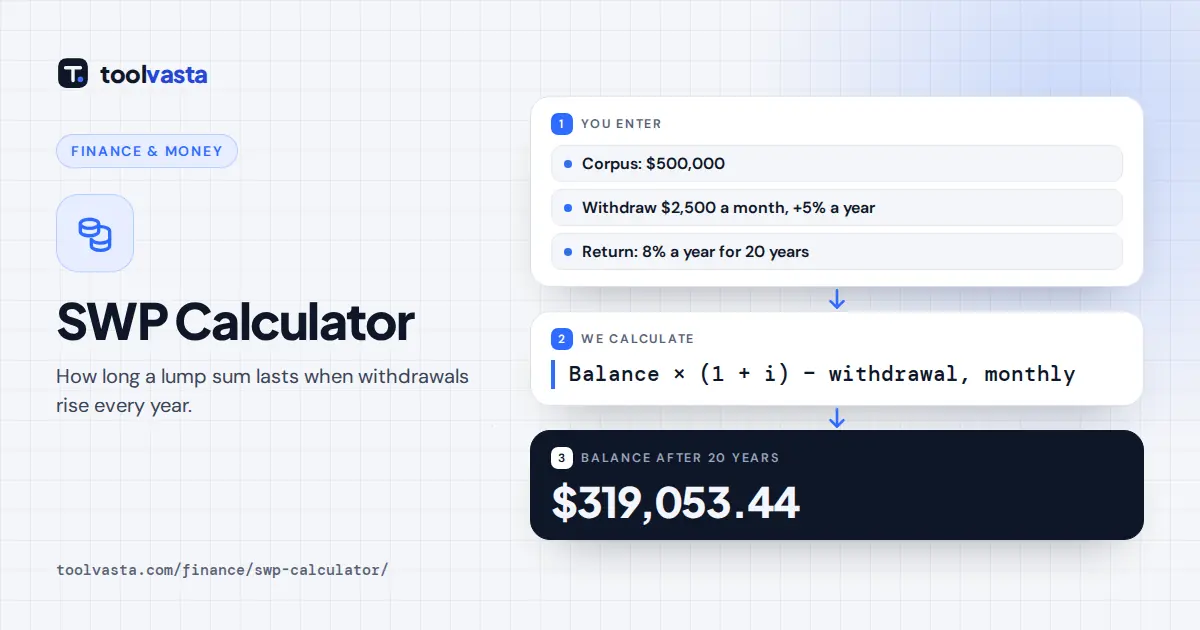
You invest $500,000, withdraw $2,500 a month, raise the withdrawal by 5% each year and expect an 8% annual return for 20 years. The money lasts the full period. By year 20 you are taking $6,317.38 a month, you have withdrawn $991,978.62 in total and $319,053.44 is still invested. The withdrawal that would use up the fund in exactly 20 years is $2,871.97 a month.
Starting at $3,000 a month instead, with the same increase, empties the fund after 18 years and 11 months. Without any yearly increase, $3,000 a month leaves $696,340.14 after 20 years, which shows how much inflation adjustments cost over time.
| Starting monthly withdrawal | Lasts with 5% yearly increases | Lasts with a fixed amount |
|---|---|---|
| $2,000 | 35 years 2 months | More than 40 years |
| $2,500 | 24 years 5 months | More than 40 years |
| $3,000 | 18 years 11 months | More than 40 years |
| $3,500 | 15 years 5 months | 38 years 3 months |
| $4,000 | 13 years 1 month | 22 years 6 months |
The table uses a $500,000 corpus and an 8% return with the annual rate divided by 12.
Tips for Planning Withdrawals
- Use a cautious return. A plan that only works at 10% a year leaves little room for a few bad years early on.
- Poor returns in the first years hurt most, because withdrawals continue while the fund is down. Keeping one or two years of withdrawals in a lower-risk fund can help.
- Check how withdrawals are taxed where you live. Each withdrawal can include a taxable gain.
- Review the plan every year and adjust the withdrawal if returns have been well above or below your assumption.
- Compare the result with the safe withdrawal figure. If your planned amount is close to it, a small change in returns can shorten the plan.
Assumptions and Limits
The projection uses a constant return every month, while real fund values move up and down. It ignores taxes, exit loads and fund expense ratios unless you lower the return to allow for them. Withdrawals are paid at the end of each month. Results work in any currency and are an estimate for planning, not investment advice. To build the corpus first, try our step up SIP calculator.
Frequently asked questions
What is an SWP?
A systematic withdrawal plan pays you a fixed amount from a mutual fund or investment account at regular intervals, usually monthly. The rest of the money stays invested and keeps earning returns while you withdraw.
How long will my SWP last?
It depends on the corpus, the withdrawal, the return and any yearly increase. The calculator runs month by month and shows the exact year and month the money runs out, or the balance left if it lasts.
What is an inflation-adjusted SWP?
It raises the monthly withdrawal every year by a set percentage, such as 5%, so your income keeps up with rising prices. It drains the fund faster than a fixed withdrawal, so test it carefully.
What is a safe monthly withdrawal from a corpus?
It is the largest withdrawal that, with your return and yearly increase, uses up the money exactly at the end of your chosen period. The calculator shows it for the timeline you enter.
Why do SWP calculators give different answers?
They use different conventions. Many divide the annual rate by 12 and pay withdrawals at month end. Some convert the annual rate exactly or withdraw at the start of the month. This tool lets you switch the return method.
Is an SWP better than a fixed deposit for income?
An SWP from a market-linked fund can earn more but its value can fall, while a fixed deposit pays a known rate. The right choice depends on your risk tolerance, tax situation and time horizon.