How to Use the XIRR Calculator
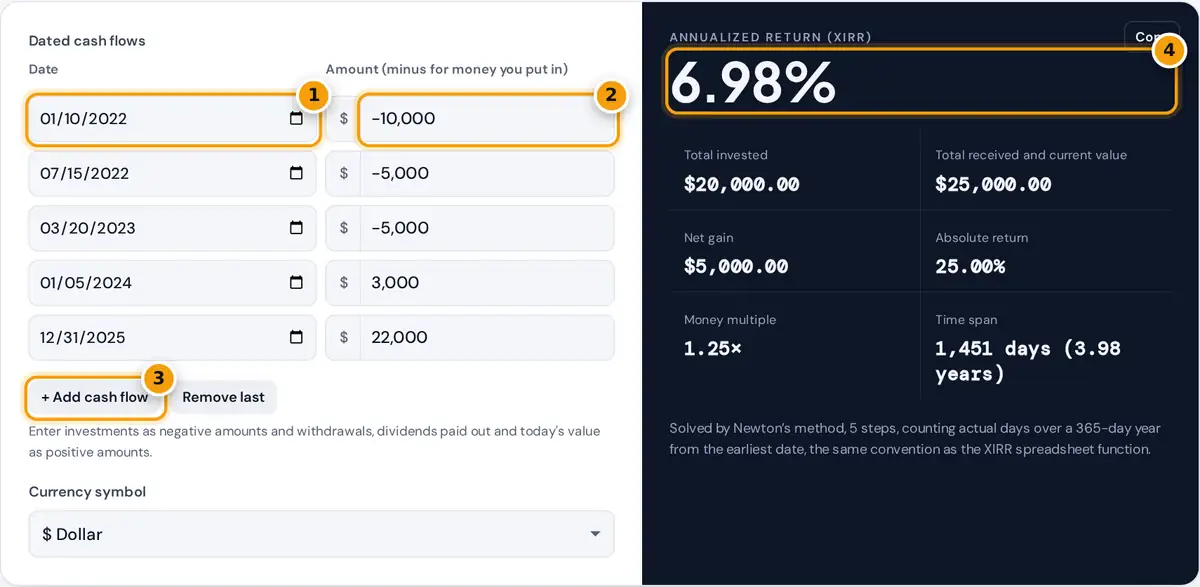
- Enter the date of each deposit, withdrawal and today's value.
- Enter amounts: negative for money you put in, positive for money you get back.
- Add more rows for every top-up or SIP installment.
- Read the XIRR, then the gain, absolute return and money multiple.
List every cash flow of the investment with its date. Money you put in, such as a lump sum, a monthly SIP installment or an extra top-up, is entered as a negative amount. Money you take out, such as a withdrawal or a dividend paid to your bank account, is positive. Finish with today's market value as a positive amount dated today, as if you sold everything.
The rows do not need to be in date order. Use Add cash flow for more rows, up to 60. The calculator shows the annualized return, the money you invested and received, the net gain, the absolute return, the money multiple and how long the money was invested. It also tells you whether Newton's method or the slower bisection method found the answer.
The XIRR Formula
d0 = earliest date, di = date of cash flow i
XIRR is the single yearly rate that makes the present value of all your cash flows add up to zero, with each one discounted by the exact number of days since the first date. Because the rate is inside an exponent, there is no direct formula. The tool starts Newton's method at 10%, refines the guess with the slope of the equation, and switches to bisection if the guess runs away or the cash flows are unusual.
This makes XIRR a money-weighted return: it rewards you for having more money invested when markets rise. That is different from a fund's published return, which ignores the timing of your own deposits.
Worked Example
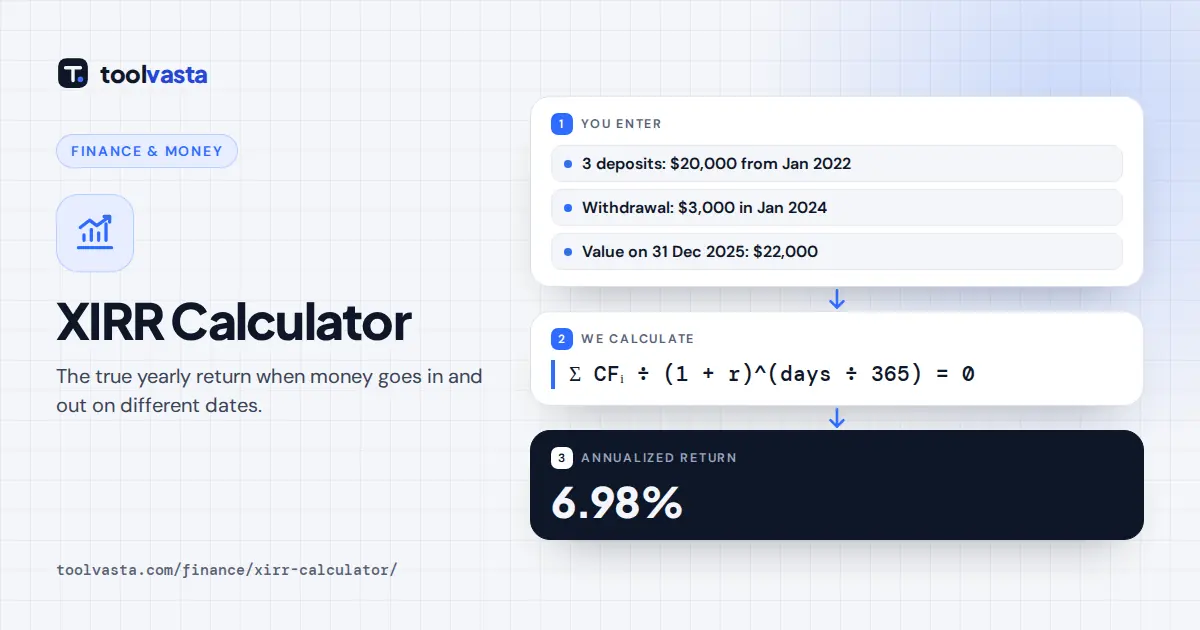
You invested $10,000 on 10 January 2022, $5,000 on 15 July 2022 and $5,000 on 20 March 2023. You withdrew $3,000 on 5 January 2024, and on 31 December 2025 the account is worth $22,000. You put in $20,000 and got back or still hold $25,000, a gain of $5,000 or 25.00% in total over 1,451 days.
The XIRR is 6.98% a year. The table shows each cash flow discounted at that rate: the present values add up to zero, which is the definition of XIRR. If the account were worth $25,000 instead, the XIRR would rise to 10.63%.
| Date | Amount | Years from start | Present value at 6.98% |
|---|---|---|---|
| 10 Jan 2022 | −$10,000 | 0.0000 | −$10,000.00 |
| 15 Jul 2022 | −$5,000 | 0.5096 | −$4,830.92 |
| 20 Mar 2023 | −$5,000 | 1.1890 | −$4,614.33 |
| 5 Jan 2024 | $3,000 | 1.9863 | $2,623.53 |
| 31 Dec 2025 | $22,000 | 3.9753 | $16,821.72 |
Tips for Accurate Returns
- Include every deposit, even small ones. Leaving out a top-up makes the return look higher than it was.
- Dividends that were reinvested stay inside the account value, so do not enter them separately. Only dividends paid out to you are positive cash flows.
- For a SIP, enter each installment on its actual debit date, then today's value as the last row.
- Over periods shorter than a year, XIRR annualizes the return and can look extreme. A 3% gain in two months shows as roughly 19% a year.
- Compare XIRR with the return of an index fund over the same dates to judge whether active choices helped.
Assumptions and Limits
The calculator uses actual days divided by 365, like the XIRR function in common spreadsheet software, so results should match a spreadsheet to the displayed precision. Fees and taxes are included only if they are part of the cash flows you enter. Cash flows that change sign several times can have more than one valid rate; the tool reports the one it finds nearest a normal return. For regular yearly cash flows, our NPV calculator also gives IRR and payback. This is an educational estimate, not investment advice.
Frequently asked questions
What is XIRR?
XIRR is the extended internal rate of return. It is the annual rate that makes the discounted value of cash flows on irregular dates add up to zero, so it measures the yearly return on money you added and withdrew over time.
How is XIRR different from CAGR?
CAGR uses only a starting value, an ending value and the time between them. XIRR handles many deposits and withdrawals on different dates, so it is the better measure for SIPs and accounts you top up.
Why should investments be entered as negative numbers?
XIRR needs the direction of each cash flow. Money leaving your pocket is negative and money coming back, including today's value, is positive. Without both signs there is no rate that balances them.
Does this calculator match Excel XIRR?
Yes, it uses the same convention: actual days between dates divided by 365, discounted from the earliest date. Results should agree with a spreadsheet to two decimal places for the same cash flows.
Why is my XIRR very high for a short period?
XIRR annualizes the return. A small gain over a few weeks is scaled up to a full year, so short holding periods can produce large percentages that are not sustainable over longer periods.
Can XIRR be negative?
Yes. If the money you received plus today's value is less than what you invested, the rate that balances the cash flows is below zero, which shows an annualized loss.