How to Use the Rental Property ROI Calculator
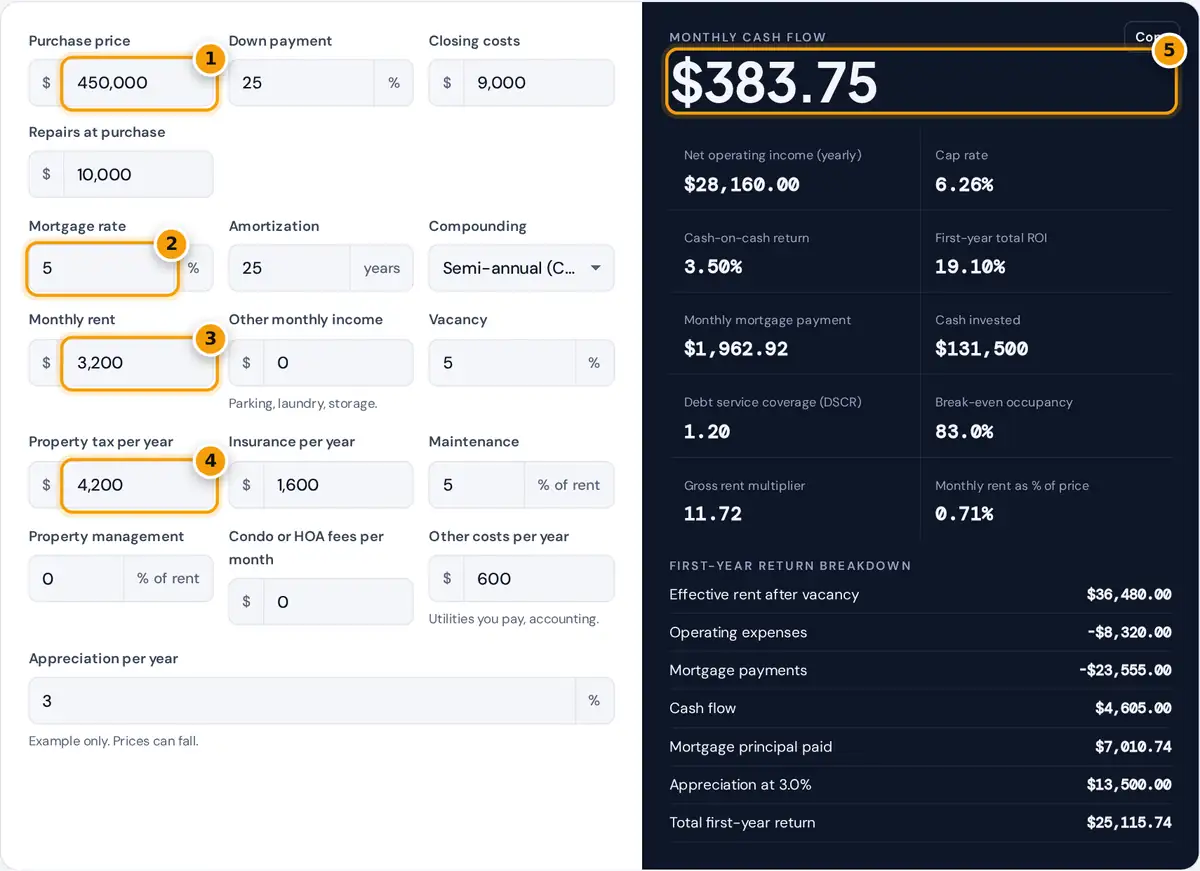
- Enter the purchase price, down payment, closing costs and repairs.
- Enter the mortgage rate, amortization and compounding method.
- Enter the monthly rent, other income and vacancy allowance.
- Enter property tax, insurance, maintenance and other yearly costs.
- Read the monthly cash flow, then cap rate, cash-on-cash and ROI.
Start with the purchase: price, down payment percentage, closing costs such as legal fees and land transfer tax, and any repairs needed before the first tenant moves in. Enter the mortgage rate, the amortization and the compounding method. Canadian fixed-rate mortgages compound semi-annually by law, while most US mortgages compound monthly.
Next, enter the monthly rent, any other income, a vacancy allowance and the yearly operating costs: property tax, insurance, maintenance, management, condo or HOA fees and anything else you pay as the owner. Add an appreciation assumption. The calculator shows the monthly cash flow and the key ratios investors use to compare properties, with a breakdown of the first-year return.
Rental Property Formulas
cap rate = NOI ÷ purchase price
cash flow = NOI − yearly mortgage payments
cash-on-cash return = cash flow ÷ cash invested
first-year ROI = (cash flow + principal paid + appreciation) ÷ cash invested
DSCR = NOI ÷ mortgage payments
Net operating income excludes the mortgage, so the cap rate compares properties as if bought with cash. Cash-on-cash return shows what your own money earns in spendable cash. Total ROI adds the equity you build by paying down the loan and any rise in value, which are real gains but not cash in hand until you sell or refinance.
Worked Example
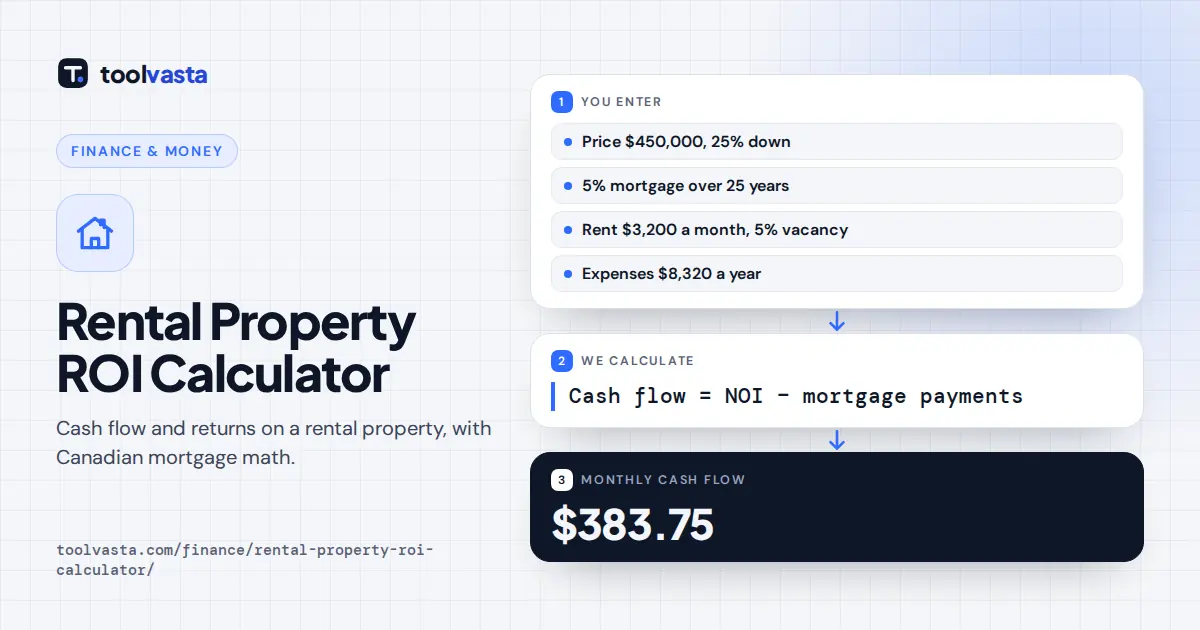
A property costs $450,000 with 25% down, $9,000 of closing costs and $10,000 of repairs, so $131,500 of cash goes in. The $337,500 mortgage at 5% over 25 years, compounded semi-annually, costs $1,962.92 a month. Rent of $3,200 with 5% vacancy brings in $36,480 a year, and expenses total $8,320, leaving NOI of $28,160 and a cap rate of 6.26%.
After $23,555 of mortgage payments, the yearly cash flow is about $4,605, or $383.75 a month, a cash-on-cash return of 3.50%. Adding $7,010.74 of principal paid in year one and $13,500 of appreciation at 3% gives a first-year total return of 19.10%. The DSCR is 1.20 and the property breaks even at 83.0% occupancy.
Key Ratios at a Glance
| Measure | What it tells you | How investors use it |
|---|---|---|
| Cap rate | Income return on price, ignoring financing | Compare properties and markets |
| Cash-on-cash | Cash flow on the money you put in | Compare with other uses of your cash |
| Total ROI | Cash flow plus equity gains | See the full first-year picture |
| DSCR | How many times NOI covers the mortgage | Lenders often look for 1.2 or more |
| Break-even occupancy | Occupancy needed to cover all costs | Lower is safer |
| GRM and 1% rule | Price relative to rent | Quick screening before full analysis |
The ratios work together. A property with a strong cap rate can still have negative cash flow when interest rates are high, which is common in expensive Canadian cities. For background on mortgage costs, see the Financial Consumer Agency of Canada.
Tips for Analyzing a Rental
- Use realistic rent from comparable listings, not the asking rent of the seller's best unit.
- Budget for maintenance and capital repairs even in a new building. Roofs, furnaces and appliances wear out.
- Include management at a market rate even if you plan to self-manage, so the numbers still work if you hire help later.
- Check rent control rules, licensing and short-term rental bylaws where the property is located.
- Run a stress test with a higher mortgage rate and a lower rent to see how much room you have.
Assumptions and Limits
The calculator shows the first year only and assumes rent, expenses and the mortgage rate stay as entered. It does not include income tax, capital cost allowance or depreciation, selling costs or tax on a future sale. Appreciation is an assumption, not a forecast. Amounts work in any currency. This is an estimate for comparing properties, not investment advice.
Frequently asked questions
How do I calculate ROI on a rental property?
Add the yearly cash flow, the mortgage principal paid and any appreciation, then divide by the cash you invested. Cash flow alone divided by cash invested is the cash-on-cash return.
What is a good cap rate for a rental property?
It depends on the market and risk. Expensive city properties often trade at lower cap rates, while smaller towns can be higher. Compare with similar properties in the same area rather than a fixed number.
What is the difference between cap rate and cash-on-cash return?
Cap rate divides net operating income by the purchase price and ignores the mortgage. Cash-on-cash return divides the cash flow after mortgage payments by the cash you actually invested.
What is the 1% rule in real estate?
The 1% rule is a quick screen that says monthly rent should be at least 1% of the purchase price. Many properties in high-cost Canadian cities fall well short of it.
Why do Canadian mortgages use semi-annual compounding?
Canadian law requires fixed-rate mortgages to state interest compounded semi-annually, not in advance. This makes the monthly payment slightly lower than the same rate compounded monthly.
Is negative cash flow ever acceptable?
Some investors accept small negative cash flow in exchange for principal paydown and expected appreciation, but it adds risk. You must cover the shortfall every month, even when rates rise or units sit empty.