How to Use the Forex Compound Calculator
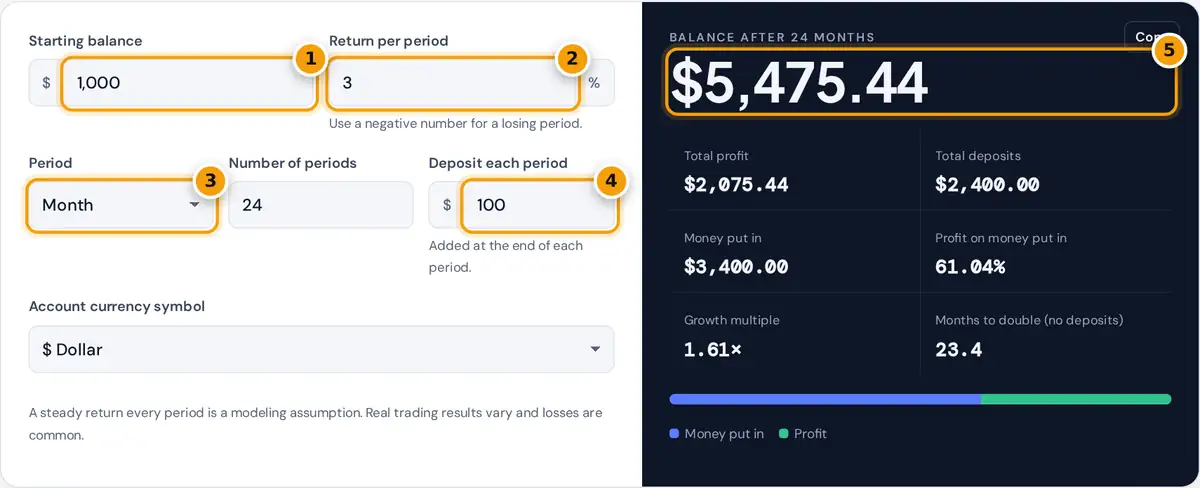
- Enter the starting account balance.
- Enter the return per period, negative for losing periods.
- Choose trading days, weeks or months and the number of periods.
- Add a deposit for each period if you plan to top up.
- Read the final balance, profit and the period-by-period table.
Enter your starting account balance and the return you want to model for each period, then choose whether a period is a trading day, a week or a month and how many periods to project. If you plan to add money regularly, enter the deposit made at the end of each period. Use a negative return to see how a run of losing periods shrinks an account.
The calculator leaves every profit in the account so it compounds, the way a trader who never withdraws would grow. It shows the final balance, the total profit, your deposits, the profit as a share of the money you put in and how many periods it takes to double at that rate. The period-by-period table lists the start balance, profit, deposit and end balance, and can be downloaded as CSV.
Forex Compounding Formula
without deposits: final = start × (1 + r)n
with deposits: final = start × (1 + r)n + D × [(1 + r)n − 1] ÷ r
periods to double = ln 2 ÷ ln(1 + r)
Compounding means each period's return is earned on a larger balance than the last. Small rates add up fast: 1% a trading day for 60 days turns $500 into $908.35. That is also why compounding targets that look modest per day are rarely sustained in real trading.
The deposit is added after the period's profit, so it starts compounding in the next period.
Worked Example
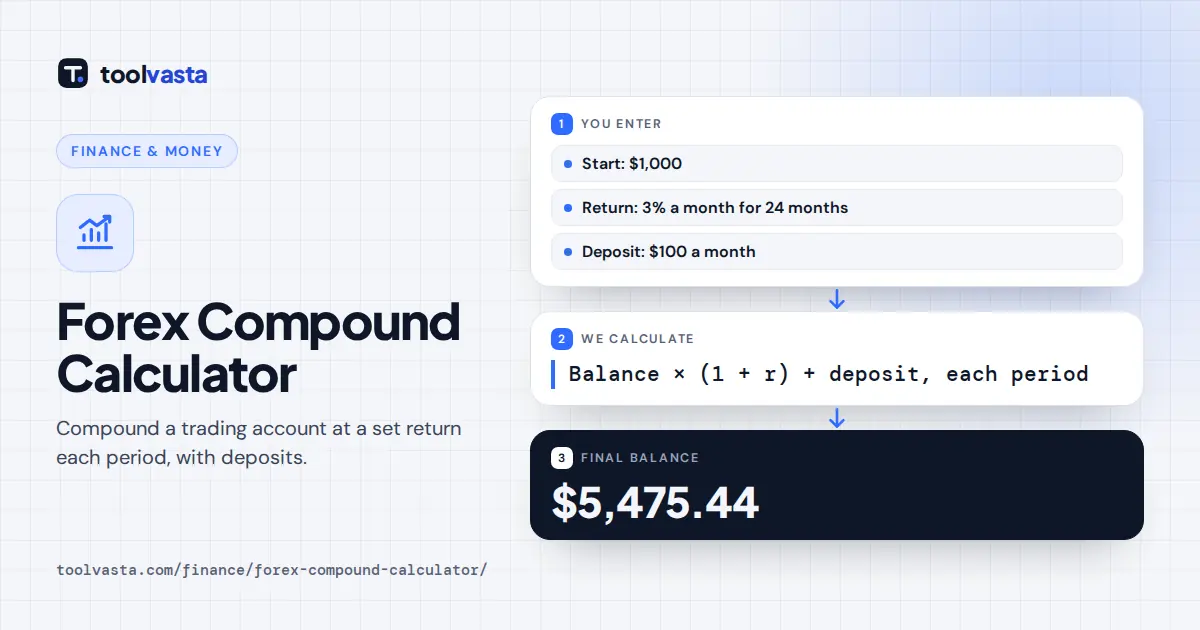
A trader starts with $1,000, adds $100 a month and models 3% a month for 24 months. The account ends at $5,475.44. Of that, $3,400.00 is money put in, the $1,000 start plus $2,400 of deposits, and $2,075.44 is profit, a 61.04% gain on the money put in. At 3% a period the balance doubles roughly every 23.4 months without deposits.
| $1,000 compounding monthly, no deposits | 12 months | 24 months | 36 months |
|---|---|---|---|
| 1% a month | $1,126.83 | $1,269.73 | $1,430.77 |
| 2% a month | $1,268.24 | $1,608.44 | $2,039.89 |
| 3% a month | $1,425.76 | $2,032.79 | $2,898.28 |
| 5% a month | $1,795.86 | $3,225.10 | $5,791.82 |
The table shows how much the rate matters. Doubling the monthly return from 1% to 2% more than doubles the profit after three years, because each gain also compounds. A losing month works the same way in reverse: after a 10% loss an account needs an 11.1% gain just to get back to where it was.
Profit on money put in compares the final profit with everything you deposited, including the starting balance. It is a simple measure, not an annualized return, because deposits made late in the period had little time to grow. To compare with other investments over the same time, enter your dated deposits and the final balance into the XIRR calculator.
Tips for Realistic Projections
- Model a range of returns, including zero and negative periods. A projection with only winning months is a best case, not a plan.
- Subtract spreads, commissions and swap fees from the return you enter.
- Do not raise position size just to hit a compounding target. Risk per trade should follow your stop loss, which the forex lot size calculator handles.
- Withdrawals reduce compounding. If you plan to take profits, lower the return or the deposit to reflect it.
- Compare with a simple index investment using the compound interest calculator to judge whether the risk is worth it.
Assumptions and Limits
The calculator applies the same return every period and adds deposits at the end of each period. Real trading returns are irregular and losses are common, especially with leverage. Taxes, fees and currency conversion are not included. This is an illustration of compounding math, not a forecast or trading advice.
Frequently asked questions
How does compounding work in forex trading?
Profits stay in the account and the next period's return is earned on the larger balance. Over many periods the growth accelerates, but losses compound the same way and shrink the account.
How much will $1,000 grow at 1% a day?
At exactly 1% every trading day with no deposits, $1,000 grows to about $1,816.70 after 60 trading days. Very few traders sustain such returns, so treat it as an illustration.
What is a realistic monthly return in forex?
There is no reliable figure. Results vary widely and many retail traders lose money. Use the calculator to test cautious, average and losing scenarios rather than a single optimistic rate.
How long does it take to double an account?
Divide the natural log of 2 by the natural log of one plus the rate per period. At 3% a month that is about 23.4 months without deposits.
Should deposits be included in profit?
No. Deposits are your own money. The calculator separates them so profit only counts what the trading returns added on top of the starting balance and deposits.
Can I model losing periods?
Yes. Enter a negative return per period to see how an account declines. A 10% loss requires an 11.1% gain to recover, which shows why limiting losses matters.