How to Use the Daily Interest Calculator
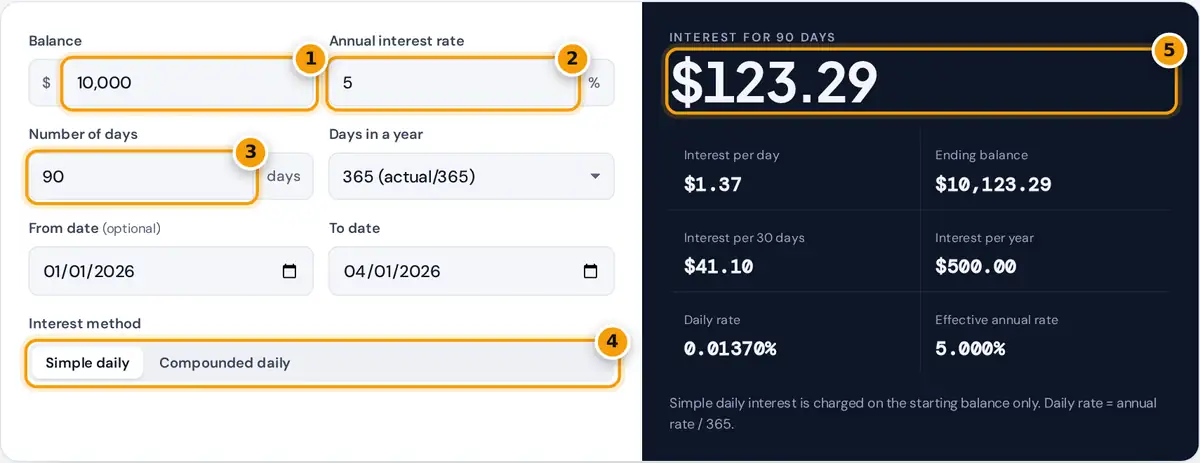
- Enter the balance of your savings, loan or credit card.
- Enter the annual interest rate as a percentage.
- Type the number of days, or set From and To dates below to count them.
- Choose simple daily interest or interest compounded daily.
- Read the interest for the period, with interest per day and the ending balance.
Enter the balance and the annual interest rate, then type the number of days. You can instead pick a start and end date, and the daily interest calculator counts the days between them for you.
Choose the day-count basis your bank or lender uses, 365, 360 or 366, and select simple daily interest or interest compounded daily. Simple suits loans and per diem quotes, while compounding suits most savings accounts.
Results show interest for the period, interest per day, the ending balance, interest per 30 days and per year, the daily rate and the effective annual rate. A table compares both methods over common periods.
Daily Interest Formula
Simple daily interest = balance × daily rate × days
Compounded daily = balance × ((1 + daily rate)days − 1)
First divide the annual rate by the days in the year to get a daily rate. Multiply that daily rate by the principal to get the interest per day in dollars, often called per diem.
For simple daily interest, multiply the interest per day by the number of days. The balance never grows during the period, so every day earns or costs exactly the same interest from start to finish.
When interest is compounded daily, each day's interest joins the balance and earns interest the next day. Over a year that lifts the effective annual rate slightly above the quoted rate, as the example shows.
Worked Example: $10,000 at 5%
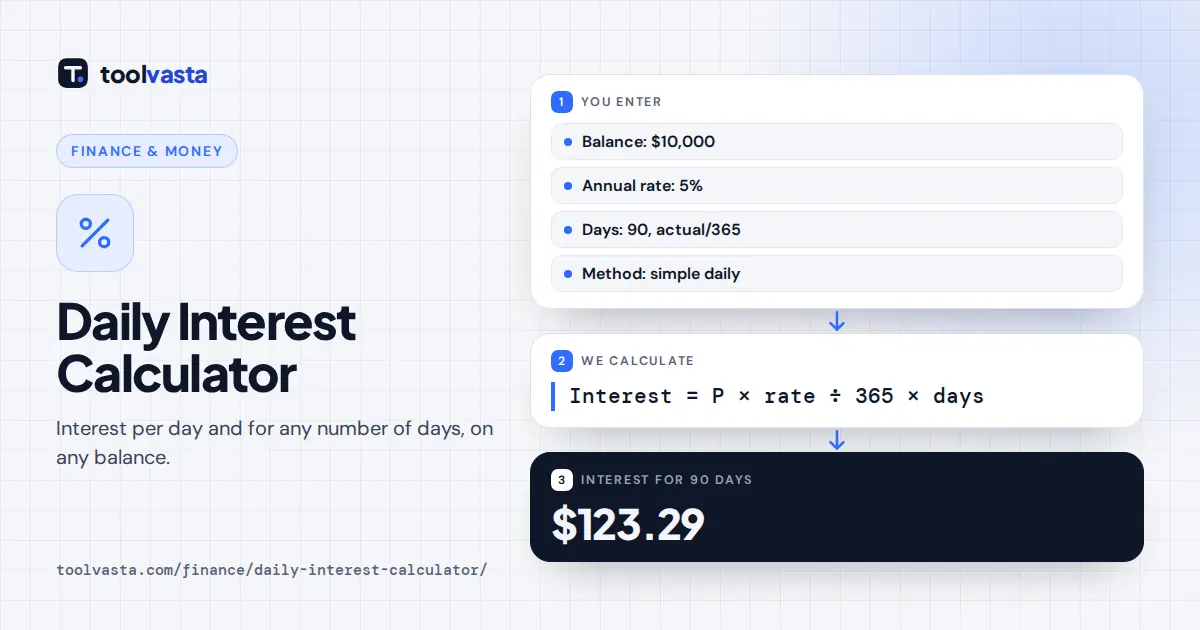
A $10,000 balance at 5% on a 365-day basis earns $10,000 times 0.05 divided by 365, or $1.37 a day. That works out to $41.10 per 30 days of simple interest on the same balance.
Over the 90 days from January 1 to April 1, 2026, simple interest on an actual/365 day basis is $123.29. With daily compounding the balance reaches $10,124.04, so you earn $124.04, just 75 cents more.
Across a full year, daily compounding turns 5% into an effective annual rate of 5.127%. Monthly compounding of the same rate gives 5.116%, so the extra benefit of daily compounding is small for most savers.
365 vs 360-Day Year
| Balance at 5% | Per day (365) | 30 days | One year, simple |
|---|---|---|---|
| $1,000 | $0.14 | $4.11 | $50.00 |
| $10,000 | $1.37 | $41.10 | $500.00 |
| $50,000 | $6.85 | $205.48 | $2,500.00 |
| $100,000 | $13.70 | $410.96 | $5,000.00 |
The day-count basis is the number you divide the annual rate by. Most Canadian deposit accounts and consumer loans use actual/365, which counts the real calendar days elapsed and divides the yearly rate by 365.
Many commercial loans and US contracts use actual/360. The U.S. Bureau of the Fiscal Service applies a 360-day year to late government payments. On $10,000 at 5% for 90 days, it costs $125.00, not $123.29.
A 366 option covers a leap year when a contract divides by the actual days in that year. Dividing by 366 gives a slightly smaller daily rate, so interest for the same days falls slightly.
Daily Interest on Credit Cards
Card issuers convert the APR into a daily periodic rate and apply it to each day's balance. A card at 20.99% charges 20.99% divided by 365, or 0.05751% a day, on whatever amount you owe.
Carry $3,000 through a 30-day statement period at that rate and simple daily interest costs about $51.76. Enter the card's APR and the days in your billing cycle to estimate your own monthly interest charge.
Issuers usually work from your average daily balance, so paying part of it early in the cycle lowers interest. Pay in full by the due date, and most cards charge no interest on new purchases.
Per Diem Interest on Loans and Payoffs
Per diem simply means per day. Lenders and lawyers quote a per diem figure for a mortgage payout or a loan payoff, so they can adjust the amount if the closing date moves a day.
To check a payoff quote, enter the outstanding principal, the loan rate and the days between the last payment and the payoff date, using simple daily interest. The interest per day is the per diem.
The same method covers interest on a late payment, private loans between family members and court-ordered judgment interest on debts. Always confirm the day-count basis in the agreement, because 360 and 365 give different answers.
Simple vs Compounded Daily Interest
Most savings account products and many GIC products in Canada calculate interest daily but pay it out monthly or at maturity. Choose compounded daily only when interest is actually added to your balance every day.
Compounding means interest on interest. Over 90 days on $10,000 the difference is under a dollar, but on large balances, high rates or long periods the gap grows, as the table shows over 365 days.
On loans, unpaid interest can capitalize, meaning it is added to the principal and starts accruing interest itself. Canada's Interest Act also requires contracts quoting a daily or monthly rate to state the yearly equivalent.
Assumptions and Limits
The calculator assumes the rate and balance stay the same for the whole period, with no deposits, withdrawals or payments. Any change in balance means you should split the period and calculate each part separately.
When you pick dates, the count will exclude the start date and include the end date, which is how most lenders count interest days. January 1 to December 31, 2026 therefore counts as 364 days.
Results are estimates rounded to the cent. Your bank statement may differ slightly because of posting dates, rounding of each daily amount, fees, or perhaps a variable rate that changed during the period you measured.
Frequently asked questions
How do I calculate daily interest?
Divide the annual rate by 365 to get the daily rate, then multiply by the balance. For several days, multiply by the number of days, or use daily compounding if interest is added to the balance each day.
How much interest does $10,000 earn per day?
At 5% a year on a 365-day basis, $10,000 earns about $1.37 a day, or $41.10 over 30 days. At 3% it earns about $0.82 a day before any tax on the interest.
Is daily compounding better than monthly?
For savings, yes, but only slightly. At 5%, daily compounding gives an effective annual rate of 5.127% compared with 5.116% for monthly compounding, a difference of about one dollar per $10,000 each year.
What is per diem interest?
Per diem interest is the simple interest charged for one day, often quoted for loan payoffs and mortgage payouts. It equals the balance times the annual rate divided by 365, or by 360 under some contracts.
Why do some lenders use 360 days?
A 360-day year is an old banking convention that simplifies calculations. Because the annual rate is divided by a smaller number, the daily rate is higher and slightly more interest is charged.
How do credit cards calculate daily interest?
Issuers divide the APR by 365 to get a daily periodic rate, apply it to your average daily balance and multiply by the days in the billing cycle. Paying in full by the due date usually avoids interest.