How to Use the Bitcoin Profit Calculator
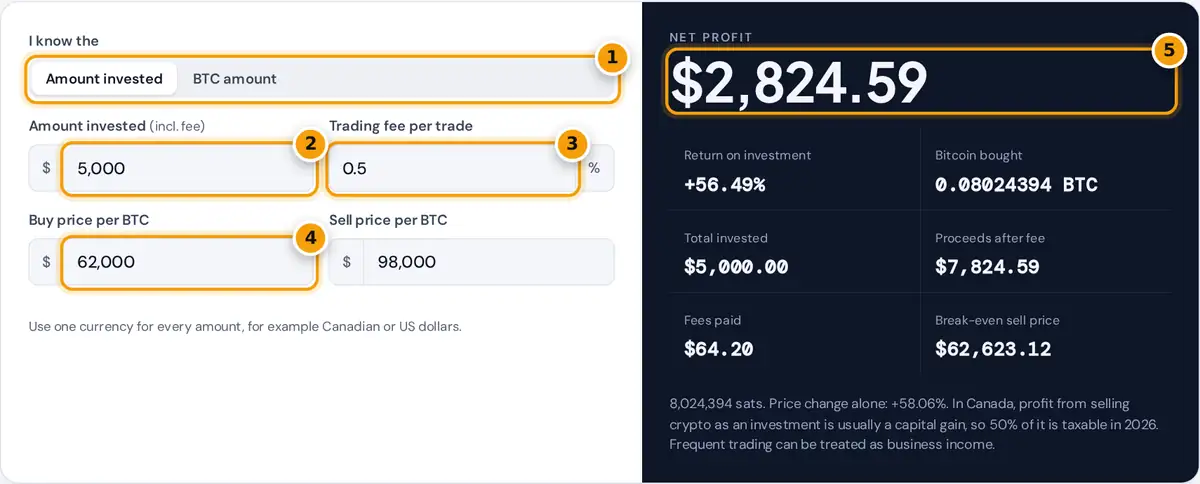
- Choose whether you know the amount invested or the BTC amount.
- Enter the amount you invested, including the fee.
- Enter your exchange trading fee per trade.
- Enter your buy price per bitcoin, then the sell price beside it.
- Read your net profit, then check ROI, BTC bought and the break-even sell price.
Choose whether you know the amount invested in dollars or the BTC amount you bought. The first option assumes your deposit already covers the buying fee, which is how most exchange receipts show a purchase.
Enter the buy price per bitcoin, then the sell price or any target price you are considering. Add the trading fee your exchange charges on each trade as a percentage, for example 0.5% or 0.1%.
Results show net profit or loss, percentage return, BTC bought, fees paid and the break-even sell price. The tool does not fetch a live bitcoin price, so copy the current quote from your own exchange.
Bitcoin Profit Formula
The bitcoin profit formula follows the money through two trades. First, part of your deposit pays the buying fee and the rest buys coins. Later, the sale produces proceeds, and the selling fee comes off.
Proceeds = BTC × sell price × (1 − fee)
Profit = proceeds − amount invested
ROI = profit ÷ amount invested × 100
Break-even price = buy price × (1 + fee) ÷ (1 − fee)
Net profit is the proceeds minus everything you paid. Because the fee is charged on the value of each trade, a sale at a higher price costs a larger dollar fee than the purchase did.
Some platforms openly advertise zero fees but build a spread into the quoted price. Others charge different maker and taker rates. Enter whichever percentage you actually pay, or the spread itself, for a closer estimate.
Worked Example: $5,000 Bought at $62,000
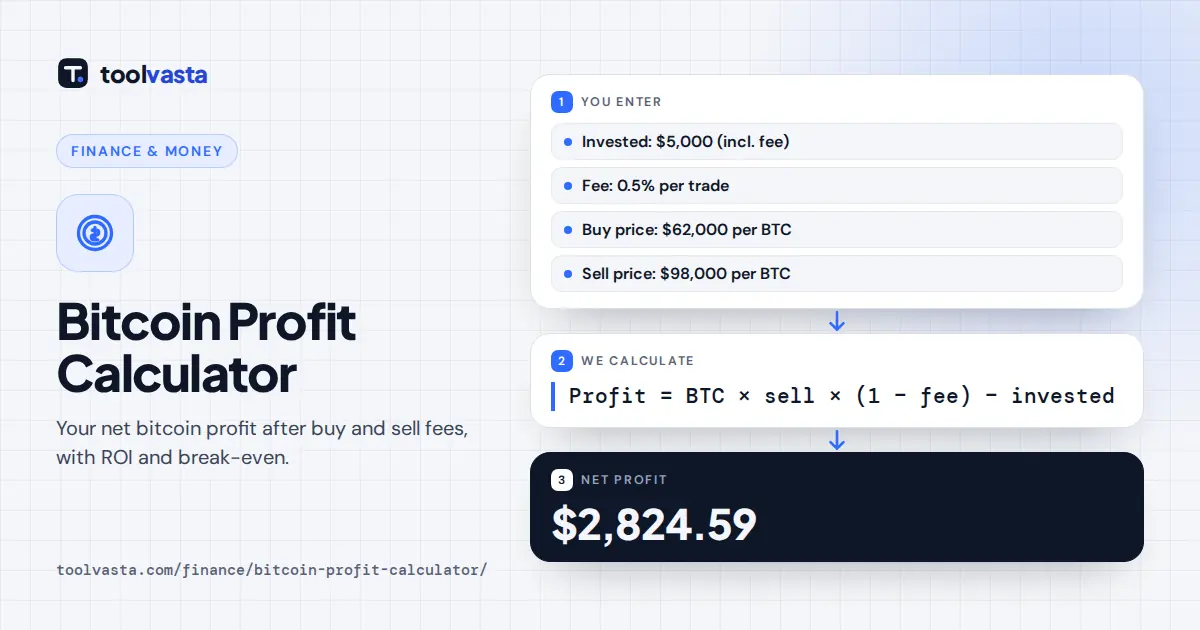
Suppose you invest $5,000 when bitcoin is $62,000 and the exchange charges 0.5% per trade. The buying fee comes to $24.88, so $4,975.12 goes into the market and buys exactly 0.08024394 BTC at that price.
When bitcoin later reaches $98,000, those coins are worth $7,863.91. The 0.5% selling fee of $39.32 leaves $7,824.59, which is a net profit of $2,824.59 and a return of 56.49% on the full $5,000 invested.
The price change itself was 58.06%, so fees totaling $64.20 cost you about 1.6 percentage points of return. You would break even at a sell price of $62,623.12, not at the $62,000 you originally paid.
How Fees Change Your Crypto Profit
The table below runs the same $5,000 purchase at $62,000 and sale at $98,000 with four different fee levels. Each row uses the same fee per trade on both the buy and the later sell.
| Fee per trade | Break-even price on a $62,000 buy | Profit on the example |
|---|---|---|
| 0% | $62,000.00 | $2,903.23 |
| 0.1% | $62,124.12 | $2,887.44 |
| 0.5% | $62,623.12 | $2,824.59 |
| 1.5% | $63,888.32 | $2,669.63 |
Exchange fees look small, yet a 1.5% rate costs about $234 more than no fee here. The higher your fee, the further the price must climb before you reach the break-even price on your purchase.
Fees matter most on short trades with small price moves. On a quick 2% gain, paying 1.5% on each side turns the same $5,000 trade into a loss of roughly $51 instead of a profit.
Reading ROI, Break-Even and Sats
Return on investment divides profit by the total you put in, fees included. A high percentage on a small stake can still be a modest dollar gain, so read both numbers carefully before deciding anything.
Bitcoin divides into 100,000,000 satoshis, and the note under the result shows how many sats you bought. The example purchase of 0.08024394 BTC equals 8,024,394 sats, which is much easier to read than eight decimals.
If you bought at several prices, for instance through dollar-cost averaging, use your average buy price and total BTC amount. The calculator handles one buy and one sell, so averaging gives the correct overall result.
Is Bitcoin Profit Taxable in Canada?
Yes. The CRA treats cryptocurrency as a commodity, and selling, spending or trading one coin for another is a disposition. Its guidance for crypto-asset users explains how to report gains, losses and income in detail.
If you hold bitcoin as an investment, profit is usually a capital gain, and 50% of it is added to taxable income for 2026. Frequent trading or a crypto business can make it business income.
Keep records of every trade, including dates, amounts, fees and the value in Canadian dollars at the time. Tax figures here are general estimates, so confirm your situation with the CRA or a tax professional.
Limits and Risk
This calculator ignores withdrawal fees, network fees and currency conversion charges, which can all trim real profit. Use one currency for every amount, either Canadian or US dollars, so the comparison stays consistent and fair.
Bitcoin is highly volatile and can fall sharply within days, so a target price is a scenario, not a forecast. The federal government notes that crypto assets are not legal tender and carry serious risks.
Results are for information and are not investment advice or tax advice. Only invest money you can afford to lose, and check your exchange statements before filing a tax return or making a trading decision.
Frequently asked questions
How do I calculate my bitcoin profit?
Multiply the BTC you hold by the sell price, subtract the selling fee, then subtract the total you paid including the buying fee. The result is your net profit or loss in dollars.
What is the break-even price for bitcoin after fees?
Multiply your buy price by one plus the fee and divide by one minus the fee. With a 0.5% fee on each side, a $62,000 purchase breaks even at a sell price of $62,623.12.
How many satoshis are in a bitcoin?
One bitcoin is 100,000,000 satoshis, often called sats. The calculator shows how many sats your purchase bought, so 0.08024394 BTC appears as 8,024,394 sats beneath the result.
Do I pay tax on bitcoin profit in Canada?
Yes. For most investors, profit on selling bitcoin is a capital gain and half of it is taxable in 2026. Frequent traders may have to report the full profit as business income.
Does the calculator use the live bitcoin price?
No. It runs entirely in your browser and never fetches prices. Enter the current price from your exchange, or any target price you are testing, to see the result instantly.
How do trading fees affect crypto profit?
Fees are charged on both the purchase and the sale, so they lower your return and raise your break-even price. On the example trade, a 1.5% fee cuts profit by about $234 compared with no fee.