How to Use the Annuity Calculator
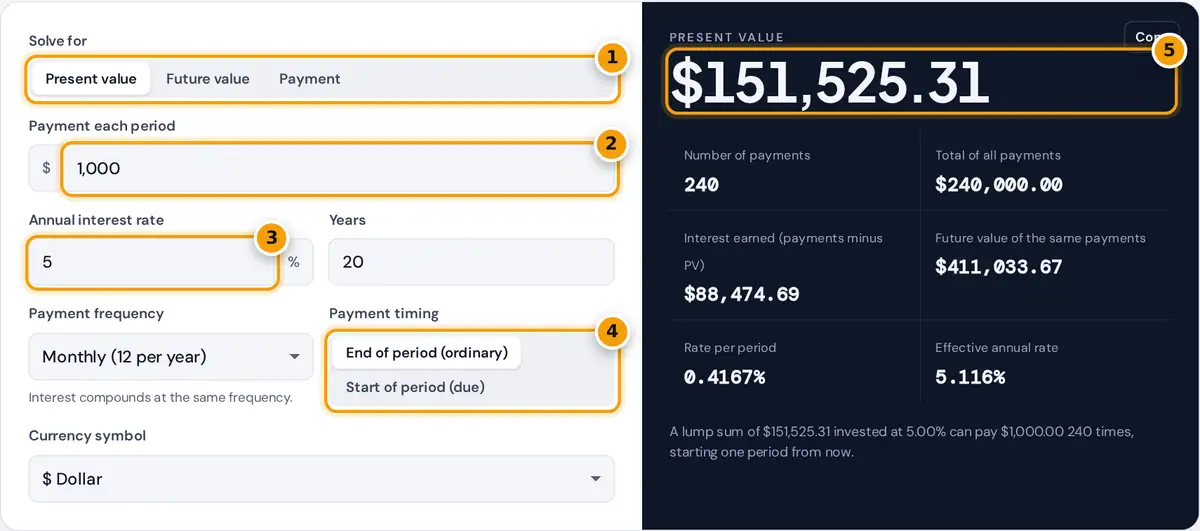
- Choose present value, future value or payment.
- Enter the payment each period.
- Enter the annual interest rate and the number of years.
- Pick end of period (ordinary) or start of period (due).
- Read the result, total payments, interest and effective annual rate.
Choose what you want to find. Present value tells you what a series of equal payments is worth today, for example the lump sum needed to fund a pension of $1,000 a month. Future value shows what regular deposits grow to. Payment works backward from a lump sum, such as a retirement pot or a loan, or from a savings goal you want to reach.
Enter the annual interest rate, the number of years and how often payments are made. Then choose the timing. In an ordinary annuity each payment happens at the end of the period, which suits loans and most savings plans. In an annuity due each payment happens at the start, which suits rent, leases and many payout products. The result shows the answer, the number of payments, the total paid, the interest and the effective annual rate.
Annuity Formulas
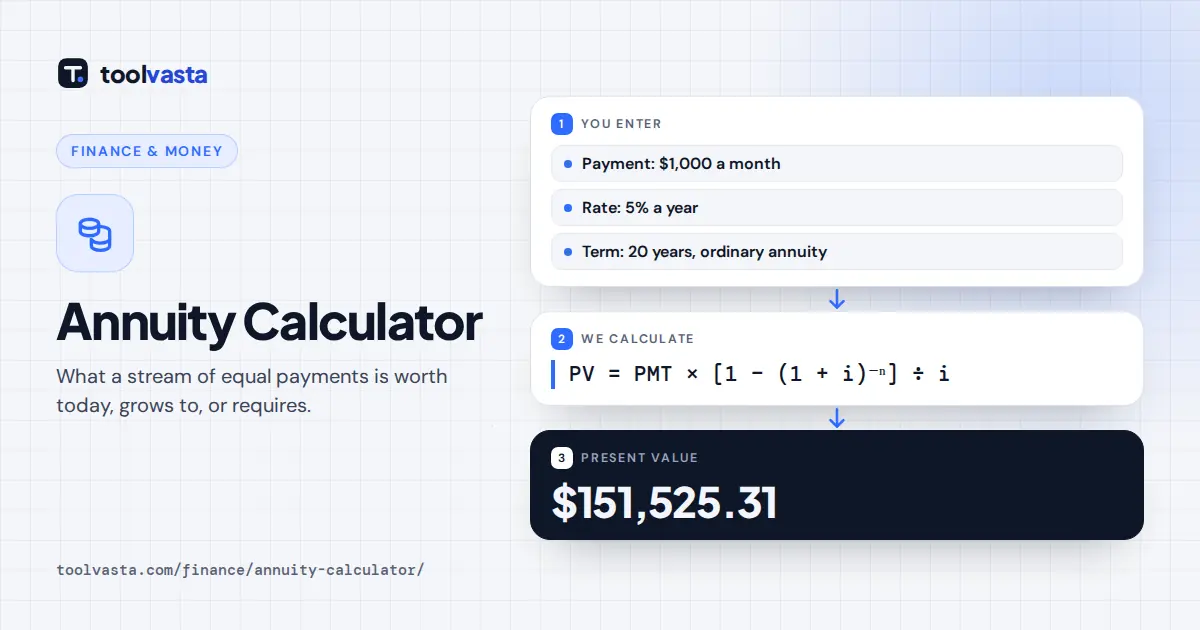
PV = PMT × [1 − (1 + i)−n] ÷ i
FV = PMT × [(1 + i)n − 1] ÷ i
annuity due: multiply PV or FV by (1 + i)
PMT = PV ÷ PV factor or FV ÷ FV factor
Interest compounds once per payment period, so a 5% annual rate with monthly payments uses 0.4167% a month. The effective annual rate shows what that compounds to over a full year. At a 0% rate the formulas reduce to payment times the number of payments.
An annuity due is always worth more than an ordinary annuity with the same payments, because every payment arrives one period earlier and earns or saves one more period of interest.
Worked Example
A payout of $1,000 a month for 20 years at 5% has a present value of $151,525.31 as an ordinary annuity. You would receive $240,000 in total, so $88,474.69 of that is interest earned on the remaining balance. Paid at the start of each month, the same stream is worth $152,156.67.
Saving $500 a month for 30 years at 6% grows to $502,257.52, of which $322,257.52 is interest. Going the other way, a lump sum of $250,000 at 5% supports a monthly payment of $1,461.48 for 25 years, and reaching $1,000,000 in 30 years at 7% needs $814.94 a month paid at the start of each month.
| Present value of $1,000 a month | 3% rate | 5% rate | 7% rate |
|---|---|---|---|
| 10 years | $103,561.75 | $94,281.35 | $86,126.35 |
| 20 years | $180,310.91 | $151,525.31 | $128,982.51 |
| 30 years | $237,189.38 | $186,281.62 | $150,307.57 |
Higher rates lower the present value, because each future payment is discounted more heavily.
The same math sits behind many everyday products. A pension that pays a fixed amount each month is an annuity, and so is a car loan or a lease. Savings plans with equal deposits, such as a monthly transfer into a retirement account, are annuities too, so the future value mode shows what steady saving builds.
Tips for Using Annuity Math
- To compare an annuity quote with a lump sum, enter the quoted payment and a rate you could earn yourself. If the present value is higher than the price, the annuity offers more at that rate.
- Use the payment mode with a lump sum to see how much income a retirement pot supports for a fixed number of years.
- Match the rate to the payment frequency. A quoted annual rate is divided by the number of payments a year.
- Inflation reduces the value of fixed payments. A level annuity buys less every year.
- For loans, the payment mode with a lump sum gives the standard amortizing loan payment.
Assumptions and Limits
The calculator assumes level payments, a constant interest rate and compounding at the payment frequency. Commercial annuity products also reflect life expectancy, fees and guarantees, so their quotes can differ from this math. Canadian fixed-rate mortgages compound semi-annually, which this tool does not model; use the mortgage calculator for that. Results work in any currency and are estimates, not financial advice.
Frequently asked questions
What is the difference between an ordinary annuity and an annuity due?
In an ordinary annuity each payment is made at the end of the period. In an annuity due it is made at the start. An annuity due is worth more because each payment arrives one period sooner.
How do you calculate the present value of an annuity?
Multiply the payment by one minus one plus the periodic rate raised to minus the number of payments, then divide by the periodic rate. For an annuity due, multiply the result by one plus the periodic rate.
How do I calculate the payment from a lump sum?
Divide the lump sum by the present value factor for your rate and number of payments. A $250,000 lump sum at 5% for 25 years supports about $1,461.48 a month as an ordinary annuity.
What is the effective annual rate?
It is the rate that compounding produces over a full year. A 5% annual rate compounded monthly grows to about 5.116% a year, which is the effective annual rate the calculator shows.
Does this annuity calculator work for loans?
Yes. A loan is an annuity from the lender's point of view. Use the payment mode with the loan amount as the lump sum to find the regular payment for any frequency.
Why is the present value less than the total payments?
Money received in the future is worth less than money today, because today's money can earn interest. Discounting each payment at the interest rate gives a present value below the simple total.