How to Use the Stock Profit Calculator
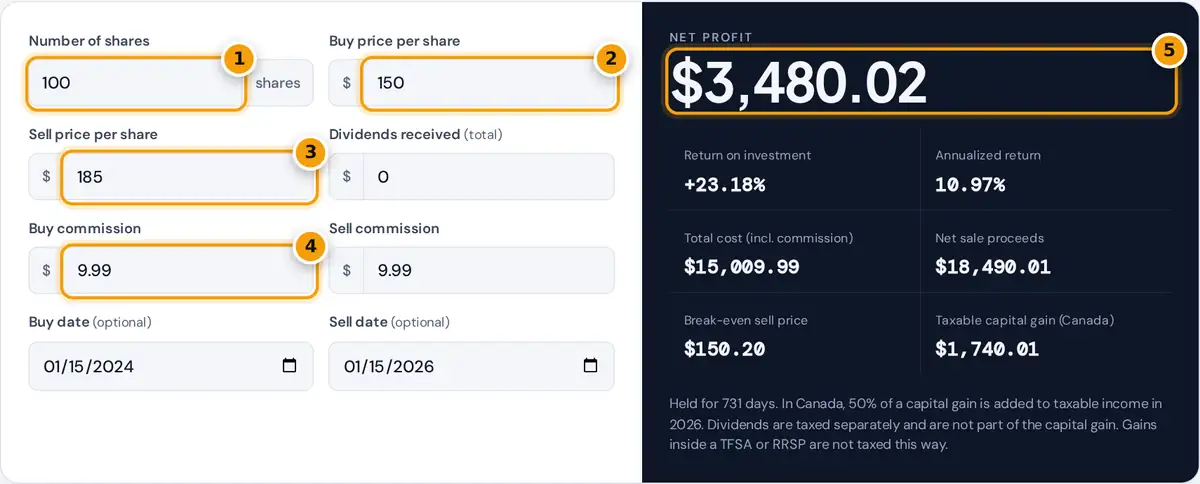
- Enter how many shares you bought.
- Enter the buy price per share.
- Enter the sell price, or a target price to test.
- Add the buy and sell commissions, and dates for an annualized return.
- Read your net profit, then check ROI, annualized return and break-even price.
Enter the number of shares, the buy price you paid per share and the sell price you received, or a target price you are considering. The stock profit calculator updates every figure as you type.
Add the commission your broker charged on each side, plus any dividends received while you held the stock. Leave a commission at zero if you traded on a zero-commission platform, which many brokers now offer.
Enter the buy and sell dates to see an annualized return. The result panel then shows net profit or loss, return on investment, total cost, net proceeds, the break-even price and the Canadian taxable gain.
Stock Profit Formula
Net proceeds = shares × sell price − sell commission
Profit = net proceeds − total cost + dividends
ROI = profit ÷ total cost × 100
Annualized return = (1 + ROI)365 / days held − 1
Break-even price = (total cost + sell commission) ÷ shares
Total cost is the shares multiplied by the buy price plus the buy commission. Net proceeds are the shares multiplied by the sell price minus the sell commission, which is the cash reaching your account.
Net profit is net proceeds minus total cost plus dividends. A positive figure is a profit and a negative figure is a loss, so the same stock gain calculator also measures losing trades very accurately.
ROI divides that profit by total cost. Dividing profit by the number of shares gives the result per share, which helps when you compare trades of very different sizes or decide how much to sell.
Break-Even Price and Commission Drag
The break-even price is the total cost plus the sell commission, divided by the number of shares. Selling below that price still loses money, even when the share price is above what you originally paid.
Commissions matter most on small positions. A flat fee of $9.99 each way barely moves a $15,000 trade, but on a $500 trade the round trip costs about 4% before the stock price even moves.
For that reason the break-even price sits slightly above your buy price whenever commissions apply. With a zero-commission broker the two prices match, though any currency conversion fees can still raise your real break-even price.
Worked Example: 100 Shares Held for Two Years
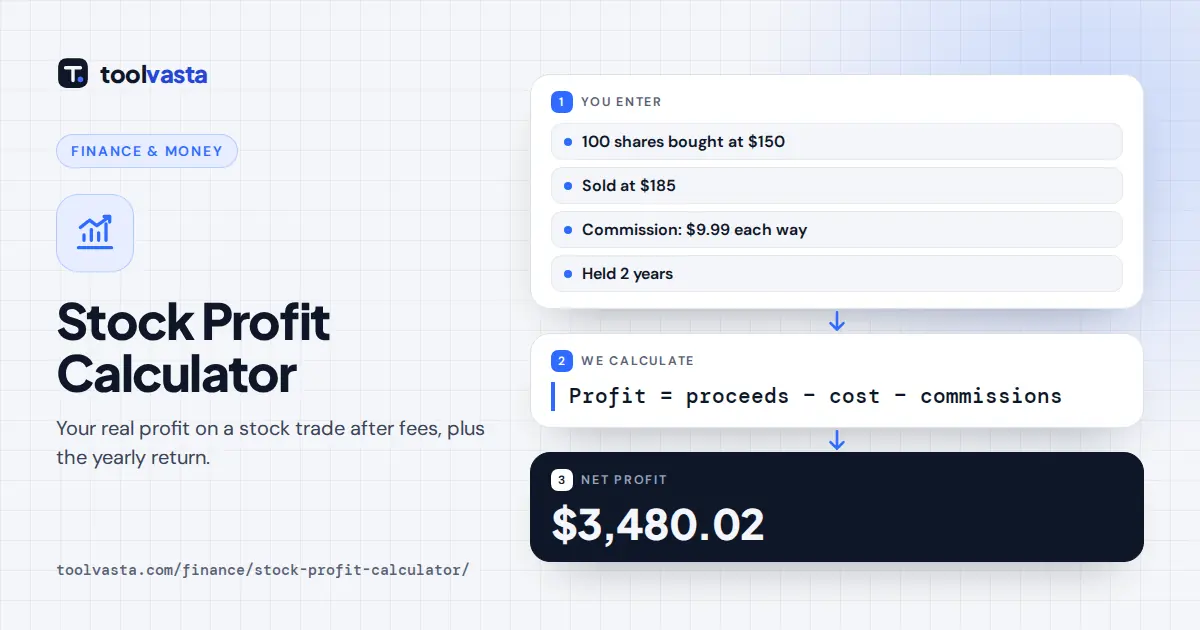
You buy 100 shares at $150 with a $9.99 commission, so total cost is $15,009.99. You later sell them at $185 with another $9.99 commission, giving net proceeds of $18,490.01 in your own brokerage account.
Your profit is $3,480.02, a return of about 23.2%. The break-even price was $150.20 per share, so any sale above that figure would have produced at least a small profit after paying both broker commissions.
Held from January 15, 2024 to January 15, 2026, which is 731 days, the trade earns an annualized return of 10.97% a year. That rate is the fair number to compare with your other investments.
| Item | Amount |
|---|---|
| Total cost (100 × $150 + $9.99) | $15,009.99 |
| Net proceeds (100 × $185 − $9.99) | $18,490.01 |
| Net profit | $3,480.02 |
| Return on investment | 23.18% |
| Annualized return (731 days) | 10.97% |
| Break-even price | $150.20 |
| Taxable capital gain in Canada (50%) | $1,740.01 |
Total Return Versus Annualized Return
A 23% total return sounds strong, but it is modest if the holding period was five years. A 10% gain in three months is better than it looks, because it happened over a short time.
Annualized return converts any holding period into an equivalent yearly rate, much like the compound annual growth rate, or CAGR. That lets you compare a trade with an index fund, a GIC or another stock.
Holdings under a year can show extreme annualized figures, because a short gain is compounded as if repeated all year. Treat those numbers with care and look at the total return alongside them before deciding.
| Total return | Held 1 year | Held 2 years | Held 5 years |
|---|---|---|---|
| +10% | 10.00% a year | 4.88% a year | 1.92% a year |
| +25% | 25.00% a year | 11.80% a year | 4.56% a year |
| +50% | 50.00% a year | 22.47% a year | 8.45% a year |
| +100% | 100.00% a year | 41.42% a year | 14.87% a year |
Capital Gains Tax on Stocks in Canada
Selling shares at a profit in a non-registered account creates a capital gain. For 2026, the inclusion rate is 50%, so half the gain is added to taxable income and taxed at your marginal rate.
In the example above, $1,740.01 of the $3,480.02 gain is taxable. A loss works in reverse: half becomes an allowable capital loss that can offset taxable capital gains, as the CRA capital gains guide explains.
Commissions form part of your adjusted cost base and reduce the gain. Only a realized gain is taxed, never an unrealized gain. Gains inside a TFSA are tax-free, while RRSP withdrawals are taxed as income.
Assumptions and Limits
The calculator handles one purchase and one sale. If you bought at several prices, enter your average cost per share, which in Canada is the adjusted cost base divided by all the shares you hold.
Foreign stocks trade in their own currency. For Canadian tax, convert the cost and the proceeds to Canadian dollars using the exchange rate on each transaction date, which can turn a gain into a loss.
Dividends are included in profit but taxed separately, not as part of the capital gain. Results are estimates for planning and are not tax advice, so confirm your actual tax bill with a qualified professional.
Frequently asked questions
How do I calculate profit on a stock?
Multiply the shares by the sell price and subtract the sell commission, then subtract what you paid including the buy commission. Add any dividends received to get your total profit or loss on the trade.
How is stock return on investment calculated?
Divide the profit by the total amount you invested, including commission, and multiply by 100. A $3,480.02 profit on a $15,009.99 cost is a return of about 23.2% before any tax.
What is the break-even price for a stock?
It is the sell price at which your proceeds after commission equal your total cost. Add the buy and sell commissions to the purchase amount, then divide by the number of shares you own.
How much tax do I pay on stock profits in Canada?
In a non-registered account, half of a capital gain is added to your taxable income for 2026 and taxed at your marginal rate. Gains earned inside a TFSA are not taxed at all.
Should I include dividends when calculating stock returns?
Yes. Dividends are part of your total return, so the calculator adds them to profit. In Canada they are taxed separately from the capital gain, which is why the taxable gain line excludes them.
Do commissions reduce my capital gain?
Yes. The buy commission is added to your adjusted cost base and the sell commission reduces your proceeds, so both lower the taxable capital gain reported on your Canadian return.