How to Use the Profit Margin Calculator
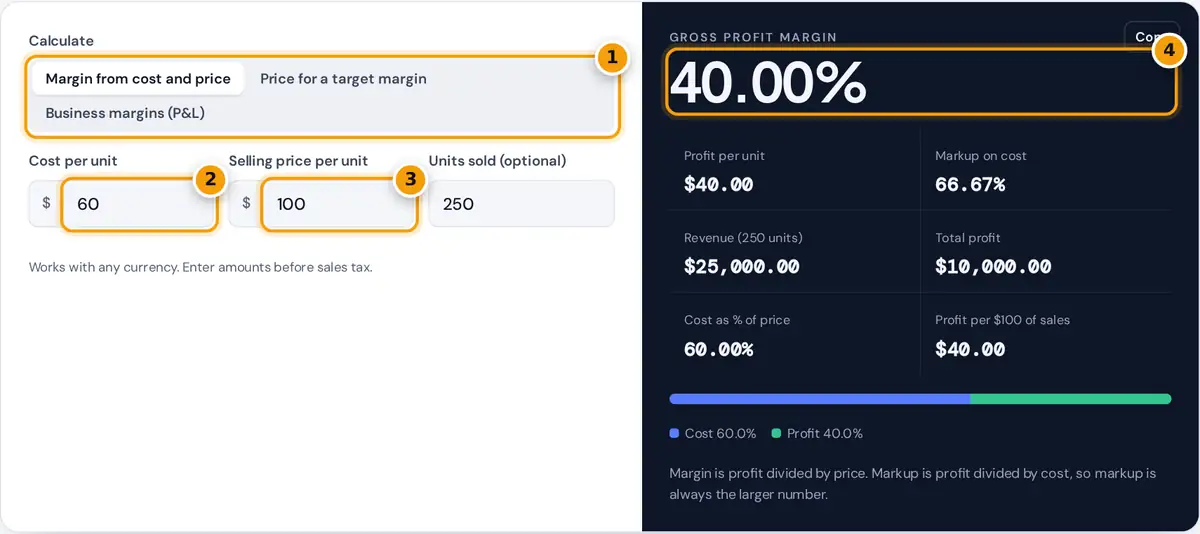
- Choose margin from cost and price, price for a target margin, or P&L margins.
- Enter the cost of one unit.
- Enter the selling price and, optionally, the units sold.
- Read the margin, with markup, profit per unit and total profit below.
Choose one of three modes. Margin from cost and price takes what one unit costs you and what you sell it for, and returns the gross profit margin, the markup and the profit per unit. Add the number of units sold to see revenue and total profit. Price for a target margin works the other way: enter your cost and the margin you want, and the calculator returns the selling price that delivers it.
Business margins (P&L) is for a whole company or a product line. Enter revenue, cost of goods sold, operating expenses, and interest plus income taxes from your profit and loss statement. You get gross, operating and net margins in one view. Amounts work in any currency, so use the figures from your own books before sales tax.
Profit Margin Formulas
markup = (price − cost) ÷ cost
price for a target margin = cost ÷ (1 − margin)
operating margin = (revenue − COGS − operating expenses) ÷ revenue
net margin = net profit ÷ revenue
Margin is always measured against the selling price, while markup is measured against cost. That is why a 50% markup gives only a 33.3% margin. Many pricing mistakes come from adding the target margin percentage to cost, which produces a markup and leaves the business short of the margin it planned.
Gross margin is the figure to use for pricing decisions on individual products, because it shows what each sale contributes toward overheads. Net margin is the figure lenders and investors look at, because it shows what the whole business keeps after every cost.
When you set prices, work out the margin you need from the bottom up: start with overheads and the profit you want, divide by expected sales, and express that amount as a share of the price, not of the cost.
Worked Examples
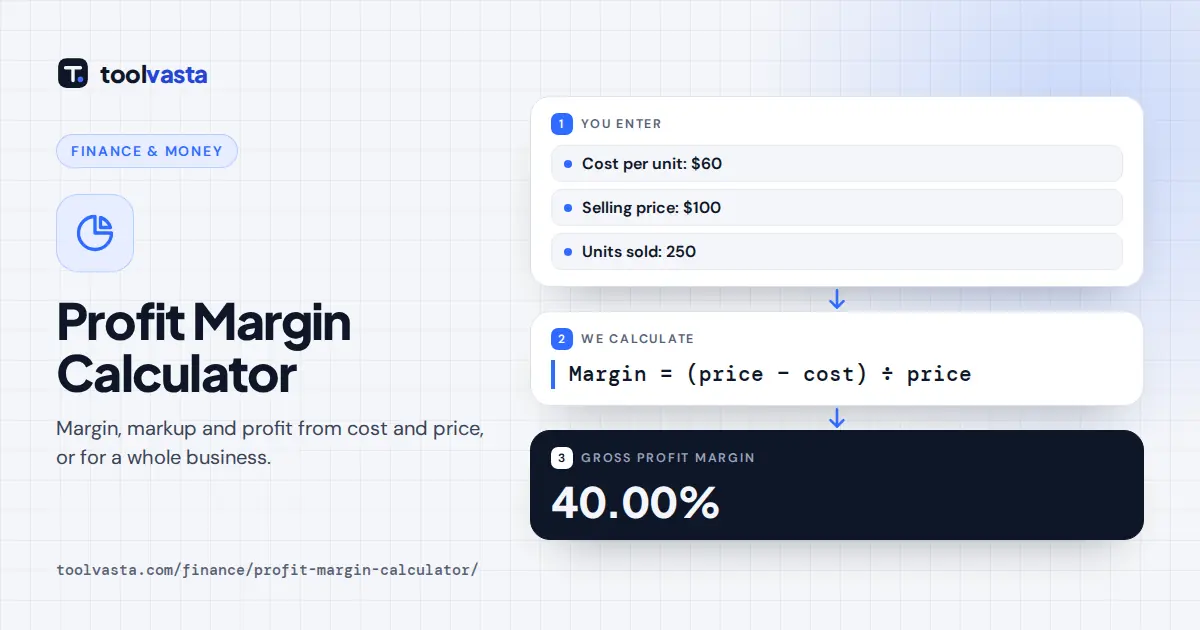
A product costs $60 and sells for $100. The profit is $40, so the margin is 40 ÷ 100 = 40.00% and the markup is 40 ÷ 60 = 66.67%. Selling 250 units brings in $25,000 of revenue and $10,000 of gross profit. To earn a 25% margin on a $60 cost instead, the price must be 60 ÷ 0.75 = $80.00, which is a 33.33% markup.
A business with $500,000 of revenue, $300,000 of cost of goods sold, $120,000 of operating expenses and $20,000 of interest and taxes has a gross profit of $200,000 (40.00%), an operating profit of $80,000 (16.00%) and a net profit of $60,000, a net margin of 12.00%.
Margin and Markup Equivalents
| Margin | Markup | Price on a $100 cost |
|---|---|---|
| 10% | 11.11% | $111.11 |
| 20% | 25.00% | $125.00 |
| 25% | 33.33% | $133.33 |
| 30% | 42.86% | $142.86 |
| 40% | 66.67% | $166.67 |
| 50% | 100.00% | $200.00 |
| 60% | 150.00% | $250.00 |
To convert, markup = margin ÷ (1 − margin) and margin = markup ÷ (1 + markup). Our markup calculator works from the cost side if that is how your supplier quotes.
Tips for Using Margins
- Compare margins with businesses in your own industry. Grocery, software and restaurants run on very different margins, so a single good number does not exist.
- Include every direct cost in the unit cost: freight, packaging, payment processing and returns can quietly cut the margin.
- Watch operating margin as you grow. Gross margin can stay steady while overheads rise faster than sales.
- Discounts come straight off the margin. A 10% discount on a 40% margin product removes a quarter of the profit.
- Track margins by product, not only for the whole business, to find items that sell well but earn little.
Assumptions and Limits
The calculator uses the numbers you enter and does not apply any tax rules. Sales tax collected for the government is not revenue and should be left out. Net margin depends on how you classify expenses, so compare like with like. For tax filings, financing or valuations, review the figures with an accountant.
Frequently asked questions
How do I calculate profit margin?
Subtract the cost from the selling price, divide the result by the selling price and multiply by 100. A product that costs $60 and sells for $100 has a 40% profit margin.
What is the difference between margin and markup?
Margin is profit as a share of the selling price, while markup is profit as a share of cost. A $40 profit on a $60 cost and $100 price is a 40% margin and a 66.67% markup.
How do I find the selling price from a margin?
Divide the cost by one minus the margin as a decimal. For a $60 cost and a 25% margin, the price is 60 divided by 0.75, which is $80.
What is a good profit margin?
It depends on the industry. Many small businesses see net margins in single digits, while software or consulting can be much higher. Compare with similar businesses rather than a single rule.
What is the difference between gross and net profit margin?
Gross margin subtracts only the cost of goods sold from revenue. Net margin also subtracts operating expenses, interest and taxes, so it shows what the business actually keeps.
Can profit margin be negative?
Yes. If costs are higher than revenue, the margin is negative, which means the business or product loses money on each sale. The calculator shows this as a negative percentage.