How to use the pay raise calculator
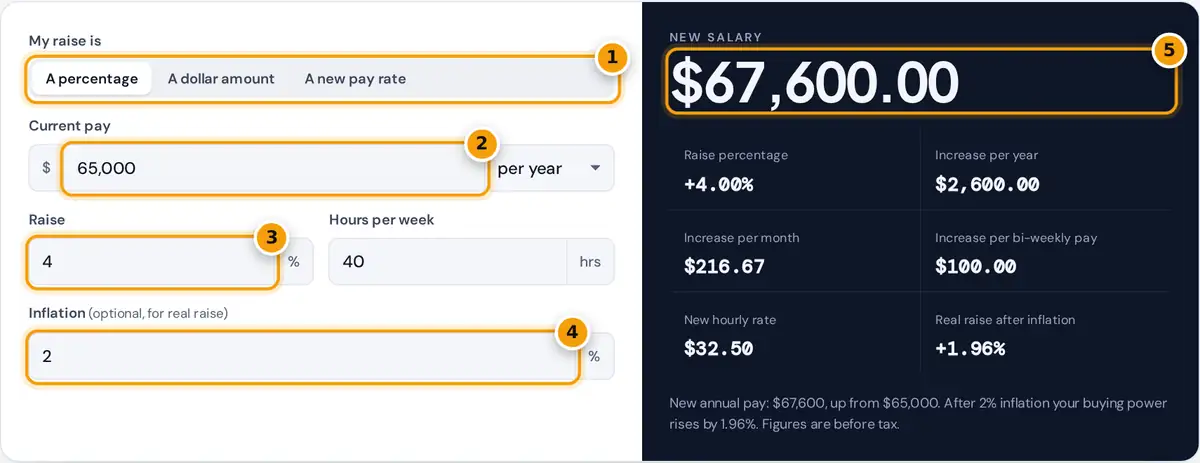
- Choose how you know your raise: a percentage, a dollar amount or the new pay rate.
- Enter your current pay and pick yearly, monthly, bi-weekly, weekly or hourly.
- Enter the raise percentage, and your hours per week for the hourly rate.
- Add inflation if you want to see your real raise.
- Read your new salary and the increase per month and per paycheque.
Choose how your raise was given. If it is a percentage, enter it and the calculator finds your new pay. If it is a dollar amount, enter the amount for the same pay period as your current pay. If you know your old and new pay, choose A new pay rate to find the raise percentage. Pick whether your pay is annual, monthly, bi-weekly, weekly or hourly, and set your weekly hours so the calculator can convert between them.
Add an inflation rate to see your real raise, which is how much your buying power actually changes. The Bank of Canada aims to keep inflation at 2%, the midpoint of its 1% to 3% target range, which is why 2% is the default.
Pay raise formulas
Raise % = (new pay − current pay) / current pay × 100
Real raise = (1 + raise %) / (1 + inflation %) − 1
Worked example
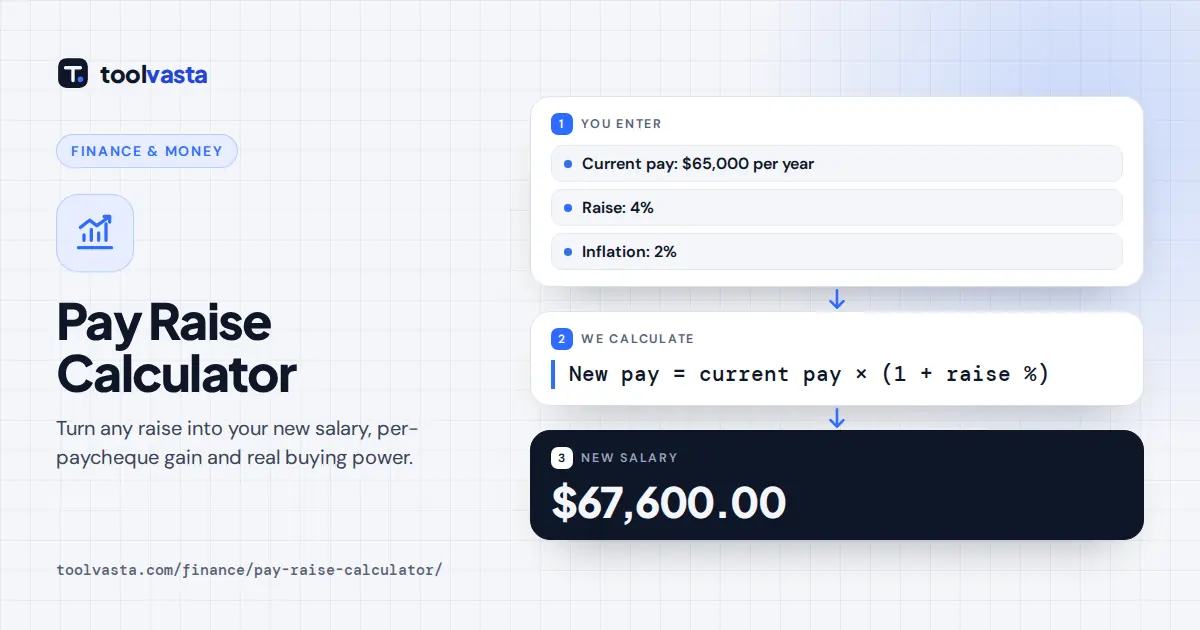
You earn $65,000 a year and get a 4% raise. Your new salary is $65,000 × 1.04 = $67,600. That is $2,600 more a year, $216.67 a month, or $100.00 on each of 26 bi-weekly paycheques before tax. At 40 hours a week your hourly rate rises from $31.25 to $32.50. With 2% inflation, your real raise is 1.04 / 1.02 − 1 = 1.96%.
If your hourly wage goes from $22.00 to $23.50, choose A new pay rate, set the period to per hour and enter both figures. The raise is 6.82%, or $3,120 a year at 40 hours a week.
Raise percentages on a $65,000 salary
| Raise | New salary | Per month | Per bi-weekly pay |
|---|---|---|---|
| 2% | $66,300 | +$108.33 | +$50.00 |
| 3% | $66,950 | +$162.50 | +$75.00 |
| 4% | $67,600 | +$216.67 | +$100.00 |
| 5% | $68,250 | +$270.83 | +$125.00 |
| 10% | $71,500 | +$541.67 | +$250.00 |
Is your raise beating inflation?
A raise only improves your standard of living if it is larger than the rise in prices. A 2% raise in a year with 3% inflation is a pay cut in real terms of about 0.97%. When you negotiate, compare your offer with the latest consumer price index figure. The inflation calculator shows how prices have changed in Canada over time.
Raise before and after tax
The increase shown is gross pay. Your take-home increase is smaller because income tax, CPP or QPP and EI come off the top. The extra dollars are taxed at your marginal rate, so the share you keep depends on your province and income. A raise never lowers your take-home pay overall, because only the dollars above each bracket threshold are taxed at the higher rate.
Assumptions
Annual figures assume 52 weeks of paid hours and 26 bi-weekly pays. Bonuses, overtime and benefits are not included. Results are rounded to the cent.
Frequently asked questions
How do I calculate a raise percentage?
Subtract your old pay from your new pay, divide by your old pay and multiply by 100. Going from $65,000 to $67,600 is a 4% raise.
What is a 3% raise on $50,000?
$50,000 × 0.03 = $1,500, so your new salary is $51,500. That is $125 more a month before tax.
How much is a $1 an hour raise per year?
At 40 hours a week for 52 weeks, a $1 an hour raise adds $2,080 a year before tax.
What is a real raise?
It is your raise after inflation. Divide 1 plus your raise by 1 plus inflation and subtract 1. A 4% raise with 2% inflation is a real raise of about 1.96%.
Does a raise push all my income into a higher tax bracket?
No. Canada taxes income in brackets, so only the part of your income above a threshold is taxed at the higher rate. You always keep more after a raise.