How to Use the Credit Card Minimum Payment Calculator
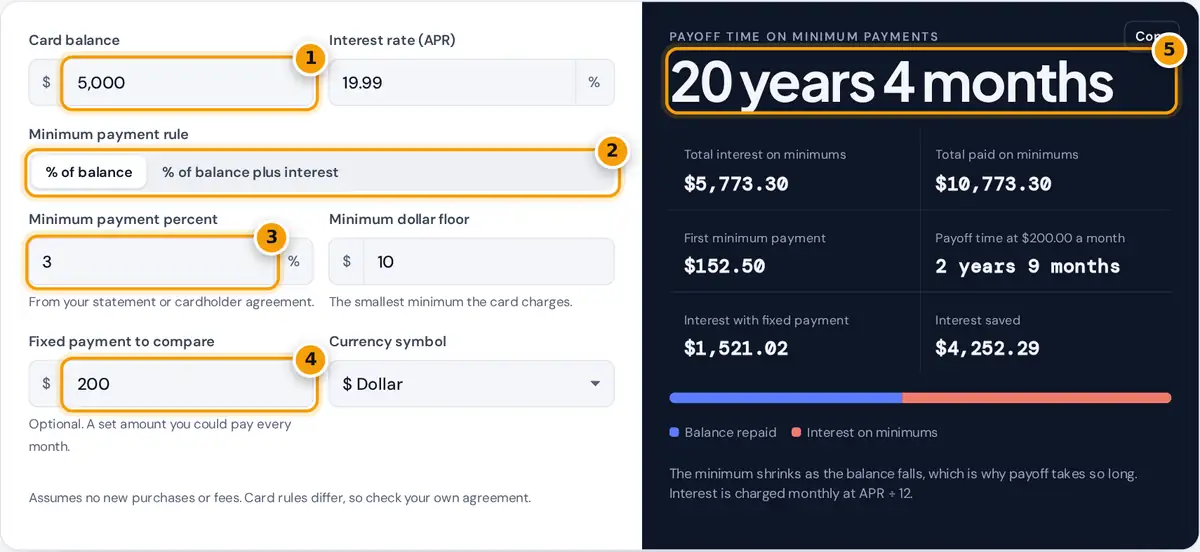
- Enter the card balance and APR.
- Pick the minimum payment rule printed in your cardholder agreement.
- Enter the minimum percent and dollar floor from your statement.
- Enter a fixed monthly payment to compare.
- Read the payoff time, total interest and the interest a fixed payment saves.
Enter your current balance and the card's interest rate (APR). Then copy the minimum payment rule from your statement or cardholder agreement. Cards usually set the minimum in one of two ways: a percentage of the whole balance, or a smaller percentage of the balance plus the month's interest. Most also have a minimum dollar floor, so the payment never drops below a set amount.
The calculator shows how long it takes to repay the balance by paying exactly the minimum every month, the total interest and the first minimum payment. Add a fixed monthly payment to see how much faster a set amount clears the debt and how much interest it saves. The yearly table shows what you pay, how much of it is interest and the balance left.
How Minimum Payments Are Calculated
rule 1: minimum = max(floor, percent × (balance + interest))
rule 2: minimum = max(floor, percent × balance + interest)
new balance = balance + interest − payment
Because the minimum is a percentage of a shrinking balance, the payment falls every month. Most of each early payment goes to interest, so the balance drops slowly. The floor eventually takes over and ends the debt, which is why the floor matters more than it looks.
Card issuers usually charge interest daily on the average daily balance. Dividing the APR by 12 is a close monthly approximation that most payoff calculators use.
Worked Example
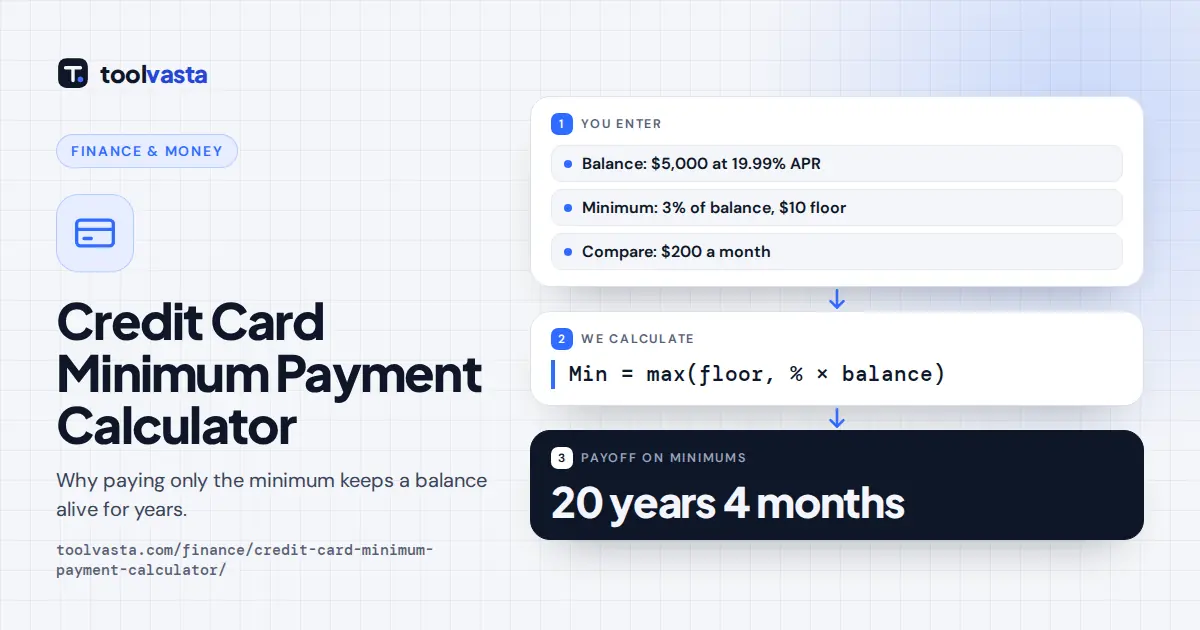
A $5,000 balance at 19.99% with a minimum of 3% of the balance and a $10 floor starts with a minimum payment of $152.50. Paying only the minimum takes 20 years and 4 months and costs $5,773.30 in interest, so you repay $10,773.30 in total, more than twice the original balance.
Paying a fixed $200 a month instead clears the same balance in 2 years and 9 months with $1,521.02 of interest, saving $4,252.29. If the card's rule were 1% of the balance plus interest, the minimum would start at $133.29 and take 26 years and 6 months, with $7,922.65 of interest.
| Payment on $5,000 at 19.99% | Time to pay off | Total interest |
|---|---|---|
| Minimum 2% of balance | 61 years 2 months | $20,979.72 |
| Minimum 2.5% of balance | 29 years 6 months | $9,013.32 |
| Minimum 3% of balance | 20 years 4 months | $5,773.30 |
| Minimum 5% of balance | 9 years 10 months | $2,384.96 |
| Fixed $150 a month | 4 years 2 months | $2,357.06 |
| Fixed $300 a month | 1 year 8 months | $906.25 |
The minimum percentage rows use a $10 floor.
Many card statements now include an estimate of how long minimum payments would take, because the figures are easy to underestimate. If yours does, compare it with this calculator. Small differences come from daily interest, the exact rule and rounding, but the overall picture should be the same: paying only the minimum keeps most balances alive for many years.
Tips to Pay Off a Card Faster
- Pay a fixed amount instead of the minimum. Keeping the payment level while the balance falls is the single biggest saving.
- Stop adding new purchases to the card while you pay it down, or the payoff time resets.
- Ask your issuer about a lower rate, or compare a balance transfer offer, but check the transfer fee and the rate after the promotion.
- Pay more than once a month if your card charges interest daily. It lowers the average balance.
- For several cards, our credit card payoff calculator helps plan a payoff date.
Assumptions and Limits
The calculator assumes no new purchases, fees or rate changes, and that you pay on time every month. Late payments can trigger penalty rates. Minimum payment rules, floors and interest methods vary by issuer and country, so use the figures from your own agreement. This is an estimate, not financial advice, and works in any currency.
Frequently asked questions
How is a credit card minimum payment calculated?
Most cards use a percentage of the balance, such as 2% or 3%, or a small percentage plus the month's interest, with a minimum dollar floor. Your statement or cardholder agreement shows the exact rule.
How long does it take to pay off a credit card with minimum payments?
Often many years. A $5,000 balance at 19.99% with a 3% minimum and a $10 floor takes over 20 years and costs more than the original balance in interest.
Why does the minimum payment go down every month?
The minimum is a percentage of the balance. As the balance falls, so does the payment, which slows repayment. Paying a fixed amount avoids this and clears the debt much faster.
What happens if I pay only the interest?
The balance never goes down. If the minimum percentage is too low to cover the monthly interest and there is no adequate floor, the debt would not be repaid, and the calculator shows a warning.
Does this calculator include new purchases?
No. It assumes you stop using the card while repaying. New purchases add to the balance and extend the payoff time, so pay them in full each month or stop using the card.
Is APR divided by 12 accurate for credit cards?
It is a close approximation. Most issuers charge daily interest on the average daily balance, which gives slightly different figures depending on the days in each month and when you pay.