How to Use the Cubic Yard Calculator
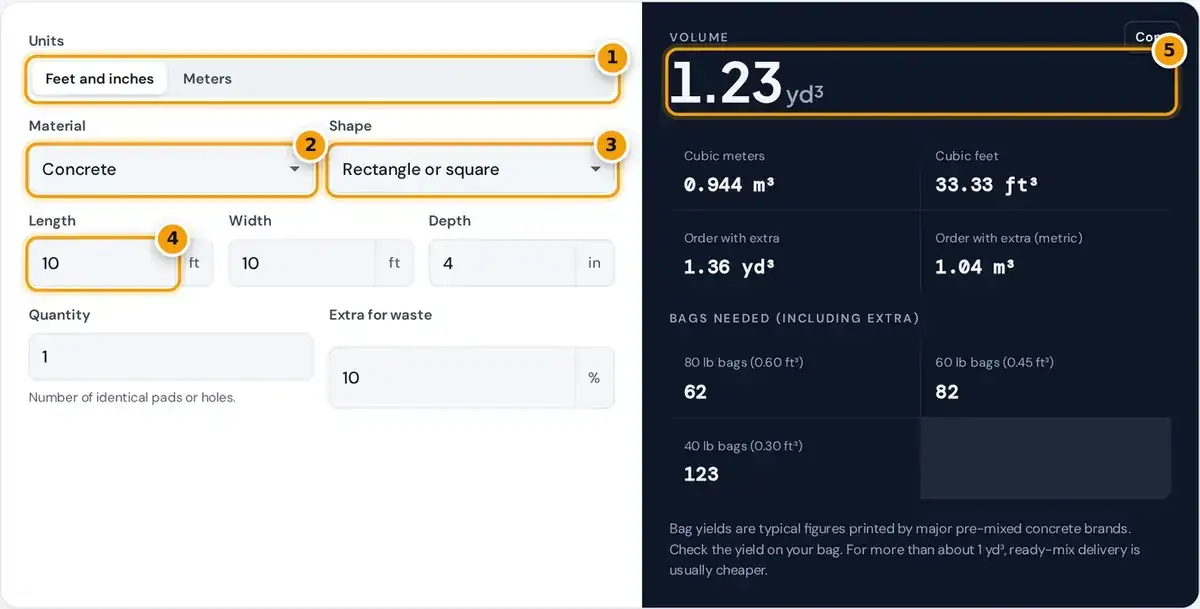
- Choose feet and inches or meters.
- Pick the material: concrete, gravel, mulch, topsoil or sand.
- Choose the shape: rectangle, circle or triangle.
- Enter length, width and depth, plus quantity and extra for waste.
- Read the volume in cubic yards, cubic meters and the bags needed.
Choose the material and shape, then enter length and width, or the diameter for a circle, and the depth. Materials include concrete, gravel, mulch, topsoil and sand, and concrete and mulch results include bag counts.
In feet and inches mode, length and width are in feet and depth in inches, the way most slab and bed plans are written. In metric mode, use meters for area and centimeters for depth.
Set a quantity for several identical pads or post holes, then add extra for waste and settling. The result shows cubic yards, cubic feet and cubic meters, plus the amount to order after the allowance.
Cubic Yard Formula
cubic yards = cubic feet ÷ 27
rectangle area = length × width circle area = π × diameter² ÷ 4 triangle area = base × height ÷ 2
1 yd³ = 0.764555 m³ 1 m³ = 1.308 yd³
A cubic yard is a cube measuring 3 ft x 3 ft x 3 ft, which holds 27 cubic feet. Find the area in square feet, multiply by depth in feet, then divide by 27.
Depth is usually measured in inches, so divide it by 12 first. A rectangle uses length times width, a circle uses pi times diameter squared over four, and a triangle uses half base times height.
For metric work, one cubic yard equals 0.764555 cubic meters and one cubic meter equals about 1.308 cubic yards. The yard itself is defined as exactly 0.9144 m, as the NIST guide to units confirms.
Worked Example: Concrete Slab
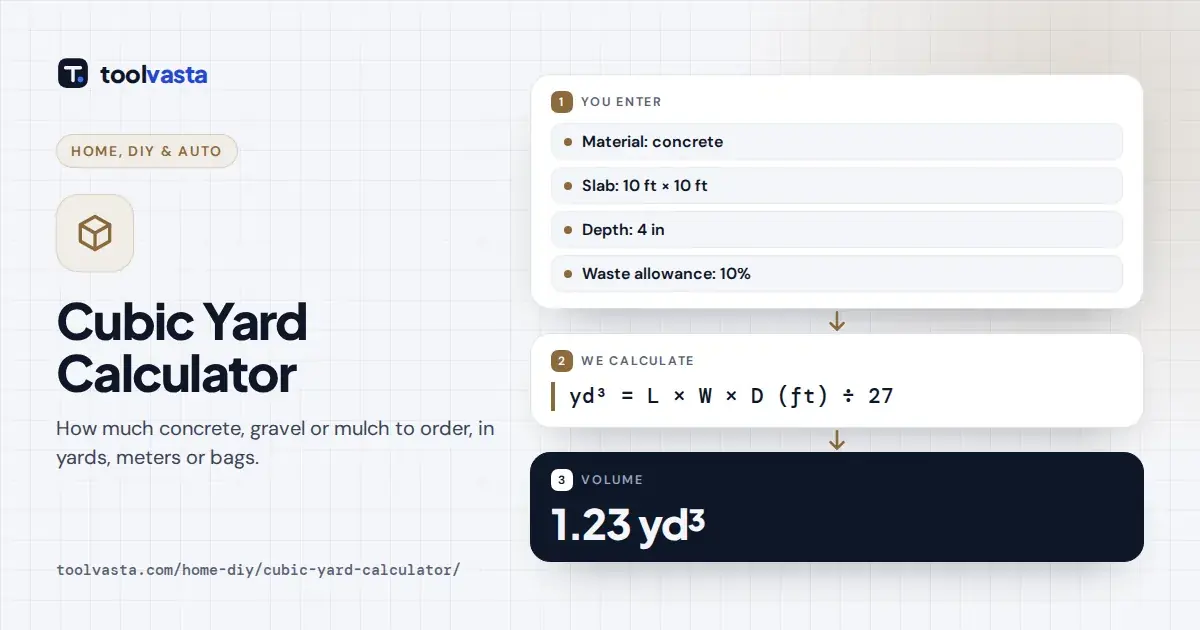
A 10 ft by 10 ft patio slab 4 in thick covers 100 square feet. Its volume is 100 × 4 ÷ 12 = 33.33 cubic feet, and dividing by 27 gives 1.23 cubic yards, or 0.94 m³.
With 10% extra for waste, order 1.36 cubic yards of concrete. That equals 36.67 cubic feet, which would take 62 bags of 80 lb concrete at a printed yield of 0.60 cubic feet per bag.
The same volume needs 82 bags of 60 lb concrete or 123 bags of 40 lb concrete. Above about one cubic yard, ready-mix delivery is usually cheaper, although many suppliers charge an extra short-load fee.
Worked Examples: Mulch Bed and Gravel Pad
A round mulch bed 12 ft across, spread with 3 in of mulch, covers π × 12² ÷ 4 = 113.1 square feet. The resulting volume is 113.1 × 3 ÷ 12 = 28.27 cubic feet, which is about 1.05 cubic yards.
With 10% extra, that becomes 1.15 cubic yards, or 16 of the 2 cu ft bags, or 11 bags of 3 cubic feet. Bagged mulch suits small beds, while bulk suits several beds at once.
A metric gravel pad 4 m by 3 m with 10 cm of gravel is 4 × 3 × 0.10 = 1.2 m³, or 1.57 cubic yards. With 10% extra, order about 1.32 cubic meters from the yard.
Typical Depths
| Project | Common depth |
|---|---|
| Walkway or patio slab | 4 in (10 cm) |
| Driveway slab | 4 to 6 in (10 to 15 cm) |
| Mulch in garden beds | 2 to 3 in (5 to 8 cm) |
| Topsoil for new lawn | 4 to 6 in (10 to 15 cm) |
| Gravel base under pavers | 4 to 6 in (10 to 15 cm) |
Walkway or patio slabs are usually 4 in thick, while a driveway runs 4 to 6 in for vehicles. Topsoil for a new lawn and gravel under pavers are typically 4 to 6 in deep.
For mulch, 2 to 3 in suits most garden beds, and coarse chips can go deeper. Iowa State University Extension advises keeping mulch no more than 4 in deep and pulling it back from trunks.
These are general guidelines. Local frost depth, soil type and loads change the right answer for footings and driveways, so follow your approved plans, your engineer or the local building code before ordering any materials.
Bags or Bulk Delivery?
Concrete bag counts use yields commonly printed by pre-mixed brands: about 0.60 cubic feet for an 80 lb bag, 0.45 for a 60 lb bag and 0.30 for a 40 lb bag. Check the yield.
In Canada, 30 kg bags are also common, so read the yield on the exact product you buy. Bagged mulch and soil usually come in 1.5, 2 or 3 cubic foot bags at garden centers.
For large jobs, bulk delivery by the cubic yard or cubic meter is usually cheaper. Ask the supplier about the minimum load and whether the truck can reach your site without damaging lawns or driveways.
Coverage, Waste and Assumptions
One cubic yard covers 324 square feet at 1 in deep, 162 square feet at 2 in, and 108 square feet at 3 in. Coverage halves every time the depth doubles, so depth matters most.
Depth is assumed to be uniform everywhere. On uneven ground, measure several points and use the average. Loose mulch and soil settle after spreading, and gravel loses volume through compaction, which the waste percentage covers.
Weight per cubic yard varies widely with moisture and density, so ask your supplier for tons before booking a trailer. Wet soil and gravel can exceed a pickup's payload long before the bed looks full.
Frequently asked questions
How do I calculate cubic yards?
Multiply length by width in feet, multiply by depth in feet, which is inches divided by 12, then divide by 27. A 10 by 10 ft slab 4 in deep is 1.23 cubic yards.
How many bags of concrete are in a yard?
One cubic yard is 27 cubic feet, so it takes 45 bags of 80 lb concrete at 0.60 cubic feet each, or 60 bags of 60 lb concrete at 0.45 cubic feet each.
How many cubic feet are in a cubic yard?
There are 27 cubic feet in one cubic yard, because a yard is 3 ft long and 3 times 3 times 3 equals 27. A cubic yard also equals about 0.76 cubic meters.
How do I convert cubic yards to cubic meters?
Multiply cubic yards by 0.764555 to get cubic meters. To go the other way, multiply cubic meters by about 1.308. The calculator shows both units for every result.
How much extra should I order?
Most people add 5 to 10% for concrete and 10% or more for mulch and soil, which settle after spreading. The default allowance in the calculator is 10%, and you can change it.
How much area does a cubic yard cover?
At 1 in deep a cubic yard covers 324 square feet. At 3 in, typical for mulch, it covers 108 square feet, and at 4 in it covers 81 square feet.