How to Use the Mortar Calculator
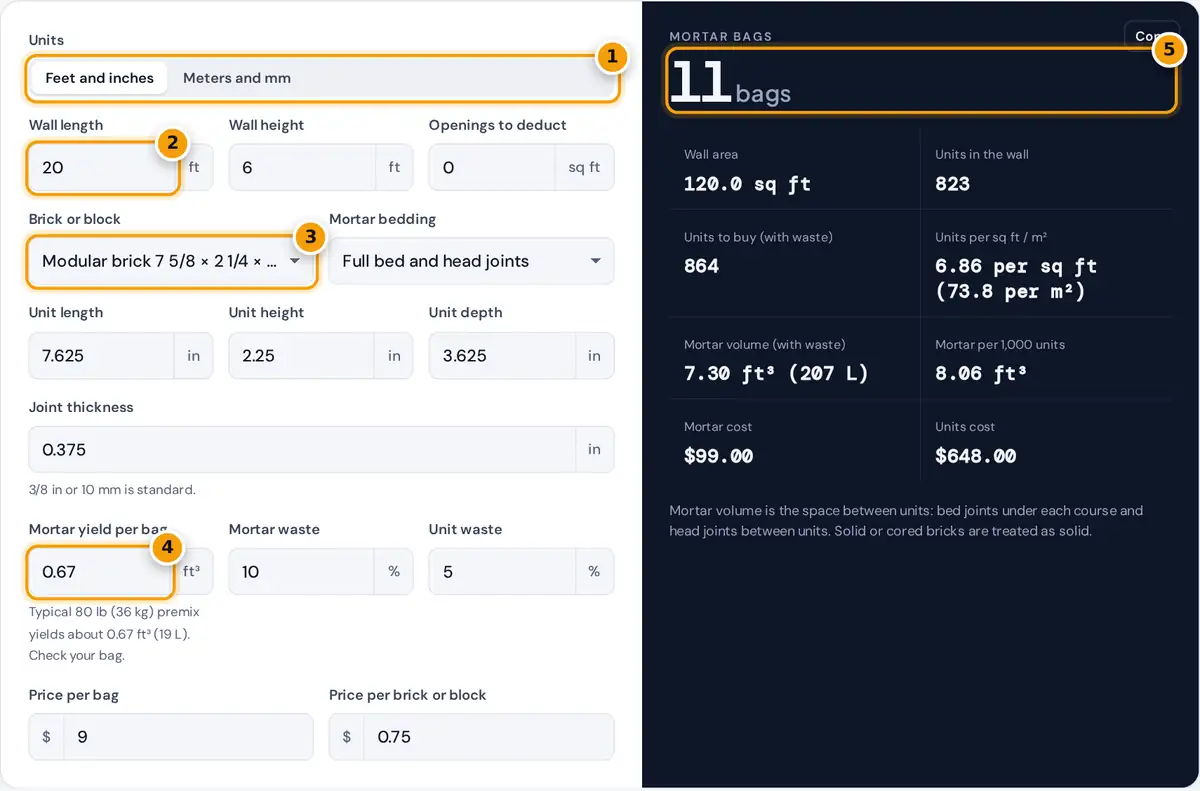
- Choose imperial or metric units.
- Enter the wall length and height, and any openings to deduct.
- Pick a brick or block size, or enter custom dimensions.
- Enter the mortar yield per bag from your bag label.
- Read the bags of mortar, units to buy and costs.
Choose imperial or metric units and enter the wall length and height. If the wall has windows or doors, enter their combined area so it is deducted. Then pick the brick or block. The unit length, height and depth fill in automatically for common sizes, and you can type your own dimensions for any other product, which switches the selection to a custom size.
Set the joint thickness, usually 3/8 in for North American masonry or 10 mm for metric work. Bricks are laid on a full bed of mortar, while hollow concrete blocks are usually laid with face-shell bedding, where mortar goes only on the front and back shells. Finally, enter the mortar yield per bag from your bag label, waste allowances and prices.
Mortar Volume Formula
full bed: mortar per unit = (L + j)(H + j) × depth − L × H × depth
face shell: mortar per unit = j × 2 × shell × (L + j + H)
bags = round up (units × mortar per unit × (1 + waste %) ÷ bag yield)
Each unit occupies its own size plus one joint in each direction. For solid bedding, the mortar is the difference between that larger block of space and the unit itself, which counts one bed joint and one head joint per unit. For face-shell bedding only the two shells carry mortar, so the volume depends on the joint thickness and the shell thickness.
Worked Example: A Modular Brick Wall
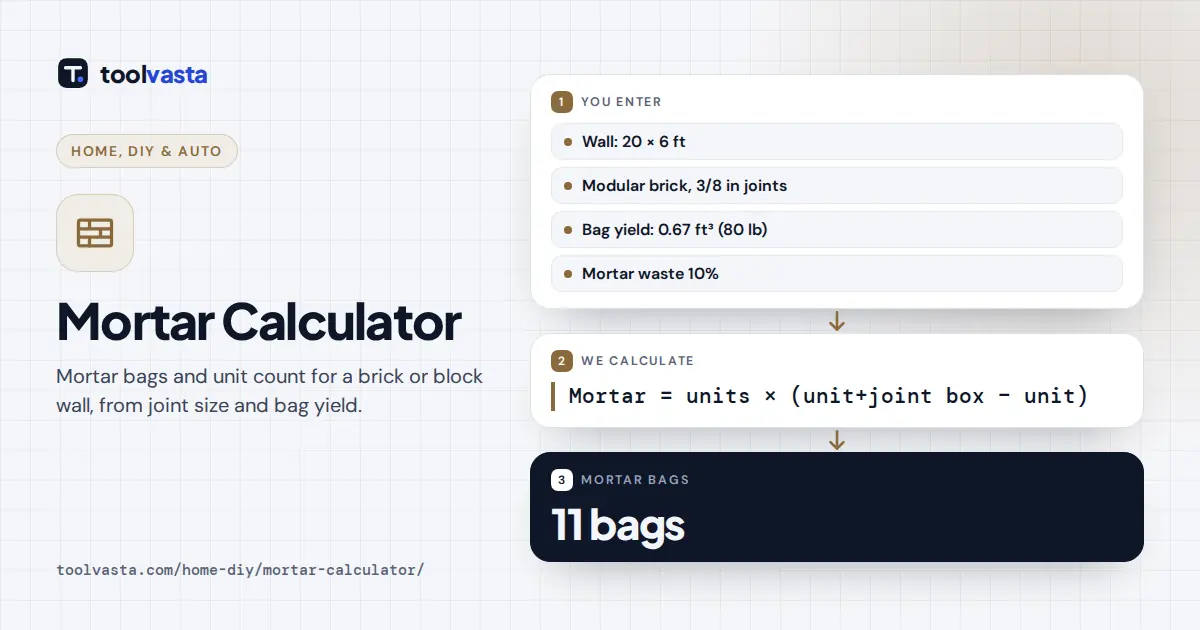
A wall is 20 ft long and 6 ft high, or 120 sq ft, built with modular bricks (7 5/8 × 2 1/4 × 3 5/8 in) and 3/8 in joints. Each brick takes up 8 × 2 5/8 = 21 sq in of wall face, so the wall holds 120 × 144 ÷ 21 = 822.9 bricks, or 864 with 5% waste.
The mortar per brick is 8 × 2.625 × 3.625 − 7.625 × 2.25 × 3.625 = 13.93 cu in. For 822.9 bricks that is 11,465 cu in, or 6.64 cu ft. Adding 10% waste gives 7.30 cu ft, and at 0.67 cu ft per 80 lb bag the wall needs 7.30 ÷ 0.67 = 10.9, so buy 11 bags. That works out to about 8.06 cu ft of mortar per 1,000 modular bricks before waste.
Units and Mortar per Wall Area
| Unit | Joint | Units per sq ft | Units per m² | Mortar per 1,000 units |
|---|---|---|---|---|
| Modular brick | 3/8 in | 6.86 | 73.8 | 8.06 ft³ |
| Metric brick 215 × 65 mm | 10 mm | 5.51 | 59.3 | 297 L |
| 8 in CMU, face shells | 3/8 in | 1.125 | 12.1 | 12.8 ft³ |
These figures come from the same geometry the calculator uses, before waste. Real consumption is often higher because mortar is dropped, scraped off and left in the board at the end of the day, which is why waste allowances of 10 to 25% are common for masonry.
Tips for Mixing and Ordering
- Use the yield printed on your bag. Premixed mortar, masonry cement and site-mixed sand and cement all yield different volumes.
- Type S mortar is often used for below-grade and structural work, and Type N for general above-grade walls. Follow your plans or local code.
- Mix only what you can use before it starts to stiffen, typically within a couple of hours.
- Grouted block cores and bond beams need grout, which is a separate calculation from mortar.
Assumptions and Limits
The calculator treats cored bricks as solid and ignores mortar that squeezes into cores, frogs and collar joints, so it can slightly understate real use. It does not include grout, wall ties or reinforcement. Unit counts assume running bond without cut-outs beyond the openings you deduct. Use the results as a planning estimate and confirm quantities with your mason or supplier.
Frequently asked questions
How many bags of mortar do I need for 1,000 bricks?
Modular bricks with 3/8 inch joints use about 8 cu ft of mortar per 1,000 bricks before waste. With 10% waste and bags that yield 0.67 cu ft, that is about 14 bags of 80 lb premix.
How many bricks are in a square foot of wall?
A modular brick with a 3/8 inch joint covers 8 by 2 5/8 inches, so a square foot of wall holds about 6.86 bricks. A metric brick with 10 mm joints gives about 59 bricks per square meter.
How much mortar does a concrete block need?
An 8 inch block laid with face-shell bedding and 3/8 inch joints takes about 22 cubic inches of mortar, or roughly 12.8 cu ft per 1,000 blocks before waste. Full bedding uses more.
What is face-shell bedding?
Face-shell bedding places mortar only on the front and back shells of a hollow block, not on the cross webs. It is the usual method for hollow concrete block walls unless the plans call for full bedding.
How much mortar does an 80 lb bag make?
A typical 80 lb bag of premixed mortar yields about 0.67 cubic feet, roughly 19 liters, of mixed mortar. The exact yield depends on the product and water added, so check the bag label.
Why add waste to a mortar estimate?
Mortar is lost when it drops from the trowel, is struck off joints and stiffens before use. Allowing 10 to 25% extra is common, depending on experience, weather and how carefully the work is done.