How to Use the Sourdough Hydration Calculator
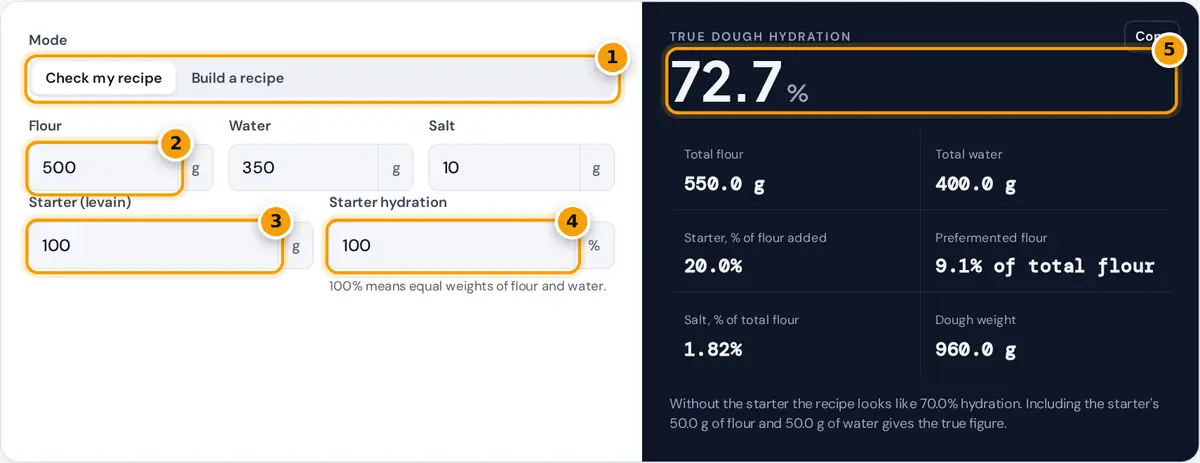
- Choose to check a recipe or build one.
- Enter the flour, water and salt you add.
- Enter the starter weight.
- Enter the starter hydration.
- Read the true hydration and baker's percentages.
Choose a mode. To check a recipe, enter the flour, water and salt you add to the dough, the weight of starter (levain) and the starter's own hydration. A 100% starter is fed with equal weights of flour and water; a stiff starter at 50% has half as much water as flour. The calculator splits the starter into flour and water and gives the true hydration of the whole dough.
To build a recipe, enter the dough weight you want, the target hydration, the starter as a percentage of the total flour, the starter's hydration and the salt percentage. The result tells you how much flour, water, starter and salt to mix. Both modes base every percentage on the total flour, including the flour inside the starter.
Sourdough Hydration Formula
starter water = starter − starter flour
total flour = flour added + starter flour total water = water added + starter water
hydration = total water ÷ total flour × 100
build: total flour = dough weight ÷ (1 + hydration + salt %)
Leaving the starter out of the calculation understates hydration when the starter is wetter than the dough, which is common with a 100% starter. Prefermented flour is the share of total flour that comes from the starter; it is a useful way to compare how much fermented flour different recipes carry.
If you hold back some water and add it later during mixing, a step often called bassinage, include it in the water figure so the result describes the finished dough rather than the first mix. The same applies to water used to dissolve the salt.
Worked Example: A Country Loaf
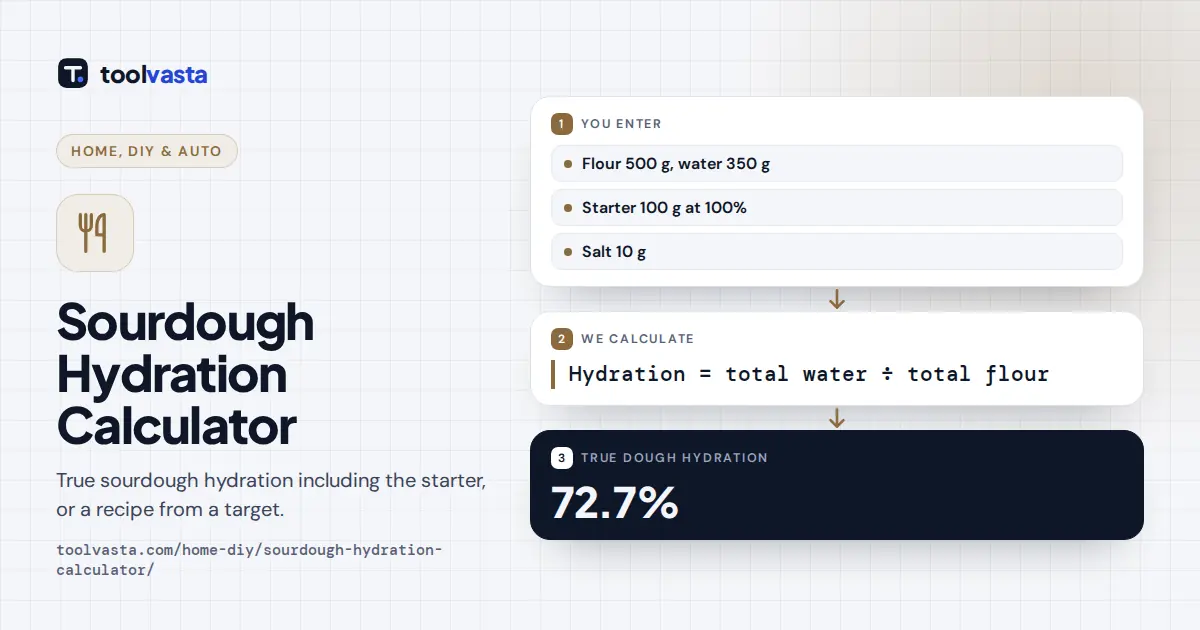
A recipe uses 500 g flour, 350 g water, 10 g salt and 100 g of starter at 100% hydration. The starter holds 50 g flour and 50 g water. The total flour is 550 g and the total water 400 g, so the true hydration is 400 ÷ 550 = 72.7%, not the 70% the added water alone suggests.
The starter is 20% of the flour added and 9.1% of the total flour is prefermented. The salt is 1.82% of total flour and the dough weighs 960 g. In build mode, a 1,000 g dough at 75% hydration with 20% starter and 2% salt needs 508.5 g flour, 367.2 g water, 113.0 g starter and 11.3 g salt.
Hydration and Dough Feel
| Hydration | Dough feel | Typical bakes |
|---|---|---|
| 60 to 65% | Firm, easy to shape | Sandwich loaves, bagels at the low end |
| 66 to 72% | Soft and supple | Everyday country loaves |
| 73 to 80% | Slack, needs folds | Open crumb loaves, some whole grain |
| 80% and above | Very wet, hard to shape | Ciabatta-style bread, high whole grain |
Whole grain flours absorb more water than white flour, so a whole wheat dough at 80% can feel like a white dough at 70%. Treat these ranges as a guide and adjust to your flour.
Tips for Sourdough Baking
- Hold back a little water at first and add it during mixing if the dough can take it.
- Keep your starter at a consistent hydration so recipes behave the same from bake to bake.
- A larger starter percentage speeds fermentation; reduce it in warm kitchens to avoid overproofing.
- Salt at about 2% of total flour is a common starting point for flavor and dough strength.
Assumptions and Limits
The calculator counts only the flour and water in the starter and dough. Milk, eggs, honey, oil, soakers and add-ins also contribute water or absorb it, and are not included. Flour absorption varies by brand and type, so treat the numbers as a precise starting point and adjust by the feel of the dough.
Frequently asked questions
How do I calculate sourdough hydration?
Add the water in the starter to the water in the dough, and the flour in the starter to the flour in the dough. Divide total water by total flour. A 100% starter is half flour and half water.
Does starter count toward hydration?
Yes. The starter contains flour and water that end up in the dough, so the true hydration includes them. With a 100% starter, ignoring it makes a 72.7% dough look like 70%.
What does 100% starter hydration mean?
It means the starter is fed with equal weights of flour and water, for example 50 g flour and 50 g water. A 50% starter has half as much water as flour and is much stiffer.
What is a good hydration for sourdough?
Many sourdough loaves fall between about 68 and 78% hydration. Lower hydration is easier to shape, while higher hydration can give a more open crumb but needs more skill to handle.
How much starter should I use in sourdough?
Many recipes use starter equal to 10 to 25% of the flour. More starter ferments faster, which suits cool kitchens, while less starter slows fermentation for warm kitchens or long proofs.
How do I adjust a recipe to a different hydration?
Keep the total flour the same and change the water. To raise a 550 g total flour dough from 72.7% to 75%, add 12.5 g more water, since 75% of 550 g is 412.5 g.