How to Use the Water Heater Size Calculator
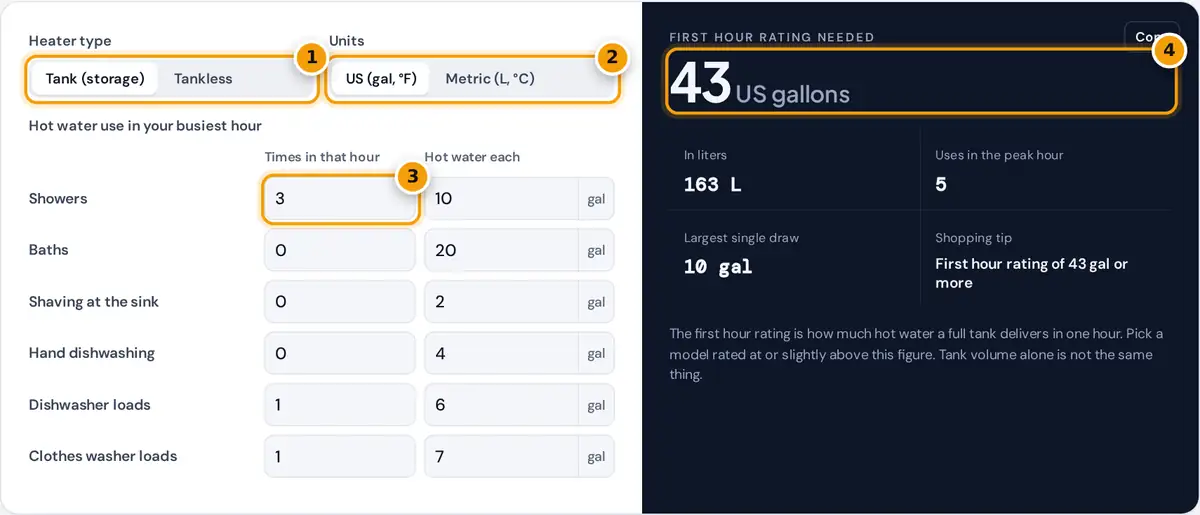
- Choose a tank (storage) heater or a tankless heater.
- Pick US units (gallons, °F) or metric (litres, °C).
- Enter how many showers, baths and other uses happen in your busiest hour.
- Read the first hour rating to look for, or the tankless flow and power.
Choose the type of heater you are sizing and your units. For a tank (storage) heater, think about the busiest hour of a normal day, often the morning rush, and enter how many showers, baths, dishwasher loads and other hot water uses happen in that hour. Each row has a typical amount of hot water per use, which you can change to match low-flow fixtures or long showers.
For a tankless heater, enter the fixtures that may run at the same time and their flow rates, the temperature of the water coming into the house and the hot water temperature you want. The calculator returns the flow the heater must handle, the temperature rise, and the heating power in BTU per hour, kilowatts and amps.
Sizing Formulas
temperature rise = hot water temperature − incoming temperature
power (W) = flow (L/s) × 4,186 J/kg·K × rise (K)
BTU/h ≈ 500 × gpm × rise (°F) gas input = output ÷ efficiency
amps = watts ÷ 240 V
Storage tanks are rated by their First Hour Rating (FHR), the hot water a full tank can deliver in one hour starting hot. It appears on EnergyGuide labels in the US and is published for models sold in Canada. A tankless heater has no stored supply, so it must heat the full flow instantly; its size depends on flow and temperature rise, which is pure physics: water's specific heat is about 4,186 joules per kilogram per degree Celsius.
Worked Examples
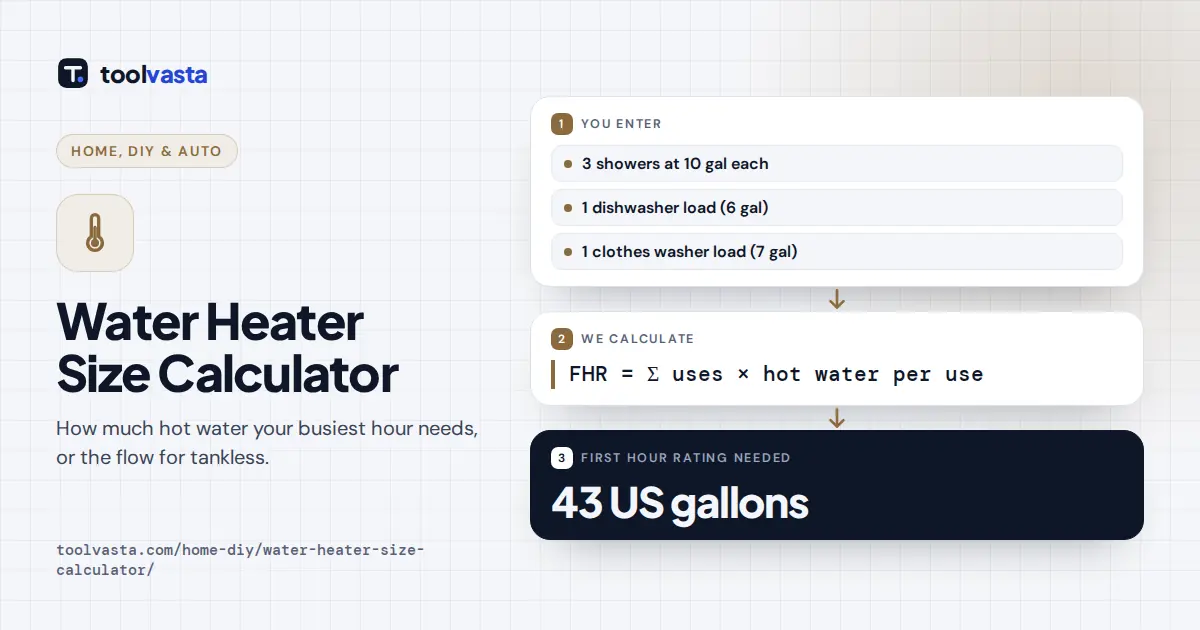
Tank: in the busiest hour a household runs three showers at 10 gallons each, one dishwasher load at 6 gallons and one clothes washer load at 7 gallons. The peak demand is 30 + 6 + 7 = 43 gallons, about 163 liters, so look for a tank with a First Hour Rating of at least 43 gallons.
Tankless: two showers at 2.0 gpm and a kitchen faucet at 1.5 gpm run together, for 5.5 gpm (20.8 L/min). Raising 50°F water to 120°F is a 70°F rise. The heat output needed is about 192,700 BTU/h, or 56.5 kW. A gas unit at 95% efficiency needs about 202,900 BTU/h of input, while an electric unit would draw about 235 A at 240 V, more than many homes can supply.
Typical Flow Rates and Hot Water Use
| Fixture | Flow while running | Hot water per use (planning) |
|---|---|---|
| Shower | 1.5 to 2.5 gpm (5.7 to 9.5 L/min) | 10 gal (38 L) |
| Bath | 4 to 6 gpm while filling | 20 gal (76 L) |
| Kitchen faucet | 1.5 to 2.2 gpm | 4 gal for hand dishwashing |
| Bathroom faucet | 0.5 to 1.5 gpm | 2 gal for shaving |
| Dishwasher | 1 to 2 gpm while filling | 6 gal per load |
| Clothes washer | 1.5 to 3 gpm while filling | 7 gal per load |
These are planning figures that vary with fixture age and habits. Check the flow rating stamped on newer showerheads and faucets. Energy efficiency guidance from the U.S. Department of Energy explains how storage and tankless heaters compare.
Tips for Choosing a Heater
- Use your coldest incoming water temperature for tankless sizing. In much of Canada, winter ground water can be much colder than in summer, which raises the temperature rise and lowers the flow a unit can deliver.
- Low-flow showerheads reduce both peak-hour demand and tankless flow, often allowing a smaller heater.
- Spread laundry and dishwasher runs away from the morning shower rush to cut the peak.
- Gas tankless units need correct venting and often a larger gas line; electric units may need a panel upgrade.
Assumptions and Limits
The tank method counts uses in one hour and does not model recovery after the first hour. The tankless method assumes the listed fixtures run at full flow at the same moment. Heat losses in pipes, mixing at the tap and very hard water are not included. Use these figures to shortlist models, then check the manufacturer's sizing charts and local code with a licensed installer.
Frequently asked questions
What size water heater do I need for a family of four?
It depends on the busiest hour, not only household size. Three showers plus a dishwasher and washer load need about 43 gallons, so look for a first hour rating near 45 gallons.
What is a first hour rating?
The first hour rating is the amount of hot water a full storage tank can deliver in one hour. It combines tank size and recovery speed, so compare it with your peak-hour demand.
How do I size a tankless water heater?
Add the flow rates of fixtures that run at the same time, then find the temperature rise from your incoming water to your hot water setting. Choose a unit that delivers that flow at that rise.
How many BTU do I need for a tankless water heater?
Multiply about 500 by the flow in gpm and the temperature rise in degrees Fahrenheit, then divide by efficiency. For 5.5 gpm and a 70°F rise, that is about 203,000 BTU/h input.
Is an electric tankless water heater enough for a whole house?
Often not in cold climates. Two showers at once with a large temperature rise can need over 50 kW and more than 200 amps, which exceeds many home electrical services.
What temperature should a water heater be set to?
Many guides suggest about 120°F (49°C) at the tap to limit scalding. Some codes and health guidance call for higher tank temperatures with mixing valves to control bacteria, so check local rules.