How to Use the Resin Calculator
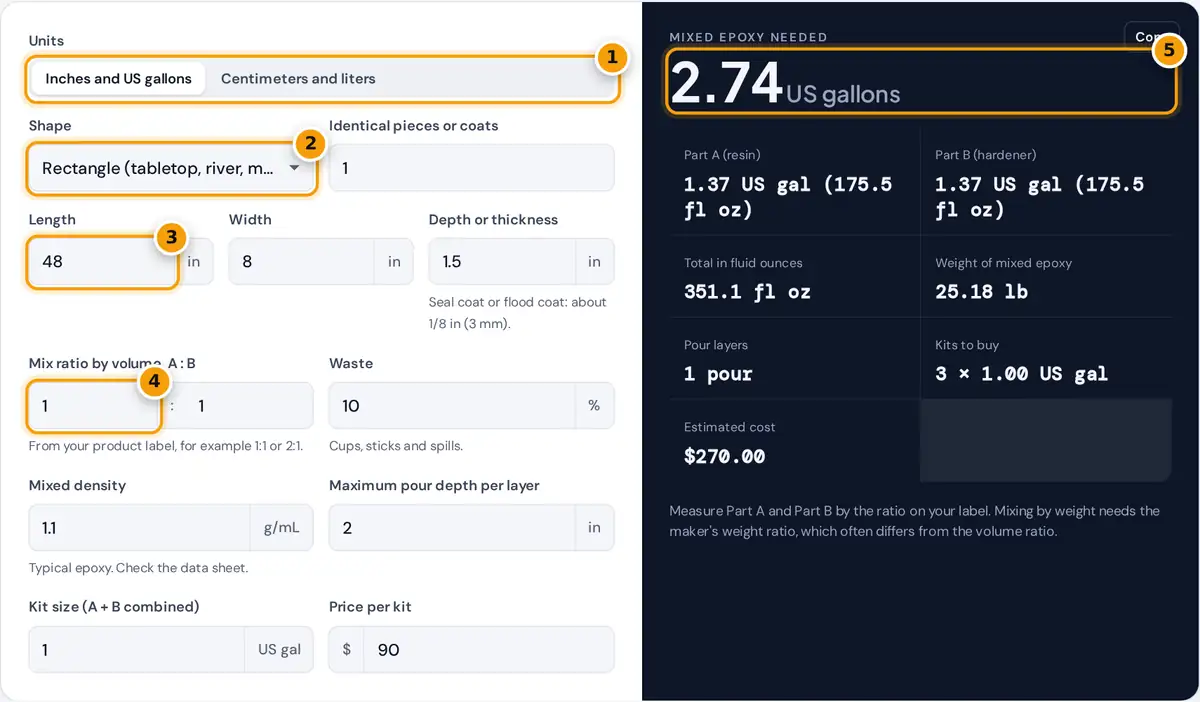
- Choose inches and US gallons or centimeters and liters.
- Pick a rectangle or a circle.
- Enter the size and depth of the pour.
- Enter the A to B mix ratio from your label.
- Read the total epoxy, Part A and B, layers and kits.
Choose inches and US gallons or centimeters and liters, then pick a rectangle or a circle. For a river table, enter the length of the river and its average width. For a flood coat on a tabletop, enter the table length and width and a depth of about 1/8 in (3 mm). For a round table or coaster mold, enter the diameter. If you are pouring several identical pieces or several coats, set the count.
Enter the mix ratio by volume from your product label, for example 1:1 or 2:1, and a waste allowance for epoxy left in cups and on stir sticks. The mixed density turns volume into weight. Set the maximum depth your product allows in one pour, then the kit size and price. The result shows the total, the Part A and Part B amounts, the layers and the kits to buy.
Epoxy Volume Formula
total = volume × pieces × (1 + waste %)
Part A = total × A ÷ (A + B) Part B = total × B ÷ (A + B)
1 US gal = 231 in³ = 128 fl oz = 3.785 L
One cubic inch is 16.387 mL, and one US fluid ounce is 29.574 mL. Weight is the mixed volume times the density; many epoxies are close to 1.1 g/mL, so a liter weighs about 1.1 kg. Pour layers are the depth divided by the maximum layer thickness for your product, rounded up.
Worked Example: A River Table
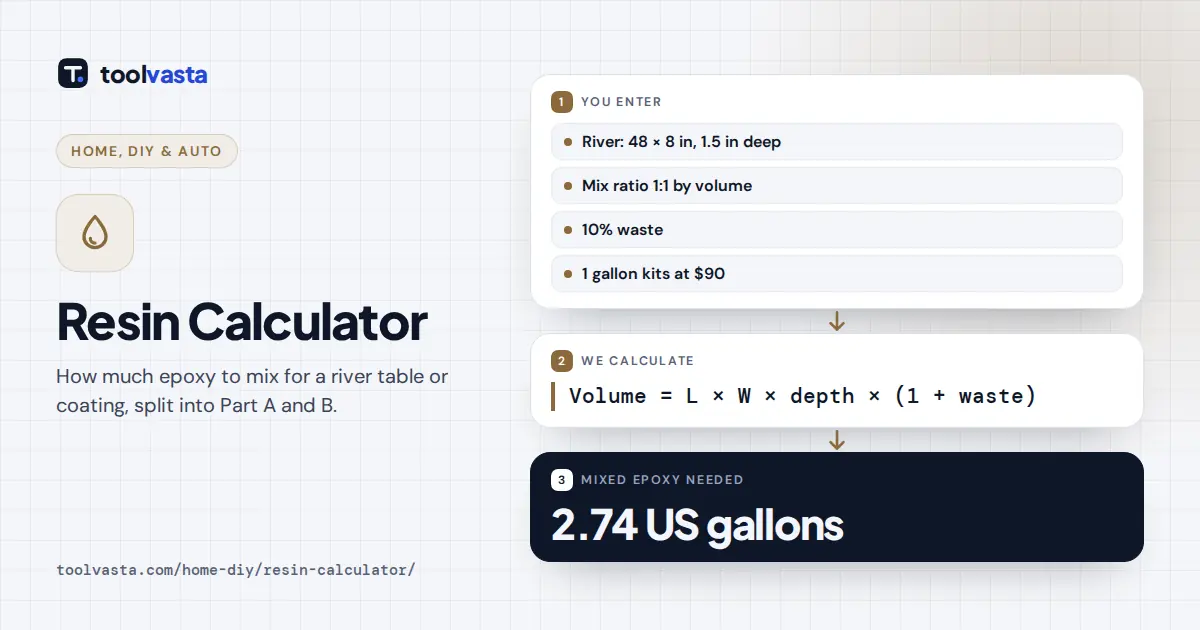
A river runs 48 in long with an average width of 8 in, and the slab is 1.5 in thick. The void is 48 × 8 × 1.5 = 576 cu in. With 10% waste the pour needs 633.6 cu in, which is 633.6 ÷ 231 = 2.74 US gallons, 351.1 fl oz or 10.38 L.
At a 1:1 ratio, measure 1.37 gallons (175.5 fl oz) each of Part A and Part B. At 1.1 g/mL the mixed epoxy weighs 11.42 kg, about 25.18 lb. A deep pour product rated for 2 in layers can fill the 1.5 in void in one pour, and with 1 gallon kits you need three kits, $270 at $90 each.
Epoxy Needed for Common Projects
| Project | Size | Mixed epoxy |
|---|---|---|
| Flood coat, coffee table | 48 × 24 in at 1/8 in | 144 cu in, 0.62 gal, 79.8 fl oz |
| Round table coat | 24 in diameter at 1/8 in | 56.5 cu in, 31.3 fl oz |
| Coaster mold | 4 in diameter, 0.25 in deep | 3.14 cu in, 1.74 fl oz each |
| Small river | 36 × 4 × 1 in | 144 cu in, 0.62 gal, 2.36 L |
Figures are before waste. Edges that drip over a tabletop, porous wood that soaks up resin and gaps under a mold can all add to the real amount, so many makers mix a seal coat first and keep extra kits on hand.
Tips for Epoxy Pours
- Seal porous wood with a thin coat first so bubbles do not rise into the main pour.
- Never pour deeper than the product allows in one layer. Thick pours of a coating epoxy can overheat, crack or yellow.
- Measure by volume with marked cups unless the maker gives a weight ratio, and mix for the full time on the label.
- Work in a warm, ventilated room and wear gloves and eye protection. Follow the safety data sheet.
Assumptions and Limits
The calculator assumes a flat, even depth over the whole shape. Live-edge rivers vary in width and depth, so measure several points and use an average, or split the river into sections. Densities and maximum pour depths vary between products, so check the technical data sheet. The kit count assumes each kit size is the combined volume of Part A and Part B.
Frequently asked questions
How much epoxy do I need for a river table?
Multiply the river length by its average width and depth to get cubic inches, add about 10% for waste, then divide by 231 for US gallons. A 48 by 8 by 1.5 inch river needs about 2.74 gallons.
How do I convert cubic inches to gallons of epoxy?
Divide cubic inches by 231 to get US gallons, or by 1.805 to get US fluid ounces. In metric terms, one cubic centimeter is one milliliter, so 1,000 cubic centimeters equals one liter.
How much epoxy for a table top coating?
A flood coat is usually about 1/8 inch thick. A 48 by 24 inch tabletop needs 144 cubic inches, about 80 fl oz, plus extra for drips over the edges and the seal coat.
What does a 2:1 epoxy ratio mean?
A 2:1 ratio by volume means two parts resin (Part A) to one part hardener (Part B). For 3 liters of mixed epoxy you measure 2 liters of Part A and 1 liter of Part B.
How much does epoxy weigh per gallon?
Many epoxies have a mixed density of about 1.1 g/mL, so one US gallon weighs about 4.16 kg, or roughly 9.2 lb. Check the technical data sheet for your product's exact density.
How deep can I pour epoxy in one layer?
It depends on the product. Coating epoxies are often limited to about 1/8 to 1/4 inch per layer, while deep pour casting resins may allow 1 to 2 inches or more. Always follow the label.