How to Use the Board Foot Calculator
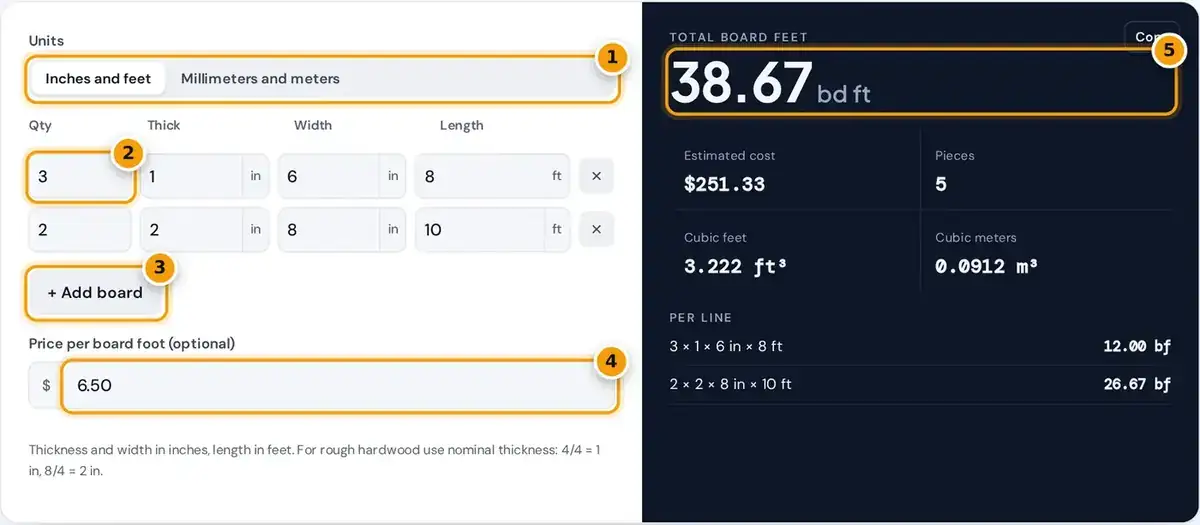
- Choose inches and feet or millimeters and meters.
- Enter the quantity, then thickness, width and length for each board.
- Add another board line for each lumber size in your cut list.
- Optional: enter a price per board foot to estimate the cost.
- Read total board feet, estimated cost, cubic feet and cubic meters.
Enter one line per board size: the quantity, the thickness, the width and the length. In imperial mode thickness and width are in inches and length is in feet, matching how lumber is usually sold.
Use Add board for every size in your cut list, and the remove button to drop a line. Enter the price per board foot from your supplier, and the estimated cost updates as you type.
The result shows total board feet, the number of pieces, cubic feet, cubic meters and a per line breakdown. The Copy button copies the total and cost, ready to paste into a quote or order.
What a Board Foot Is
A board foot is a lumber volume unit equal to 144 cubic inches. Picture a piece 1 in thick, 12 in wide and 12 in long, or one square foot of board one inch thick.
Because it measures volume, the shape does not matter. A 1x12 and a 2x6 of the same length contain the same number of board feet, even though they look very different on the lumber rack.
Twelve board feet make one cubic foot, which is 1,728 cubic inches. The unit is defined in the unit tables of NIST Handbook 44, Appendix C, the official United States reference for weights and measures.
Board Foot Formula
board feet = thickness (in) × width (in) × length (ft) ÷ 12
1 board foot = 0.002359737 m³ 12 board feet = 1 ft³
With every measurement in inches, multiply thickness by width by length and divide by 144. With length in feet, as lumber yards quote it, you divide by 12 instead, because one foot holds 12 inches.
Multiply the result by the quantity to get the total for that line, then add all lines together. Forgetting to divide by 12 is the most common mistake, and it inflates the answer twelve times.
For metric sizes, multiply thickness and width in meters by length in meters to get cubic meters, then divide by 0.002359737, the number of cubic meters in one board foot, rounded to seven significant figures.
Worked Example
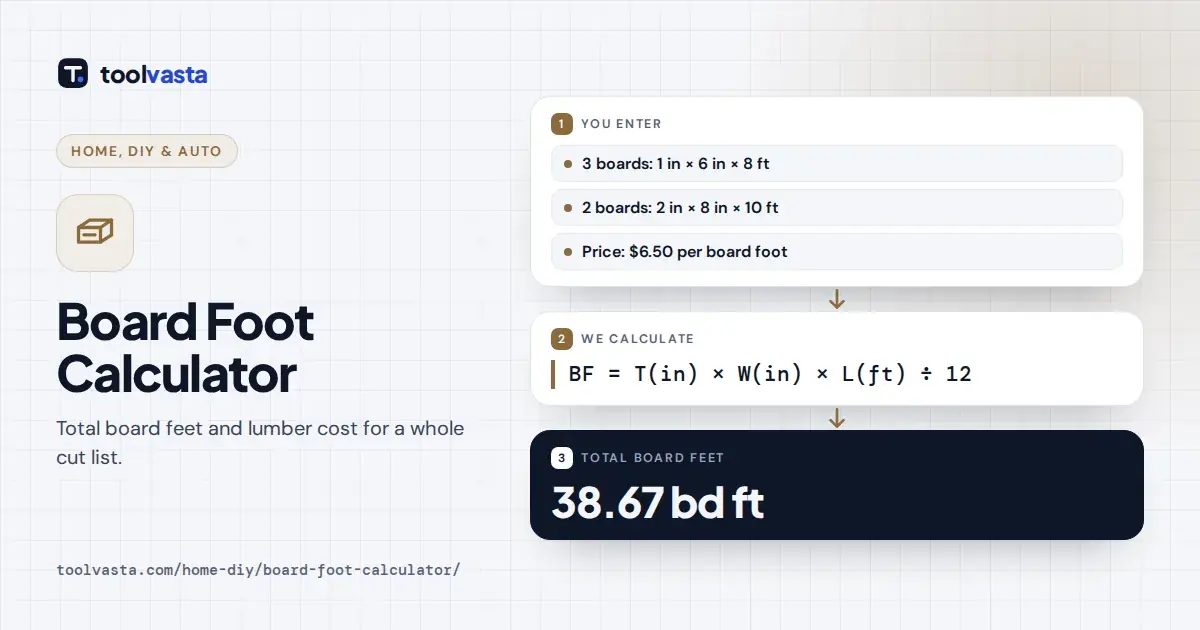
The defaults include three boards of 1 in by 6 in by 8 ft. Each is 1 times 6 times 8 divided by 12, or 4 board feet, so all three total 12 board feet.
It also has two boards of 2 in by 8 in by 10 ft. Each is 2 times 8 times 10 divided by 12, or 13.33 board feet, or 26.67 board feet for the pair.
The order totals 38.67 board feet, and at $6.50 per board foot the total cost is $251.33. That volume equals about 3.222 cubic feet or 0.0912 cubic meters of wood. Each line is listed separately.
Nominal vs Actual Size
| Board | Length | Board feet |
|---|---|---|
| 4/4 × 6 in | 8 ft | 4.00 |
| 4/4 × 8 in | 10 ft | 6.67 |
| 8/4 × 6 in | 8 ft | 8.00 |
| 2 × 4 (nominal) | 8 ft | 5.33 |
| 2 × 10 (nominal) | 12 ft | 20.00 |
Hardwood is usually sold rough and measured in the quarter system, so 4/4 is 1 in thick and 8/4 is 2 in thick. Board feet use that rough thickness, even after it is surfaced thinner.
Softwood dimensional lumber such as a 2x4 is named by its nominal size, while the actual size is about 1.5 in by 3.5 in. An 8 ft 2x4 is 5.33 board feet nominal, 3.5 actual.
Suppliers normally price on the nominal size, so enter nominal figures unless your local yard says otherwise. For species data, shrinkage and moisture effects, the USDA Forest Service Wood Handbook is the standard technical reference.
Board Feet, Linear Feet and Square Feet
A board foot measures volume, a linear foot measures length only and square feet measure face area. You cannot convert square feet to board feet without also knowing the exact thickness of the material involved.
Trim, moldings and many softwood boards are sold by the linear foot or by the piece, while hardwood is sold by volume. Knowing which unit a supplier quotes avoids unpleasant surprises when you compare prices.
Sawmills, wholesalers and large dealers often quote prices per MBF, meaning one thousand board feet. Divide a price per MBF by 1,000 to get the price per board foot you can enter in the calculator.
PMP and Metric Measurements
In Quebec, lumber is often priced in PMP, short for pied mesure de planche. One PMP is exactly one board foot, so this tool works as a PMP calculator without any conversion needed at all.
Switch to metric mode to enter thickness and width in millimeters and length in meters. The result always stays in board feet, because Canadian and US lumber yards still price most hardwood using board footage.
A metric board of 25 mm by 150 mm by 2.4 m has a volume of 0.009 cubic meters, which is about 3.81 board feet. Values convert automatically when you switch between the two systems.
Plan for Waste
Rough lumber often has defects, end checks and random widths. Woodworkers commonly buy 15 to 30 percent more than the finished cut list, depending on species, grade and how much figure matching the project needs.
This calculator shows the exact volume you enter, with no waste allowance built in. Add your own by increasing quantities or adding an extra line, so the cost estimate reflects what you will actually buy.
Dealers may also round a hardwood tally, for example under NHLA rules, rounding thickness up to the next quarter inch. Measure a few boards at pickup and compare them with your invoice before you leave.
Frequently asked questions
How do you calculate a board foot?
Multiply thickness in inches by width in inches by length in feet, then divide by 12. A board 1 in thick, 6 in wide and 8 ft long is 4 board feet.
How many board feet are in a 2x4x8?
Using the nominal size, 2 times 4 times 8 divided by 12 gives 5.33 board feet. Using the actual size of 1.5 by 3.5 inches, the same stud holds only 3.5 board feet.
How many board feet are in a cubic foot?
Twelve. A cubic foot is 1,728 cubic inches and a board foot is 144 cubic inches, so dividing one by the other gives exactly 12 board feet per cubic foot.
What is 4/4 lumber?
Four quarter lumber is rough sawn to 1 in thick. 5/4 is 1.25 in, 6/4 is 1.5 in and 8/4 is 2 in. Board feet are calculated on these nominal rough thicknesses, not the planed size.
What is a PMP?
PMP, or pied mesure de planche, is the French Canadian name for a board foot. The two units are identical, so any board foot result on this page is also a PMP result.
Is a board foot the same as a linear foot?
No. A linear foot measures length only, while a board foot measures volume. A 1 in by 12 in board that is 1 ft long is both one linear foot and one board foot.