How to Use the EV Charging Cost Calculator
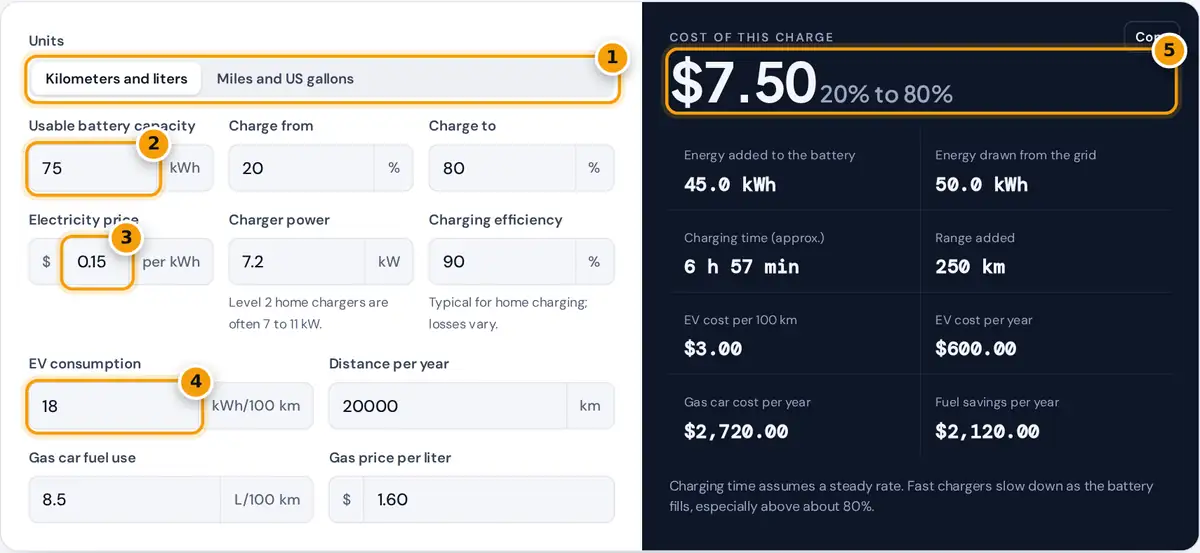
- Choose kilometers and liters or miles and US gallons.
- Enter the battery size and the charge levels.
- Enter your electricity price, charger power and efficiency.
- Enter consumption, yearly distance and the gas car to compare.
- Read the cost per charge, time and yearly savings.
Choose kilometers and liters or miles and US gallons. Enter the usable battery capacity of your car in kWh, then the charge level you start from and the level you charge to. Many drivers charge daily between about 20% and 80%. Enter your electricity price per kWh from your bill, including delivery charges if you want the full cost, and the power of your charger.
Charging efficiency covers the energy lost in the charger, cables and battery, so more energy leaves the wall than reaches the battery. For yearly figures, enter your car's consumption, your yearly distance, and the fuel use and gas price of the car you are comparing with. The result shows the cost per charge, the time, the cost per 100 km or 100 miles, and the yearly savings.
EV Charging Cost Formula
energy from grid = energy added ÷ charging efficiency
cost = energy from grid × price per kWh
time = energy from grid ÷ charger power
cost per 100 km = kWh/100 km ÷ efficiency × price
Consumption figures on the dashboard usually measure energy taken from the battery, which is why the calculator divides by the charging efficiency to get the energy you pay for. For the gas car comparison, metric fuel use is in liters per 100 km and US fuel economy in miles per US gallon; the calculator converts between them when you switch units.
Worked Example: Charging at Home
A car has a 75 kWh usable battery and charges from 20% to 80%. That adds 75 × 0.60 = 45 kWh to the battery. At 90% efficiency the charger draws 45 ÷ 0.9 = 50 kWh from the grid, which costs $7.50 at $0.15 per kWh and takes about 6 h 57 min on a 7.2 kW charger.
At 18 kWh per 100 km, the charge adds about 250 km of range. Each 100 km costs 18 ÷ 0.9 × 0.15 = $3.00, so 20,000 km a year costs about $600. A gas car using 8.5 L/100 km at $1.60 per liter would spend $2,720 on fuel, so the EV saves about $2,120 a year on energy.
Charging Time by Charger Power
| Charger | Typical power | Time to draw 50 kWh |
|---|---|---|
| Level 1 (120 V outlet) | 1.4 kW | about 36 h |
| Level 2, 32 A at 240 V | 7.7 kW | about 6.5 h |
| Level 2, 48 A at 240 V | 11.5 kW | about 4.3 h |
| DC fast charger | 50 kW | about 1 h |
| DC fast charger | 150 kW | about 20 min if the car accepts it |
Power is volts times amps, so a 32 A circuit at 240 V delivers about 7.7 kW. The car's onboard charger can limit Level 2 speed, and fast charging slows as the battery fills, so treat these times as rough guides.
Tips to Lower Charging Costs
- Check whether your utility offers time-of-use or EV rates, and schedule charging overnight when prices are lower.
- Public fast chargers often cost several times more per kWh than home charging. Use them for trips rather than daily driving.
- Cold weather raises consumption, partly because the battery and cabin need heat. Preheat while plugged in.
- Keep tires at the recommended pressure. Rolling resistance has a noticeable effect on range.
Assumptions and Limits
The calculator uses one price per kWh and a constant charging efficiency. Real efficiency changes with charger power, temperature and battery state, and some public chargers bill by the minute or add session fees. Yearly savings cover energy only, not maintenance, insurance or purchase price. Use the result as an estimate.
Frequently asked questions
How much does it cost to charge an electric car?
Multiply the energy drawn from the grid by your price per kWh. Adding 45 kWh to the battery at 90% efficiency draws 50 kWh, which costs $7.50 at $0.15 per kWh.
How long does it take to charge an EV at home?
Divide the energy drawn from the grid by the charger power. Drawing 50 kWh on a 7.2 kW Level 2 charger takes about 7 hours, while a standard 1.4 kW outlet would take about 36 hours.
What is the cost per 100 km for an EV?
Divide consumption by charging efficiency and multiply by your electricity price. At 18 kWh per 100 km, 90% efficiency and $0.15 per kWh, it costs about $3.00 per 100 km.
Is it cheaper to charge an EV than buy gas?
At typical home electricity prices, yes. In the example, 20,000 km costs about $600 in electricity versus $2,720 in gasoline for a car using 8.5 L per 100 km at $1.60 per liter.
Why should I only charge to 80%?
Many manufacturers suggest charging to about 80% for daily use to reduce battery wear, and fast charging slows sharply above that level. Charge to 100% when you need the full range for a trip.
What is charging efficiency?
It is the share of energy from the wall that ends up stored in the battery. Some energy is lost as heat in the charger, cables and battery, often around 10% for home charging.