How to Use the Linear Feet Calculator
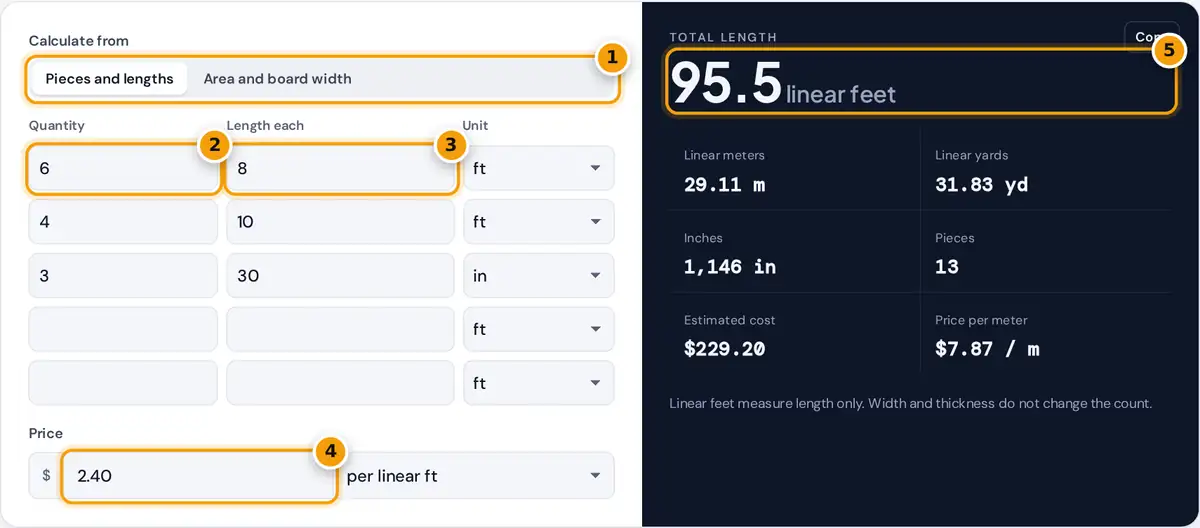
- Choose pieces and lengths, or area and board width.
- Enter the quantity for each group of pieces.
- Enter the length of each piece and pick its unit for that row.
- Enter a price per linear foot or per meter to see the cost.
- Read the total linear feet, then meters, yards, inches and cost.
Pick how you want to calculate. In Pieces and lengths mode, enter each group of pieces as a quantity and a length, and choose the unit for that row: feet, inches, meters, centimeters or millimeters. Rows can mix units, so 6 boards of 8 ft and 3 pieces of 30 in add up correctly. Leave unused rows empty.
In Area and board width mode, enter the area you want to cover, such as a wall, ceiling or deck, and the face width of the boards. The calculator converts the area into the length of boards needed and adds a waste allowance. Enter a price per linear foot or per meter in either mode to see the cost.
Linear Feet Formulas
1 in = 1/12 ft 1 m = 3.28084 ft 1 ft = 0.3048 m
linear feet from area = square feet × 12 ÷ board width (in) × (1 + waste %)
linear yards = linear feet ÷ 3
price per meter = price per foot ÷ 0.3048
A linear foot is simply one foot of length, whatever the width or thickness of the material. That is why trim, fencing, countertop edges and gutters are priced per linear foot, while lumber volume uses board feet and flooring uses square feet.
Mixing units is common on real jobs: trim measured in inches, fence panels in feet and imported materials in metric. Converting every row to feet before adding avoids the classic mistake of summing inches and feet as if they were the same unit.
Worked Examples
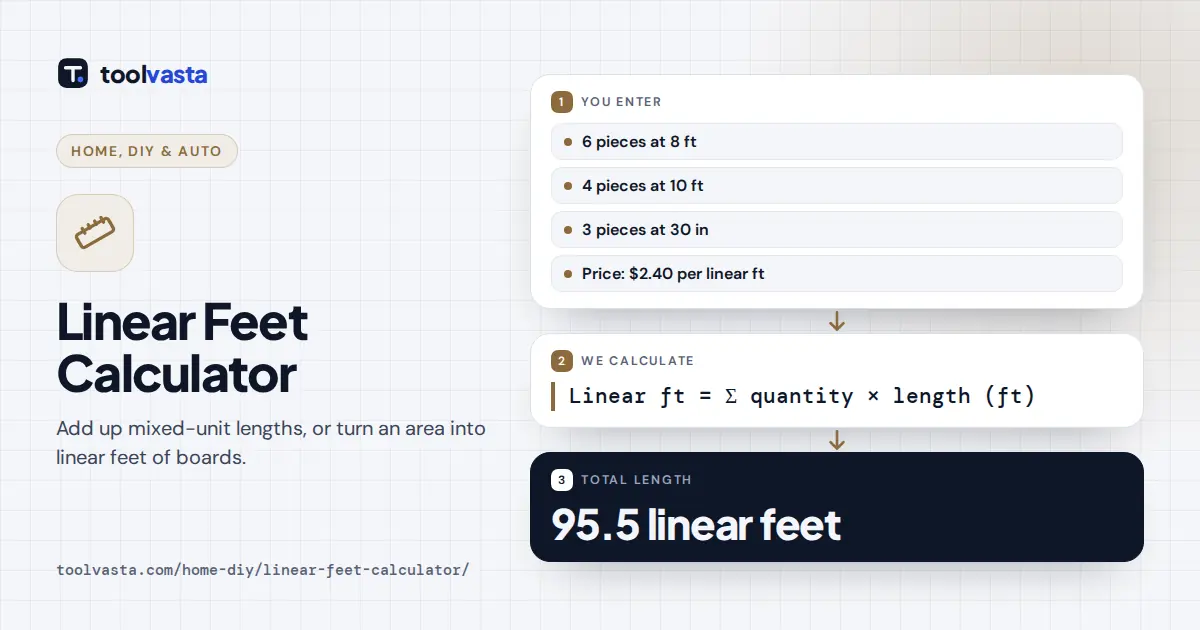
A trim job needs 6 pieces at 8 ft, 4 pieces at 10 ft and 3 pieces at 30 in. That is 48 + 40 + 7.5 = 95.5 linear ft, or 29.11 m, 31.83 yards and 1,146 in. At $2.40 per linear foot the material costs $229.20, which is $7.87 per meter.
A ceiling of 200 sq ft is covered with 1x6 tongue-and-groove boards that show 5.5 in of face. The boards needed are 200 × 12 ÷ 5.5 = 436.4 linear ft, and with 10% waste that rises to 480 linear ft, or 146.30 m. That is about sixty 8 ft boards.
Retailers often list the same molding per piece, per foot and per meter. Dividing the piece price by its length in feet gives the price per linear foot, which makes products of different lengths easy to compare.
Square Feet to Linear Feet by Board Width
| Face width | Linear ft per sq ft | For 100 sq ft | Typical board |
|---|---|---|---|
| 2.25 in (57 mm) | 5.33 | 533 | Strip hardwood flooring |
| 3.5 in (89 mm) | 3.43 | 343 | 1x4 paneling |
| 5.5 in (140 mm) | 2.18 | 218 | 1x6 or 5/4x6 deck board |
| 7.25 in (184 mm) | 1.66 | 166 | 1x8 siding |
| 9.25 in (235 mm) | 1.30 | 130 | 1x10 boards |
Values exclude waste. For deck boards, add the gap between boards to the face width before dividing, for example 5.5 in plus a 3/16 in gap.
Tips for Accurate Measurements
- Measure each wall or run separately and round up to the next full piece length you can buy.
- For baseboard, measure the room perimeter and subtract door openings. Add about 10% for miter cuts and short pieces.
- For fencing, measure the full line and subtract gates if they are bought as separate units.
- Use the actual face width of boards, not the nominal size. A nominal 1x6 is about 5.5 in wide.
- When prices are quoted per meter in a store and per foot online, compare using the price-per-meter line in the results.
Assumptions and Limits
The area method assumes boards are laid edge to edge across the whole surface with no gaps unless you add them to the width. It does not plan cut lengths, so leftovers from short runs may need more waste. Results are rounded for display and the cost uses your own price, so treat it as a planning estimate.
Frequently asked questions
How do I calculate linear feet?
Multiply the number of pieces by the length of each piece in feet, then add the groups together. Six 8 ft boards and four 10 ft boards make 88 linear feet.
How do I convert square feet to linear feet?
Multiply the square feet by 12 and divide by the board width in inches. For 200 sq ft of boards with a 5.5 in face, that is about 436 linear feet before waste.
Is a linear foot the same as a foot?
Yes. A linear foot is a straight-line measurement of 12 inches, used for materials sold by length such as trim, fencing, pipe and gutters, regardless of width.
How many meters is a linear foot?
One linear foot is exactly 0.3048 meters. To convert linear feet to meters multiply by 0.3048, and to convert meters to feet multiply by about 3.2808.
How do I calculate linear feet from inches?
Divide the total inches by 12 to get feet. For example, three pieces of 30 inches each total 90 inches, which equals exactly 7.5 linear feet.
What is the difference between linear feet and board feet?
Linear feet count length only. Board feet measure volume: one board foot is 12 by 12 by 1 inch, so a 2x6 has one board foot per linear foot.